Saturday, April 10, 2010

Rev. John Codman


Lizzie's father, Rev. Dr. John Codman (1782-1847)

1782 - Born, August 3rd.
1813 - Married to Mary Wheelwright, January 19th.
1826 - Daughter, Elizabeth Codman, born December 10th.
1847 - Died, December 23rd, Dorchester, Mass.

1800's - worked as a minister/preacher.

Monday, October 30th 1854 ~ Chamonix

Hotel de Londres ~ We were called at six and a half this morning and breakfasted at seven. After breakfast bid the girls good bye (I kissed Alice at parting) and started off for Sallenches. The idea was so ridiculous of our going in different directions that it put us into fine spirits. We left our trunks to the girls to take care of and at eight o’clock were comfortably seated in the coupé of the diligence and “en route.” This is the best seat. It is front, just under the driver and shut in with glass. It holds just three people and after the first two hours we had it all to ourselves. The early morning was misty so that we saw but little of the country. As we approached Sallenches the view became superb. The great chain of Mt. Blanc coming into sight, the sun gilding its summits and the mist rolling upward from the valley and creeping up the hill sides. At Sallenches, we obtained our second sight of Mt. Blanc (the first was from Geneva). We dined there and the dinner was miserable in the extreme, bad wine, bad meat, bad everything, cold room. It was market-day however and the costumes of the peasants in the great square were very pretty, standing before their booths, ornamented with ribands etc. We dined with a Polish Count and his sister, the widow of a Russian officer, and with them we took a carriage for Chamonix. They had been fellow travelers in the diligence from Geneva. By the way, on the road to Sallenches we met quantities of market people coming from and going to the fair with droves of cattle, shepherds carrying their little lambs and followed by the flock, droves of black pigs, carts of calves, in one a number of dead ones and one standing alive in their midst. The Polish Count was very deaf and did no talking but his sister did enough for both and in very glib French (which was her native tongue) and we had to keep our heads very clear to understand her rattle. She told us she had one son who was in the Russian army and to my question “how do you like the Russians and their rule” she answered with an expressive shrug “je suis Polonaise.” {I am Polish.} That told the whole story and seemed a history of a great nation’s wrongs. She seemed much interested in hearing about America and showed us by her questions that she had read much about us. The country between Sallenches and Chamonny is very beautiful. The road winds between the mountains, now ascending, now descending, passing through deep defiles, by rushing brooks and waterfalls and among snow capt hills. We had a drunken driver, who whirled us down the hills at a pace that threatened to shake the carriage to pieces; still we did not reach Chamonnix until eight o’clock. Our view as we drove through the vale of Chomonix by moonlight passes description. Mt. Blanc and his aiguilles on the one hand and lesser mountains on the other; in the half light they seemed supernaturally high and their glittering summits seemed as if cut out of solid silver. In many places they were so high that the moon rays did not reach us at all, but were arrested on the sides of the opposite mountains, daguerreotyping there the fantastic shapes of the great Alpine range. The road passes close to three arms of the great “mer de glace,” which descends from the summit of Mt. Blanc into the plain, wave upon wave of ice throwing back the moonlight. Just as the moon rose this evening the sun disappeared so that their rays were blended on the great white dome of Mt. Blanc, the moon rising over it, the sun’s last rays gulding it with rosy hues after they had for some time left us in the valley in the shades of night. Oh man, what are thy works compared with Natures wonders! We cannot help asking here “what is man that thou should’st be mindful of him! We took tea with our Polish friends and retired at midnight. We are the only people at the hotel which is about to be closed for the season.

Sunday, October 29th 1854 ~ Geneva


Caesar Malan

The day has been perfectly splendid. Lake Leman unruffled and clear as crystal, and in the distance the white chain of Mt. Blanc presided over by the monarch himself. A little before ten this morning Lizzie and myself sallied out on a voyage of discovery for the chapel of the celebrated Caesar Malin {actually spelled Malán}. He does not seem at all popular in his native place and we found it difficult to hear where he could be found. After many inquiries we discovered his house just out of the city proper and his church in the grounds. We rang at his garden gate and were told by the woman that came that he would not preach until two o’clock so we went back to the English Chapel and heard the service badly read and a sermon so delivered that we could comprehend very little of it. After church we returned to the hotel and in a quarter of an hour set out again for Mr. Malan’s. It is a very plain little building of wood not painted on the inside with a high old fashioned pulpit, narrow and covered by a canopy of green velvet. Mr. Malin is a fine looking old man about middle height with long hair white as snow. His text was from St. John’s gospel “He it was that should betray him being one of the twelve.” His doctrine we found were very severe (Calvinistic), and somewhat peculiar, but his sermon forcible and manner most impressive, voice musical and instinct with deep feeling. In speaking of the love of Christ it faintly trembled. It is needless to say the sermon impressed us all much. It was in French but remarkably distinct and clear. As he descended from the pulpit in his long black robe he extended his hand to one, a stranger, and I took the opportunity to introduce myself and Lizzie whose father he remembered well. The sunset was superb; we saw it returning along the banks of the lake. The giant shadows of the mountains were reflected in the many colored waters. Byron’s description does not now seem over drawn. In the evening before our woodfire we talked over our plans and concluded to separate our party, Mary and Alice passing over the lake to Hotel Byron and meeting us at Martigny and we going by way of Chamonix, Alice not being able to bear the fatigue of this route.

Saturday, October 28th 1854 ~ Geneva

Hotel de l’Eau ~ Mary’s birthday; the sun shines brightly and Mt. Blanc is in full view. I finally decided upon my watch this morning and took it. I then called at the police office rue de la Cite’ and obtained my passport which had been taken from me on our arrival. Nothing of importance transpired. There is nothing particularly to see in Geneva and I have no impressions to write.

Wednesday, March 31, 2010

Friday, October 27th 1854 ~ Geneva

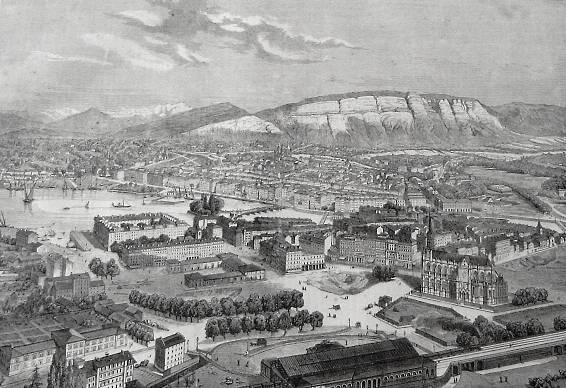
File:Geneve panorama 1860.JPG
Geneva, ca. 1860.

Hotel de l’Eau ~ This is indeed a beautiful city, clean, modern, and enjoyable. The houses are large and handsome – almost every second one bears the sign “horrologerie” (watchmaking). The watchmakers shops are large and handsome besides being thick as blackberries. Mount Blanc has not shown himself today. I passed the morning in shopping and have seen so many watches as perfectly to confuse me. I give the preference to two that I have seen. One for 280 francs ($56), a fine gold watch, lepine, or “echappement a cylindre” with eight holes in rubies. It is the quality sold in Boston for 75 or 80 dollars I think. The other is a compensated lever (“ichappement a l’ancre”) or half chronometer with fifteen holes in rubies, splendid workmanship, and costs 380 francs or 76 dollars. It would be worth in Boston from $125 to $150. On our arrival yesterday I posted off to the post office immediately and found a long and pleasant letter to me from Mother, one from Kitty to Lizzie, and several more indifferent ones. Alice had none and feels very badly. Poor girl, her last was received at London. We dined at four today on broiled chicken, dessert and “vin du pays.” The Swiss silver is much mingled with copper so that their size is large for value. Pieces of from 5 to 50 centimeters - 8 Francs, with gold Napoleon always {} Francs.

Thursday, October 26th 1854 ~ Geneva

File:MountBlanc04.jpg
Mount Blanc.

Hotel de l’Eau ~ We became quite attached to the Hotel Byron. It was so neat orderly and pleasant. In fact I suppose it might be called a “pension” more than a hotel. We dined there yesterday as they had us table d’hote on broiled chicken, vin du pays, and dessert. At ten o’clock we took the little steamer at Villeneuve for Geneva. (Some palpitations about the Treadwells!) The lake struck us as beautiful but not remarkably so, for the end toward Villeneuve alone commands a view of the mountains and the shores elsewhere and low and ordinary looking. On the trip we made the acquaintance of the English ladies, residents of Vivey, going also to Geneva and to Italy afterward by the Mount Cenis. They cautioned us against the snows of the Semplon, the elder of the two having met with some accident there. We arrived here at three in the afternoon and were obliged to give up our passport on landing to a Swiss soldier on the g-way. Geneva is built around the bay so that its finest streets face the water and face Mt. Blanc in the distance looking over the lake. A great snow capt dome seems from here merely the highest of a high chain of mountains, nearly equal in majesty. The range must be superb from here in Summer for they are always white with snow.

Monday, March 29, 2010

Saturday, October 21th 1854 ~ Interlochen


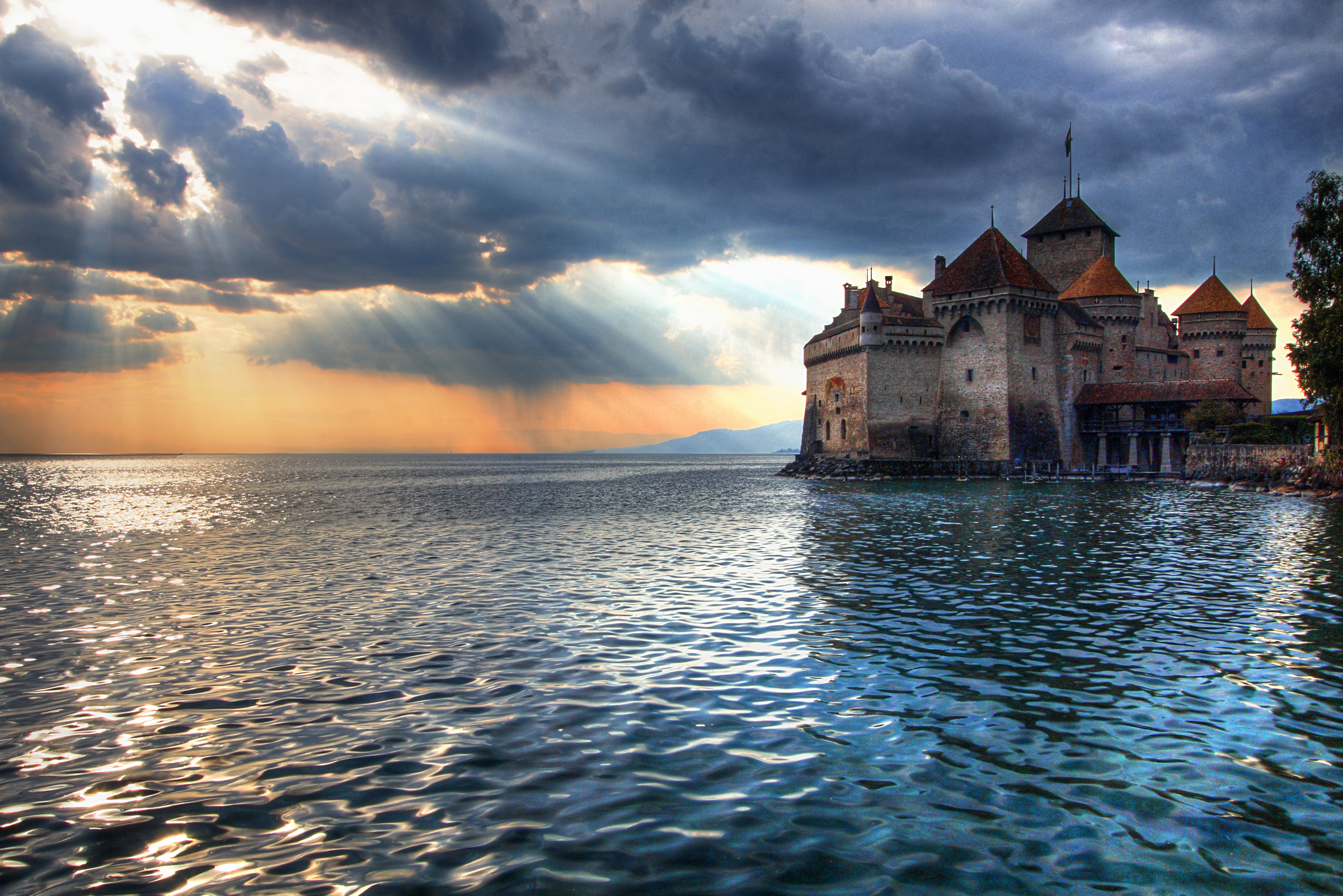
File:The Sun Sets on Château de Chillon.jpg
Castle of Chillon, on the shores of Lake Geneva.

Hotel Belvidere ~ Our windows at Grindelwald looked out upon the {Mittenberg} mountain and Unt glacier which descended close to us. It is a small but pretty collection of wooden houses, surrounded by mountains. The Wetterhorn Eiger, Mittenberg, and Wengern Alp all look very near. In fact, we seemed to be just under them. The Eiger is the most imposing at Grindelwald. It rises so like a needle of rock (as the Swiss call it) into the air. Its summit always clothed in ice and snow, from which the black rock shows itself in jagged points and ridges.

At ten o’clock this morning we took a carriage for Lauterbrunnen and Staubach on the way to Interlachen. The drive was a very pleasant one although it rained quite hard. The road winds between high mountains, but we could not see their summits on account of the clouds. The Staubach fall is about half a mile from Lauterbrunnen and this last place was about three miles out of our way. Still we thought it would be a shame not to see a fall so celebrated by Byron, Longfellow and other poets. At Lauterbrunnen we were forced to leave the carriage and walk under umbrellas though the wind to see this beautiful object. Our path was pointed out by the driver and after having pursued it for some time we asked a peasant to point out the fall and were told we had “just past it!” and there it was, a little meek stream trickling down from very high rocks; scarcely a teacup full of water. We had passed it without remarking it. I can however imagine its being very beautiful during the spring and summer when there is more water and of a bright day where the sun would tinge with rainbow hues the “lace veil” which the water is converted into before it reaches the earth by the action of the air. A little girl and boy seeing us staring at this “wonder work of God and Nature’s hand”! brought out an Alpine horn and sounded it there. The echo was wonderful. The air was instinct with the melody long after the instrument ceased. It is a long wooden pipe, perhaps five feet long and produces a very loud and at a distance a very melodious sound. We did not appreciate Longfellow’s fall or his chime of Bells at Bruges. The magnificent king Frau and {Monk} here rose just above us but we could not see them. We reached Interlachen at four o’clock, and after getting settled at the hotel I posted off to the “poste aux lettres” and received there a letter from Mother, our first since leaving Liverpool. Poor Alice had none and is in {} despair. Also a letter from Sidney Homer saying he would meet {} chain. In descending to Vivey we took out our Childe Harold and read the passages which have added if possible even more renown to Lake Geneva so celebrated in history, poetry, and painting. We remained for two hours at Vivey and then took a boat for Ville{men}, a little place just at the extreme end of the lake. The sail of course was delightful, the waters smooth and clear reflecting every cloud. On the other side of Vivey the shores are rather low and on the other, hills not very high just serve to shut off the view of the great mountain range behind them. The lake has no islands and is not in itself as beautiful as many of our own lakes. It cannot compare in beauty with Lake Lucerne although they can hardly be compared for one has the charms of wilderness, the other is all smiles and soft sunlit beauty. Vivey is far the handsomest Swiss city we have yet seen. The streets are wide, clean and well paved, the houses large and tasty.

Our hotel here is about a quarter or half mile from Villeneuve and quite near the Castle of Chillon. It looks much more like a gentleman’s country place than a hotel. The long avenue leading from the road to the door is shaded with high trees while a large flower garden behind, perfume in the air. English people often pass the summer here, for it is said to be a particularly healthy situation. We ordered dinner and then started the walk over a muddy road to the Castle. It is a fine looking old place, but not as picturesque as many of the Rhemish castles. Its chief interest to us consisted in the story with which Lord Byron has invested it – “the prisoner of Chillon.” The castle is of reddish stone. It is built at the waters edge so that its principal tower stands in the water. Just opposite it and quite near is the “little isle” on which the “prisoner” saw the sun beams play. It is a mere heap of stones not large enough to contain the trees spoken of. We were shown the dungeon where Bonivard was confined. The ring which had bound him to one of its stone pillars and the little path worn by his feet in the stone pavement, about three feed long, in a half circle, around the pillar showing the length of his chain. On a neighboring column Byron, Jean Jaque Rousseau, Eugene Sue, Victor Hugo, Richard Dana and others have inscribed their names. Why Dana’s name should be in such company I cannot conceive. The vaulted roof is supported by about seven of these columns. The dungeon though strong is not as gloomy and terrible as that of Baden. In one of the apartments we were shown a great slanting stone on which two thousand Jews had been strangled. In the torture room is still standing a beam to which offenders were fastened while fire was applied to the soles of their feet. The wood is still scorched. Here also is an “oubliette” A cross beam of an often used gibbet which stands or stood opposite an image of the Virgin. These relics should teach us to appreciate our days of law and order. “Chillon thy prison is a holy place and thy sad floor an altar.”