Showing posts with label Helen Augusta Kane. Show all posts

Wednesday, March 31, 2010

Friday, October 27th 1854 ~ Geneva

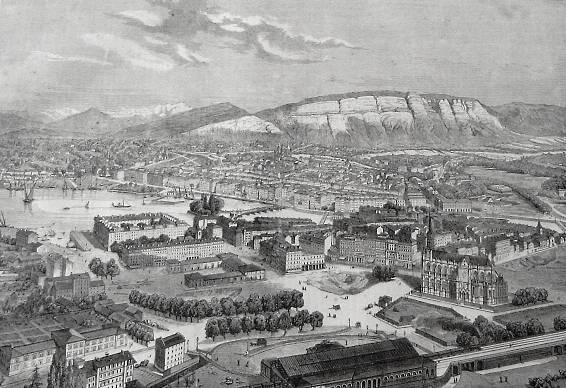
File:Geneve panorama 1860.JPG
Geneva, ca. 1860.

Hotel de l’Eau ~ This is indeed a beautiful city, clean, modern, and enjoyable. The houses are large and handsome – almost every second one bears the sign “horrologerie” (watchmaking). The watchmakers shops are large and handsome besides being thick as blackberries. Mount Blanc has not shown himself today. I passed the morning in shopping and have seen so many watches as perfectly to confuse me. I give the preference to two that I have seen. One for 280 francs ($56), a fine gold watch, lepine, or “echappement a cylindre” with eight holes in rubies. It is the quality sold in Boston for 75 or 80 dollars I think. The other is a compensated lever (“ichappement a l’ancre”) or half chronometer with fifteen holes in rubies, splendid workmanship, and costs 380 francs or 76 dollars. It would be worth in Boston from $125 to $150. On our arrival yesterday I posted off to the post office immediately and found a long and pleasant letter to me from Mother, one from Kitty to Lizzie, and several more indifferent ones. Alice had none and feels very badly. Poor girl, her last was received at London. We dined at four today on broiled chicken, dessert and “vin du pays.” The Swiss silver is much mingled with copper so that their size is large for value. Pieces of from 5 to 50 centimeters - 8 Francs, with gold Napoleon always {} Francs.

Monday, March 29, 2010

Saturday, October 21th 1854 ~ Interlochen


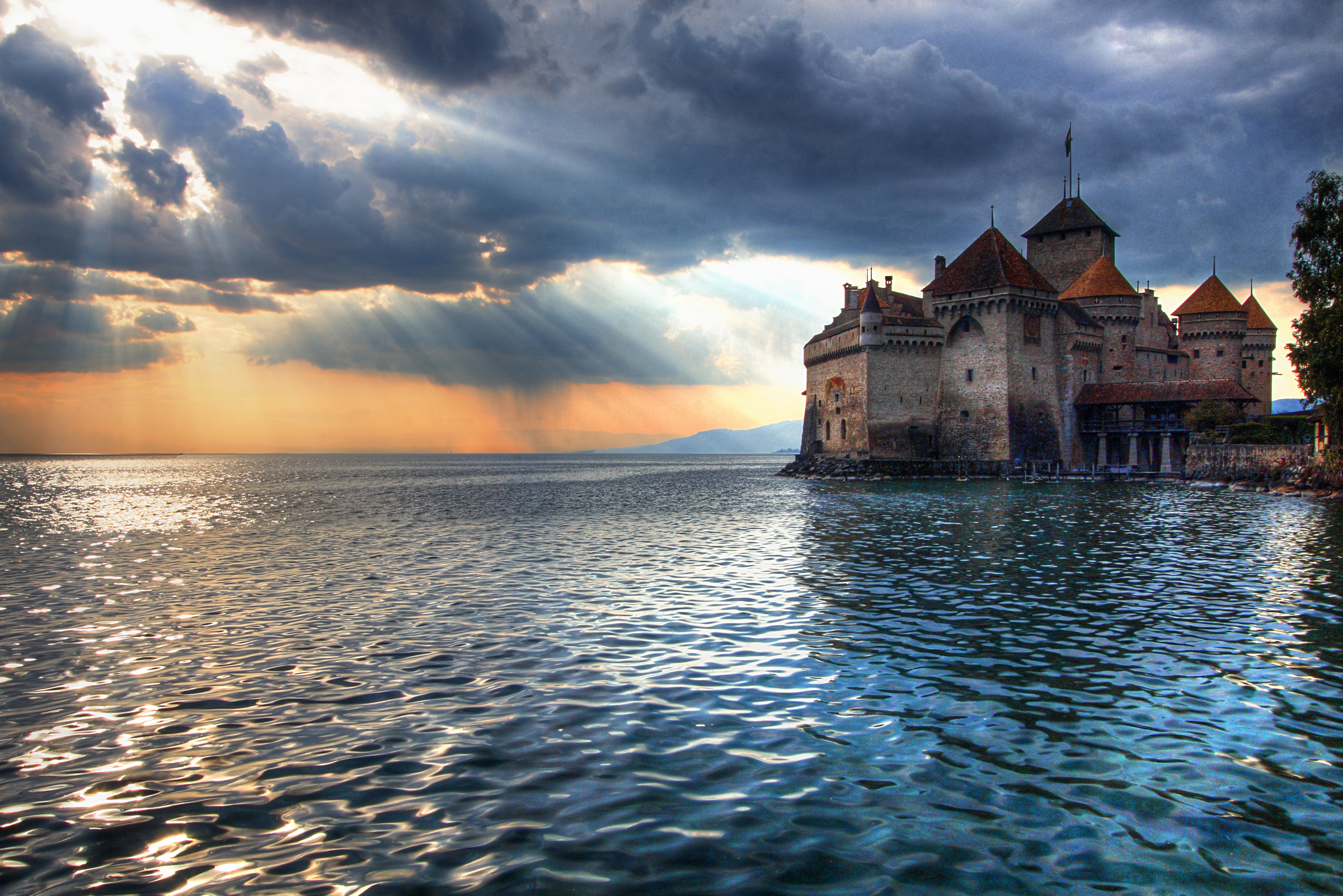
File:The Sun Sets on Château de Chillon.jpg
Castle of Chillon, on the shores of Lake Geneva.

Hotel Belvidere ~ Our windows at Grindelwald looked out upon the {Mittenberg} mountain and Unt glacier which descended close to us. It is a small but pretty collection of wooden houses, surrounded by mountains. The Wetterhorn Eiger, Mittenberg, and Wengern Alp all look very near. In fact, we seemed to be just under them. The Eiger is the most imposing at Grindelwald. It rises so like a needle of rock (as the Swiss call it) into the air. Its summit always clothed in ice and snow, from which the black rock shows itself in jagged points and ridges.

At ten o’clock this morning we took a carriage for Lauterbrunnen and Staubach on the way to Interlachen. The drive was a very pleasant one although it rained quite hard. The road winds between high mountains, but we could not see their summits on account of the clouds. The Staubach fall is about half a mile from Lauterbrunnen and this last place was about three miles out of our way. Still we thought it would be a shame not to see a fall so celebrated by Byron, Longfellow and other poets. At Lauterbrunnen we were forced to leave the carriage and walk under umbrellas though the wind to see this beautiful object. Our path was pointed out by the driver and after having pursued it for some time we asked a peasant to point out the fall and were told we had “just past it!” and there it was, a little meek stream trickling down from very high rocks; scarcely a teacup full of water. We had passed it without remarking it. I can however imagine its being very beautiful during the spring and summer when there is more water and of a bright day where the sun would tinge with rainbow hues the “lace veil” which the water is converted into before it reaches the earth by the action of the air. A little girl and boy seeing us staring at this “wonder work of God and Nature’s hand”! brought out an Alpine horn and sounded it there. The echo was wonderful. The air was instinct with the melody long after the instrument ceased. It is a long wooden pipe, perhaps five feet long and produces a very loud and at a distance a very melodious sound. We did not appreciate Longfellow’s fall or his chime of Bells at Bruges. The magnificent king Frau and {Monk} here rose just above us but we could not see them. We reached Interlachen at four o’clock, and after getting settled at the hotel I posted off to the “poste aux lettres” and received there a letter from Mother, our first since leaving Liverpool. Poor Alice had none and is in {} despair. Also a letter from Sidney Homer saying he would meet {} chain. In descending to Vivey we took out our Childe Harold and read the passages which have added if possible even more renown to Lake Geneva so celebrated in history, poetry, and painting. We remained for two hours at Vivey and then took a boat for Ville{men}, a little place just at the extreme end of the lake. The sail of course was delightful, the waters smooth and clear reflecting every cloud. On the other side of Vivey the shores are rather low and on the other, hills not very high just serve to shut off the view of the great mountain range behind them. The lake has no islands and is not in itself as beautiful as many of our own lakes. It cannot compare in beauty with Lake Lucerne although they can hardly be compared for one has the charms of wilderness, the other is all smiles and soft sunlit beauty. Vivey is far the handsomest Swiss city we have yet seen. The streets are wide, clean and well paved, the houses large and tasty.

Our hotel here is about a quarter or half mile from Villeneuve and quite near the Castle of Chillon. It looks much more like a gentleman’s country place than a hotel. The long avenue leading from the road to the door is shaded with high trees while a large flower garden behind, perfume in the air. English people often pass the summer here, for it is said to be a particularly healthy situation. We ordered dinner and then started the walk over a muddy road to the Castle. It is a fine looking old place, but not as picturesque as many of the Rhemish castles. Its chief interest to us consisted in the story with which Lord Byron has invested it – “the prisoner of Chillon.” The castle is of reddish stone. It is built at the waters edge so that its principal tower stands in the water. Just opposite it and quite near is the “little isle” on which the “prisoner” saw the sun beams play. It is a mere heap of stones not large enough to contain the trees spoken of. We were shown the dungeon where Bonivard was confined. The ring which had bound him to one of its stone pillars and the little path worn by his feet in the stone pavement, about three feed long, in a half circle, around the pillar showing the length of his chain. On a neighboring column Byron, Jean Jaque Rousseau, Eugene Sue, Victor Hugo, Richard Dana and others have inscribed their names. Why Dana’s name should be in such company I cannot conceive. The vaulted roof is supported by about seven of these columns. The dungeon though strong is not as gloomy and terrible as that of Baden. In one of the apartments we were shown a great slanting stone on which two thousand Jews had been strangled. In the torture room is still standing a beam to which offenders were fastened while fire was applied to the soles of their feet. The wood is still scorched. Here also is an “oubliette” A cross beam of an often used gibbet which stands or stood opposite an image of the Virgin. These relics should teach us to appreciate our days of law and order. “Chillon thy prison is a holy place and thy sad floor an altar.”

Friday, January 8, 2010

Frederick Augustus Cobb


Charles' father, Frederick Augustus Cobb (1801 - 1848)

1801 - born in Portland, ME on July 26th.

1820 to ≥ 1833 -
Lived in Boston, where he attended Harvard
(a member of the
"Porcellian Club"), was a member of the local
library, owned lots of stock, married Helen Augusta Kane, and
had two children: Charles (1831) and Mary Wray Cobb (1833).
(Mary accompanied Charles and Lizzie to Europe).

≤ 1838 to 1848 - Lived in Schenectady, NY., where he donated
$5 to a church and apparently attended political conventions of
the
Whig party! He died in Schenectady on August 2nd 1848
(aged 47), when Charles was 17.


It isn't clear where all of his money came from...or where it went for that matter!

Thanks to great-great-grandson-in-law Rich Allen and great-great-great granddaughter Becky James for digitizing the painting!

Wednesday, January 6, 2010

Charles Kane Cobb, timeline


A photo of Charles K. Cobb ca. 1861.

1831 - Born in Boston, MA.
1833 - Sister Mary Wray Cobb is born in Boston.
1830s - Family moves to Schenectady, NY.
1848 - Father, Frederick Augustus Cobb, dies in Schenectady.

1850 - Possibly boards at 7 Morton Pl., Boston (Charles Cobb, clerk).
1852 - Boards at "Winthrop House" in Boston.
1853 - Marries Elizabeth Codman.

1854 - Clerkship in a dry goods commission house.
1854 - Trip to Europe with wife Lizzie and sister Mary.

1855 - Son born in Schenectady, NY: Charles Kane Cobb, Jr.

1856 - Grandmother mentioned in journal (
Maria Wray) dies.
1857 - Resides at 18 E. Brookline St., Boston.
1857 - Daughter born in Boston: Helen Kent Cobb.

1857-8 Works as a m
erchant at 53 Central Wharf.
1858 - Possibly boards at 4 Bulfinch Place (C.K. Cobb).
1858 - Mother, Helen Augusta Kane, dies in Boston.

1859 - Son born in Boston: Frederick Codman Cobb.

1860 - Appears in US Census as Boston resident, merchant.
1861 - Works at 22 Central Wharf, J.P. Hawes & Co., merchants.
1861-? - Lieutenant/adjutant in Civil War, stationed in Boston Harbor.

1862 - Absent from the Boston Directory. At war?
1864 - Daughter born in Boston: Elizabeth Codman Cobb.

1864 - Starts a bank and brokerage company.

1865-6 - Partners with Francis V. Parker becoming "Parker & Cobb."

1865 - Resides at 11 Brookline St.
1865 - Parker & Cobb located at "1 Phoenix Building" in Boston.
1868 - Parker & Cobb located at 8 Devonshire St.
1868-death - Resides at 11 Marlboro St.
1870-3 - Parker & Cobb located at 36 Devonshire St.
1872 - Parker & Cobb narrowly escapes the "great fire" of Nov 9.
1873 - Charles is a member of the Boston Stock and Exchange Board.
1873-6 - Parker & Cobb is located at 78 Devonshire St.

1876 - Dies in Boston, age 45. Bank becomes F.V. Parker & Co.


Advertisement from The Banker's Almanac, 1874.

sources:
Banker's Almanacs, 1872-1874.
Barron, C. W. and J. G. Martin. 1893. The Boston Stock Exchange.
Boston Directories 1849 to 1875.
Chandler, A. 1876. Secretary's Report, class of 1868, Harvard.
Greenough, Jones & Co. 1872. Boston Business Directory.
Parker, F. J. 1880. The story of the 32nd regiment Massachusetts...
Reno, C. 1900. Memoirs of the judiciary and the bar of New England...

Note: some dates and/or places may be wrong! (i.e., mistaken identities)

Wednesday, December 23, 2009

Monday, September 18, 1854 ~ Liverpool, U.K.

oil painting showing sailing ships tied at a busy dockside, with men and horses loading and unloading cargo.
Liverpool docks, ca. mid 1800's (painting by R. Dudley)

Queens Hotel ~ Captain Knowles dined with us yesterday at six o’clock. Prof. Treadwell* undertook to do the honors of the table. He ordered the dinner and had the general getting up of the whole affair. Dr. Gallup and Dr. Spooner dined also with us. We had a very fair dinner – an immense piece of roast beef in real English style, so large that it took my appetite away to look at it, but the Prof. did not provide properly in the way of wine, and before dinner was over we had to look at empty bottles, and no more was ordered. I should have taken the matter into my own hands, but did not do it. Thus far I have not been particularly pleased with the English, with whom we have come in contact. They have shown themselves somewhat extortioners and unjust in little ways, however we are still green, verdant in the ways of the old world. Professor Treadwell has been joking Dr. Gallup so much at the table and elsewhere about Alice, that the little gentleman has evidently been persuaded that he is in love. Unfortunately Alice at such times could not always refrain from a blush, which of course greatly encouraged the Dr. I fear we shall have some little trouble in getting rid of the fellow, or keeping him quiet. He is in many respects a fine man but this time “can not come in”. Our rooms are in the third story and look out on a large square, in which is the great St. Lawrence Hall just being finished; an immense stone building to be used (I believe) for municipal purposes. Most Americans go to Mrs. Blodget’s boarding house, we called there yesterday but it was full. The “Queens” is not the crack house, but it was the best we could get into yesterday, all are full. It is however first class and very comfortable. This morning I went dawn to the custom house with Prof Treadwell; there we met Capt Knowles and had our baggage passed with but a slight examination. Capt Knowles brought it in, with the emigrants and their effects on a steam tug. They are particular here in searching Americans for Segars and tobacco in every form, for there is a very high duty on it, $2.25 I think on every pound. By the way it is the custom for American ships to give a pound paper of chewing tobacco to the pilot when he boards them. The custom house are careful to see that no reprints of English books are brought into the country. I called on Brown and Shipley, and took a letter of credit on the London house. Received a delightful letter from Mother. Mr. and Mrs. Treadwell left today for the Chester and London also Dr Spooner. I presented letters of introduction to Chas Humbertson** and others. He wears a threadbare coat and is a plain enough man for one so well known.

--------------------
*Prof. Treadwell may be the inventor and Harvard professor Daniel Treadwell (1791-1892). He was a friend of Longfellow and the inventor of the first mechanized printing press and rope spinner!!

**A newspaper in Liverpool references Charles Humberston as a "commission merchant," which was also C.K. Cobb's trade at the time.

Friday, December 18, 2009

Sunday, August 27th, 1854 ~ At sea

http://www.danielreeve.co.nz/Merchandise/images/CapeCod1.jpg

At sea ~ The wind in the night has been gradually increasing, and is now blowing hard from the old quarter (South East) and we are pitching about a great deal. The waves do not look high but as they strike our broadside they cause us to roll heavily. It seemed impossible yesterday that our noble ship could have so much motion – she is very “crank”, as the sailors call it, that is, lays over on her side, so that it is really quite a feat to climb from one side of the cabin to the other. All the passengers are sick – too much so for prayers or indeed for anything under the sun – none of the ladies have been out of their births today. I got up early and went to breakfast and managed to eat a pretty hearty one of chicken etc. but was relieved of it all soon after, the captain noticed that I walked to the deck railing in a contemplative mood, and I thought I saw in his face that he divined a reason in the procedure. I took a light dinner and feel better, but still see no beauty in sea or sky and earth is nearly out of sight. This morning we got a parting glimpse of Cape Cod, the last we shall have of our country if no accident happen. Our course is South East, it should be due East I believe. Lizzie is very sick and confined to her birth, Mary is also sick but cannot relieve her feelings! Poor Alice is the greatest sufferer of us all and wishes devoutly that she was again in Boston. The table today has assumed a new garb, long parallel stats of wood, extend its whole length beneath the table-cloth, they are about three inches high and serve to balance our plates upon and keep them out of our laps. All the glass is suspended above our heads on a swinging shelf that vibrates with the motion of the ship. A poor fellow who came aboard to say goodbye to his friends of the steerage, was carried off by mistake and now he is anxiously looking out for “sails” in hopes that he may be transferred to an inward bound ship, but his chances are small – he will probably have to go with us to Liverpool.

Is Mother watching the weather at Saven Hill, or at Newport? It will be long before we can know.

Saturday, August 26, 1854 ~ Ship Chariot of Fame

Ship Chariot of Fame ~ Our project of a tour in Europe was hastily made two weeks ago; on account (on my part) of increasing ill health and need of relaxation from the labor of a clerkship in a dry goods commission house. Mary has not been well and thought the change of air and scene might benefit her, besides, of course, anticipating much pleasure from foreign travel; while of course my little wife, always ready for a “spree”, was doubly so for one of such a magnitude. Everything combined to make our way clear before us, and here we are a party of four on board the Chariot of Fame, a noble ship of 2000 tons, at sea and bound for Liverpool. I have spoken of three of our party the fourth is Mrs. Alice Watts – we feel as if we know her very well, having past a year under the same roof, and trust that quarter “familiarity” will not breed contempt on either side. We missed the cars this morning which were to carry us in to Boston from Savin Hill, and were forced to take Pa Little’s old carryall and drive in town where we joined Alice at the depot of the Old Colony railway, and as it was too early for carriages there, we four drove, with baggage, to the ship in our carryall, and must have looked very like an Irish family moving, or a Neapolitan turnout. Poor Mother bid us goodbye at Saven Hill with a tear or two and Grandmother says she never expects to see us again (the prevailing tune, by the way, of the last five years at every parting). They bore it, on the whole, much better than could have been expected considering that Mother was trusting to the ocean her all for an absence of perhaps a year. We felt very badly at parting with her, she has to look forward to a long, and perhaps lonely winter in Schenectady. William Codman, Mr. Foster, Mr. Watts, and others went to the limits of the harbor with us in the towboat “Rescue” which carried us out, and as the waving of their handkerchiefs disappeared in the distance, the last material link seemed broken that bound us to our American relatives and friends, but I hope their hearts will be with us on the watery way that is opening before us and I am sure ours will often revisit home and follow them in their daily occupations.


The day is cloudy, the wind unfavorable, being light and from the North East, so that we are close hauled and moving slowly. We have 150 steerage passengers on board, most of them paupers sent home to Ireland by the state. They are grouped forward, among the sailors, and present quite and picturesque appearance. The vessel is covered with flags of the sailors’ songs, being a novelty, sound very pleasantly to our landlubber ears. I doubt if we see any harbor more beautiful than this, with its little islands, its frowning fort, its fine shipping etc. We can detect no motion (up and down) in our vessel, although fairly out at sea, she lays upon the water like a great leviathan, slowly edging Eastward. It seems impossible to us that she could ever be the “sport of the waves.” Our cabin passengers are Mr. and Mrs. Prof. Treadwell, Dr. Spooner, young Shelton, Mrs. Ashendon and children, Dr. Gallup surgeon of the ship and of course Capt. Knowles, our commander. We left the wharf this morning at ten o’clock and now, at ten at night have a lee shore in plain sight. Mary and Alice have a stateroom together next to ours.