Showing posts with label English tourists. Show all posts

Thursday, May 27, 2010

Monday, November 6th 1854 ~ Milan


Hotel de Ville ~ I began today’s labors by visiting the post office and found there a letter for Alice. The first she has had since leaving home. Of course, she is perfectly enchanted and has been clapping her hands and jumping about like a child with a new toy. I bought a hat this morning and the girls looked for bonnets. After this important business ended, we walked to the other end of the city following the lead of our friend Mr. Murray to see the celebrated painting in frescoe of Leonardo da Vinci “the last supper.” It is on the wall of the refectory of the Jesuit college Santa Maria delle Grazie, a tumble down old building of brick now used as a military barrack. The refectory itself is quite a large room, somewhat longer than it is broad and paved with brick. The painting occupies all one end of it, and is dropping off every year. Traces of the great master are still to be seen in its fading design and general conception, more than in any particular part. It has been repainted and thus greatly damaged several times and it is said that the faces of the Saviour and of Judas are the only ones which are at all perfect (whose expression has not been entirely changed by the repainting). The apostles are placed around a long table, and the scene is drawn at the moment when the servant Peter demands of his Lord “is it I?” Our Lord’s expression is most saintlike and is clothed with an almost unearthly spirituality and dignity. The faces of the group show their interest in the answer expected, and their innocence. The features of Judas are thrown a little in the shade, the better to produce a fiendish expression in which evil passions and cowardice are blended. His face alone does not ask “is it I” but retired from the light. The monks have cut a door through the lower part of the painting, thus taking off all the lower part of our Lord’s person. It’s study gave me a new idea of the effects attainable in painting. As we passed out, soldiers were practicing gymnastic exercises in front of their quarters. They had a rope suspended from the roof to the sidewalk, and were coming down on it head downwards, sitting on each other’s shoulders etc. These operations were superintended by an officer in uniform and apparently on duty. We then walked over to the castle where fifteen hundred or two thousand men were on parade, marching over the great square in front.

Just at the end of this ground is the “Arco della Pace,” a very beautiful triumphal arch, modern, surmounted by bronze statues, chariot and horses and a group of figures about it. We dined at six, just after the table d’hote, and Lizzie was much incommoded by being stared at by an Englishman, who was lingering over his coffee.

Saturday, November 4th 1854 ~ Milan

Hotel de Ville ~ We breakfasted this morning at Como and after much discussion we decided to make an excursion on the lake; so we took the little steamer at eight o’clock for Bellaggio arriving there after a delightful sail of an hour and a half. The lake is long and narrow, bounded by quite high hills on either hand, along the base of which are beautiful Italian villas in great profusion, with their terraced gardens still clothed in summer verdure. These villas are generally white square houses, having an air of wealth and elegance. The houses at Longwood resemble them very much. We have struck up an acquaintance with an English family aboard, a father, mother and grown up son, bu speedily found them, like all the other specimens of their race that we have met, reserved, uncommunicative, and purse-proud. They were talking continuously about their courier, their servants from England etc. etc. We left our shawls etc. at a hotel in the village and ascended a hill on which is placed the Villa Serbilloni, from the garden of which we obtained some magnificent views of the lake and surrounding country. Bellaggio is on a spur of land running into the lake so that here we had water on both sides, indeed all sides but one. This garden is a succession of terraces, which shelter almost tropical fruits and flowers. Here again we met the English party, the lady riding in a sedan chair carried by two men. We dined at Bellaggio and found the names of J.V.C. Smith {mayor of Boston} and party on the books. Mrs. Smith had written a warm commendation of the hotel, and had added a note in which she says that after having received the bill she found herself obliged take back all her previously expressed praise!! We left at two for Como again, and had to row off to the steamer in a little boat. There was considerable wind and the ladies of the party found a sad pleasure in looking over the side of the little boat! Arrived at Como we had just time to get our passport and baggage in order to take the six o’clock train for Milan. At the depot no one spoke a word of French or German and I was obliged to use signs. It is very disagreeable. The money is still francs (called by another name) and I know the Italian numbers, still it is hard work. The cars are good and the comfort of passengers well attended to. As we crossed the boundary line between Switzerland and Italy (the Alps), the language, manners, customs, as well as climate seemed to change in a moment. Our baggage was again examined on entering this city. Officials are plenty and very strict, but civil.

Tuesday, May 25, 2010

Wednesday, November 1st 1854 ~ Brigue

Hotel des Trois Couronnes ~ This place seems to lie just at the end of the valley of the Rhone. Mountains enclose it on all sides but one, and here the river takes its first waters from the snows of the great mountains. Just above us towards the Semplon and its great road built by Napoleon. We passed last evening at Matigny in recounting our mutual adventures. The girls met in the diligence an old lady who was a great mineralogist having her collections for the day in a bag with her. She was English and going to the salt mines for Stalactites. Also, Mrs Edward Cathy an intimate friend of Mrs Gillebran, Miss Ropes that was etc., etc. They were treated with great consideration at the Hotel Byron and altogether had a most comfortable time. We left Matigny at three o’clock and arrived here at one at night. The diligence conductors wear a uniform consisting of a blue frock coat with brass buttons, standing collar and a blue cap. Both cap and coat have a bugle embroidered on them in gold to denote the postal service. The “cocher” wears a coat which would be a dress coat if the tails were double the size. This coat boasts scarlet collar and cuffs and is mounted with gilt bugle buttons. The hat is of glazed leather having a gold band and embroidered bugle. On our arrival here we went down into the kitchen and helped ourselves to some “potage” we found on the stove. It was the only comfortable place in the house.

Wednesday, March 31, 2010

Thursday, October 26th 1854 ~ Geneva

File:MountBlanc04.jpg
Mount Blanc.

Hotel de l’Eau ~ We became quite attached to the Hotel Byron. It was so neat orderly and pleasant. In fact I suppose it might be called a “pension” more than a hotel. We dined there yesterday as they had us table d’hote on broiled chicken, vin du pays, and dessert. At ten o’clock we took the little steamer at Villeneuve for Geneva. (Some palpitations about the Treadwells!) The lake struck us as beautiful but not remarkably so, for the end toward Villeneuve alone commands a view of the mountains and the shores elsewhere and low and ordinary looking. On the trip we made the acquaintance of the English ladies, residents of Vivey, going also to Geneva and to Italy afterward by the Mount Cenis. They cautioned us against the snows of the Semplon, the elder of the two having met with some accident there. We arrived here at three in the afternoon and were obliged to give up our passport on landing to a Swiss soldier on the g-way. Geneva is built around the bay so that its finest streets face the water and face Mt. Blanc in the distance looking over the lake. A great snow capt dome seems from here merely the highest of a high chain of mountains, nearly equal in majesty. The range must be superb from here in Summer for they are always white with snow.

Monday, March 29, 2010

Saturday, October 21th 1854 ~ Interlochen


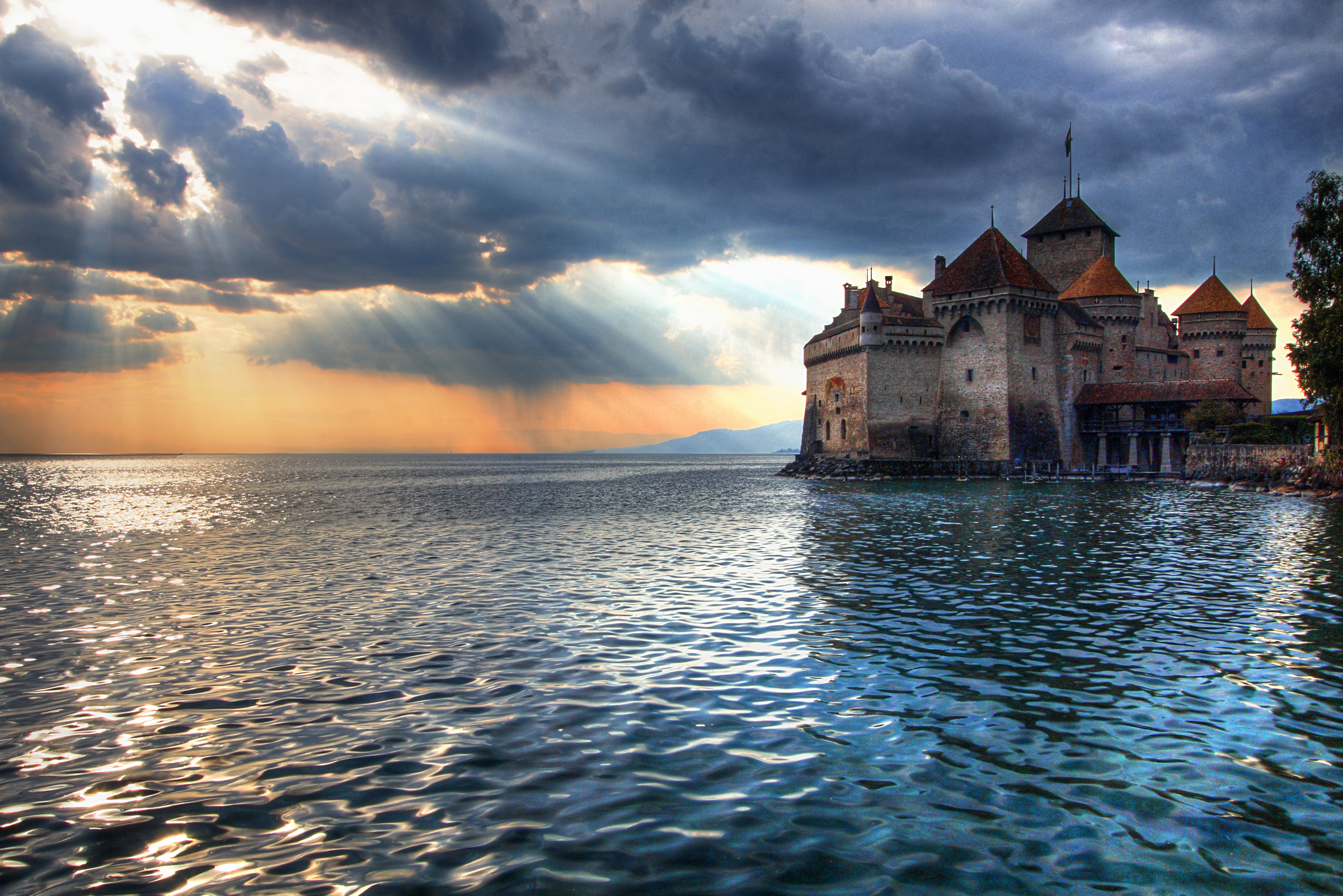
File:The Sun Sets on Château de Chillon.jpg
Castle of Chillon, on the shores of Lake Geneva.

Hotel Belvidere ~ Our windows at Grindelwald looked out upon the {Mittenberg} mountain and Unt glacier which descended close to us. It is a small but pretty collection of wooden houses, surrounded by mountains. The Wetterhorn Eiger, Mittenberg, and Wengern Alp all look very near. In fact, we seemed to be just under them. The Eiger is the most imposing at Grindelwald. It rises so like a needle of rock (as the Swiss call it) into the air. Its summit always clothed in ice and snow, from which the black rock shows itself in jagged points and ridges.

At ten o’clock this morning we took a carriage for Lauterbrunnen and Staubach on the way to Interlachen. The drive was a very pleasant one although it rained quite hard. The road winds between high mountains, but we could not see their summits on account of the clouds. The Staubach fall is about half a mile from Lauterbrunnen and this last place was about three miles out of our way. Still we thought it would be a shame not to see a fall so celebrated by Byron, Longfellow and other poets. At Lauterbrunnen we were forced to leave the carriage and walk under umbrellas though the wind to see this beautiful object. Our path was pointed out by the driver and after having pursued it for some time we asked a peasant to point out the fall and were told we had “just past it!” and there it was, a little meek stream trickling down from very high rocks; scarcely a teacup full of water. We had passed it without remarking it. I can however imagine its being very beautiful during the spring and summer when there is more water and of a bright day where the sun would tinge with rainbow hues the “lace veil” which the water is converted into before it reaches the earth by the action of the air. A little girl and boy seeing us staring at this “wonder work of God and Nature’s hand”! brought out an Alpine horn and sounded it there. The echo was wonderful. The air was instinct with the melody long after the instrument ceased. It is a long wooden pipe, perhaps five feet long and produces a very loud and at a distance a very melodious sound. We did not appreciate Longfellow’s fall or his chime of Bells at Bruges. The magnificent king Frau and {Monk} here rose just above us but we could not see them. We reached Interlachen at four o’clock, and after getting settled at the hotel I posted off to the “poste aux lettres” and received there a letter from Mother, our first since leaving Liverpool. Poor Alice had none and is in {} despair. Also a letter from Sidney Homer saying he would meet {} chain. In descending to Vivey we took out our Childe Harold and read the passages which have added if possible even more renown to Lake Geneva so celebrated in history, poetry, and painting. We remained for two hours at Vivey and then took a boat for Ville{men}, a little place just at the extreme end of the lake. The sail of course was delightful, the waters smooth and clear reflecting every cloud. On the other side of Vivey the shores are rather low and on the other, hills not very high just serve to shut off the view of the great mountain range behind them. The lake has no islands and is not in itself as beautiful as many of our own lakes. It cannot compare in beauty with Lake Lucerne although they can hardly be compared for one has the charms of wilderness, the other is all smiles and soft sunlit beauty. Vivey is far the handsomest Swiss city we have yet seen. The streets are wide, clean and well paved, the houses large and tasty.

Our hotel here is about a quarter or half mile from Villeneuve and quite near the Castle of Chillon. It looks much more like a gentleman’s country place than a hotel. The long avenue leading from the road to the door is shaded with high trees while a large flower garden behind, perfume in the air. English people often pass the summer here, for it is said to be a particularly healthy situation. We ordered dinner and then started the walk over a muddy road to the Castle. It is a fine looking old place, but not as picturesque as many of the Rhemish castles. Its chief interest to us consisted in the story with which Lord Byron has invested it – “the prisoner of Chillon.” The castle is of reddish stone. It is built at the waters edge so that its principal tower stands in the water. Just opposite it and quite near is the “little isle” on which the “prisoner” saw the sun beams play. It is a mere heap of stones not large enough to contain the trees spoken of. We were shown the dungeon where Bonivard was confined. The ring which had bound him to one of its stone pillars and the little path worn by his feet in the stone pavement, about three feed long, in a half circle, around the pillar showing the length of his chain. On a neighboring column Byron, Jean Jaque Rousseau, Eugene Sue, Victor Hugo, Richard Dana and others have inscribed their names. Why Dana’s name should be in such company I cannot conceive. The vaulted roof is supported by about seven of these columns. The dungeon though strong is not as gloomy and terrible as that of Baden. In one of the apartments we were shown a great slanting stone on which two thousand Jews had been strangled. In the torture room is still standing a beam to which offenders were fastened while fire was applied to the soles of their feet. The wood is still scorched. Here also is an “oubliette” A cross beam of an often used gibbet which stands or stood opposite an image of the Virgin. These relics should teach us to appreciate our days of law and order. “Chillon thy prison is a holy place and thy sad floor an altar.”

Thursday, January 7, 2010

Monday, October 9th 1854 ~ Strasbourg, France

File:Hohenbaden hb.JPG
View from "Das alte Schloss," the Old Castle.

Hotel de la Ville de Paris ~ We left Baden at one o’clock this afternoon and arrived here at four by rail. The country is somewhat uninteresting but the cars are good and very comfortable. In the cars we met an English family who came also from Baden, the man a great fop and fool, the lady more sensible. They had lived so long in Germany that they spoke English with a decided accent. Their child (a little girl) was quite a prodigy. She was but five years old and spoke about equally well English, French, German, and Italian and all very well. Before leaving Baden this morning Lizzie and myself walked to “das neue Schloss” the present summer residence of the Dukes of Baden. This castle is rather a modern looking gothic building, founded in 1471 but which has built and demolished several times since, so that now only the foundation of the edifice remains. We were taken into the cellars by the castellan and found ourselves at a great depth in chambers hewn out of the solid rock on which the castle is placed. The first room we entered was a Roman bath, then followed a succession of cells, closed by doors of stone two feet thick, which led us into the judgment hall, where still are the stone seats of the judges of the secret tribunal. Out of this chamber opens a small room called the chamber of torture. Here stood the rack, rows of iron rings still remain in the walls, part of the paraphernalia of the dreadful apparatus. On one side of this room is a narrow passage terminated by an image of the Virgin. Just before reaching this image is a deep well called the “oubliette,” ninety feet deep, armed at the bottom by knives etc. and covered with a trap door. Along this passage the trembling victim is told to pass to kiss the image of the Virgin. Before he reaches it, the “oubliette” receives its victim. All these apartments are about 8 feet in height and perfectly dark, that is the light of day does not penetrate at all.


From these subterranean passages we again ascended to the realms of day, and visited the gorgeously furnished apartments of the Duke. These were the handsomest rooms we have thus far seen. The walls and ceiling are principally of oak, heavily carved and richly gilded. The floors of colored woods inlaid and highly polished, of course without carpets. In the state rooms were portraits of all the Dukes of Baden full length and in complete armor. The Protestant dukes on one side and the catholic on the other. From this chateau we ascended to “das alte Schloss,” a ruin on a high neighboring hill. Lizzie took an ass for the trip with a pretty little boy to lead him, while I went up on foot. The path wound through thick woods and was extremely pretty, to the old castle. This is a highly picturesque ruin which was the residence of the Dukes of Baden until somewhat more peaceful times, when they ventured down from their inaccessible cliff, to a strong castle below. The view from here is superb. At our feet is the beautiful little village of Baden, its tiled roofs glittering in the sunlight. To the west may be traced the course of the Rhine, in the distance looking like a thread of light in the green meadows. Behind us is seen the commencement of the great “black forest.” Beautiful walks wind through the woods.

Tuesday, January 5, 2010

Thursday, October 5th 1854 ~ Mayence, Germany

File:Rhein river and Ehrenfels post-1840.jpg
Rhine view showing Mouse Tower and Ehrenfels ruin (anonymous, after 1840).

Hotel de l’Europe ~ This morning we obtained a splendid view of the river and its scenery from Coblentz, which I think is one of the most beautiful points. Almost directly above us, on the opposite side rose the strong fortress of Ehrenbreitstein, capable of holding one hundred thousand men. Its situation is highly picturesque, being an immense stone structure on an almost inaccessible rock. Murray calls it the fortress of Germany. This scenery is beyond all my conceptions. We left Coblentz at one o’clock this afternoon by boat and reached here about nine o’clock this evening. It has been a delightful sail to us, finer I think than between Bonn and Coblentz. The deck of the steamer was quite full of English with their red covered guide books and [sules] of shawls. Ruined castles greeted us at every turn, while nature itself is most charming, wild yet soft, grand yet beautiful. High hills bound the river continuously and every few moments we pass one crowned by a fortress, most of them in ruins but some still kept up. These old castles on steep rocks give a good history of the middle ages (perhaps better than books) when no man could trust his neighbor, all were at strife and only concurred in levying contributions on the peasantry, and on the trade of the country. This river being a great highway of communication it abounds with strong holds from whence, when might made right, the noble might levy contributions on all merchandise passing up and down the river. Perhaps the most striking point we have passed today is in the neighborhood of St. Goar. Close to the water on a little hill is the great fortress of Reinfels in ruins. Just above it on a steep rock is perched the “Castle of the Cat” and below on the river, in plain sight, is the beautiful ruin of the “Castle of the Mouse.” This seems like fairy land, every few moments shows us a ruin which has some romantic history and every bend of the river discloses new natural beauties. We were much struck by the appearance of two ruined castles within a stones throw of each other, on rival peaks, which once belonged to brothers, who had the misfortune to fall in love with the same “fair” lady and who for her sake fell by each others hands. The castles and even their respective hills are exactly alike. It was moonlight long before we arrived at Mayence so that we saw it streaming through the loopholes and broken walls of these feudal towers. By night it is more easy to picture them in their strength, “when they were young and proud and banners waved on high and battles passed below,” and to people them with the mail clad men to whose tread their walls of old resounded.

Sunday, January 3, 2010

Sunday, October 1st 1854 ~ Brussels, Belgium

A Canal near Brussels in 1871 Claude Monet
"A canal near Brussels in 1871" (C. Monet).

Hotel de l’Univers ~ We all went to an English chapel this morning and heard the service badly performed. After church I wandered about the city and saw the Place Royale in the centre of which is a beautiful equestrian statue in bronze of Godfrey of Bouillon of enormous size. This square is in the very best part of the city at the upper end of the Park. I walked around the Park, seeing in passing the Palais Royal, the Palais de la Nation and the Museum or Palais des Beaux Arts. This last I went into, but was unable to see anything but ordinary paintings. Those by Rubens and Van Dyck being closed for the season. The public buildings are large and handsome and the whole city wears an air of fite. It is clean, has nice, broad sidewalks, wide streets and a gay mirth seeking population. Brussels is said to imitate Paris closely, at least as closely as a place of this size can. All the shops are open today and many places of amusement which are open once each week. Even during the morning the shops were all open. Many English people come here to enconomize, so many that Brussels has ceased to be a cheap place to live in. The Park is truly beautiful. It is made into hill and dale, and ornamented with statuary. It is well shaded with large trees and contains several little ponds of water. There was one that took my fancy very much, with a grotto at one end and in it a reclining nymph. The whole shaded with high trees and the grounds about covered with the greenest grass. Brussels like Paris boasts here Boulevarts, which are long wide avenues shaded with trees, not paved, but macadamized. These were originally the top of the walls of the city, but as the city grew, they have in some places become almost its centre. The boulevards today are crowded with ladies and gentlemen showily drest, walking and driving. Young men in handsome military uniforms form a large part of the assemblage. The stately trees, the gay looking people, the bright uniforms, the foreign intonation, the military bands, makes this to me a scene of enchantment. This city is more lively and strikes me as more beautiful than London. In this fashionable part of the town each house is a palace. I past the house in which the Dutchess of Richmond gave a ball the night before the battle of Waterloo. “There was a sound of revelry by night.” This house is close to the great conservatory. One of the largest in Europe. The weather is fine, too warm for an overcoat, and the trees have not yet lost their verdure.

Thursday, December 24, 2009

Wednesday, September 20th 1854 ~ London


Pasture in Gumley, UK (photo: pdeee454 via flickr)

Miss Ayers boarding house, 29 George St Hanover Sq. ~ This is a boarding house in the American style, or at least it is called the American style but is in fact a poor imitation. She has a common parlor and charges by the week, but has a different price for brand varying with the size and situation of her rooms. This is a great place of resort for Americans who always prefer living together at a boarding house to living shut up in their own apartments at a hotel. At an English hotel a party of gentlemen and ladies are obliged to take a private parlor, in which they dine and from which they never emerge except to go to their bedrooms, or out of the house. There is no public saloon and no table (d’hote). Then the charges are made in accordance with each separate convenience or necessary one has. For instance – bedrooms so much, parlor so much, breakfast so much, tea so much, dinner so much, candles and fire are another charge. Even the dinner has no regular price, it depends upon what one orders. Being at a first class English hotel costs a party containing ladies from $3 to $6 per day each. $3 would be living with great economy. --- At half past nine this morning we started from Liverpool and reached London at half past four. We left our sea chests at the hotel in Liverpool, to be called for on our return there, in route for home. It is a great deal of extra trouble to carry much baggage in traveling abroad and a very great expense as well, for the allowance of baggage is very small to each person in public conveyances. In England it is about 60 pounds and in some places on the continent I believe every pound is charged for. We passed through an extremely beautiful country today and its is a beauty never seen with us- one arising from a state of high cultivation. The land is generally level, and almost all of it in grass, pasture or meadow, along this route, so that the effect is very beautiful. You ride for hours through a country covered with the greenest, cleanest looking grass, shaded with fine looking old trees. One almost imagines himself in a gentleman’s park for the whole distance. The houses of the cultivators are scarcely ever seen from the railroad – in a word it is a perfect garden scene, unlike anything one sees in America, where nature wild, beautiful, but uncultivated in this degree, invites labor and promise plenty. The white cows and droves of sheep look very picturesque. The depots have little flower gardens in front, are built in cottage style, and have neither the air of business or the cake and gingerbread look that ours have. Then English when they travel are not always eating cakes and pies. Both are almost unknown.