Showing posts with label carriages/drivers. Show all posts
Showing posts with label carriages/drivers. Show all posts
Thursday, May 27, 2010
Sunday, November 5th 1854 ~ Milan
Hotel de Ville ~ We find ourselves in a fine situation not far from the cathedral and the Imperial Palace. Today (there being no protestant church in the city) we attended the Catholic church “San Carlo Borromeo” and heard some very fine music there. It happened to be the day of this saint and a fine opera corps had been engaged for the occasion who supplied us with music that sounded anything but devotional. After services there we went over to the celebrated cathedral or “Duomo” and were delighted with its beauties and overcome with wonder at the {minute a dommient}. Its many long graceful gothic spires of stone recall in a measure Westminster Abbey. It is unfair for me to attempt its description. As a mere item however I may mention that the outside is adorned with two thousand statues, all in marble, the size of life or greater, in niches, at different heights. As a whole the cathedral is wonderful in its beauty and imposing in its proportions. I had often read descriptions and seen prints of it but never knew it as it is. Today all the shops are closed here, as much as in one of our own New England villages, but the city lacks that aspect of quiet; for the streets are crowded. Apple, cake, and candy venders abound. People peddling portraits of saints etc. etc. At four, Lizzie and myself took a walk out to the Porte Orientale to see the “belle-monde”. This fashionable thoroughfare was crowded with ladies and gentlemen handsomely drest, Austrian officers in their gay uniforms, handsome carriages , and single turnouts, each gentleman with his footman behind etc. A fine military band way playing in the square. We returned to a five o’clock table d’hote dinner as usual in the French style. In the evening we read the Episcopal service before a wood fire in our own room. When we entered the cars at Como for Milan, an official in uniform took away our passport and gave us a receipt for it on the back of which I found that unless I called at the police office in Milan within 24 hours I should subject myself to a fine and fourteen days imprisonment etc. The arrival at the gates of the city was the signal for the receipt being demanded and shown. We had not been in the hotel half an hour when a printed blanc was sent me to be filled up with my country, age, profession, wherefrom, destination, object in traveling etc. Tomorrow I must call at the police office in propria personae to verify the description and furthermore must wait upon the gentlemen every third day after, while I remain to report myself. A government loved at home and respected abroad!


Tuesday, May 25, 2010
Friday, November 3rd 1854 ~ Como
Hotel de l’Angello ~ We took tea last evening at Domo d’Ossola last evening and then took the diligence again in route. There being none but night conveyances. The conductors and all the other officials were Italians; it was a crowded, uncomfortable conveyance. Mary was perhaps the greatest sufferer having if possible the worst seat. I slept well all night awaking only when horses were changed, or when someone came to the window and roused us all up to pay 5 centima (one cent) each for toll. We arrived at Barina on Lake Maggiore at five o’clock this morning and were dropt at the Hotel de la Poste before day break where we made ourselves comfortable with a good wood fire and a meat breakfast. About seven o’clock we took a row boat with two rowers and started out over the Lake for Laveno on the opposite side by the way of the Borromean Islands. It seemed very strange to us to be driving last night over a great level expanse after the mountainous country we have left. At half past eight we landed at Isola Bella having past by the other little islands of the group, Isola Pescatori, and Isola Madre. Isola Bella is square; rises in formal terraces from the water and is devoted to what was once a magnificient palace and a splendid garden. The garden is still a curious monument of Italian art and taste. It is in fact a great greenhouse, the greater part of it being covered in during the winter. We were shown through the upper rooms of the palace, which did not seem to us very remarkable. Napoleon lodged here at one time during his great Italian campaign and of course his bed room is still shown. Also a tree in the garden on which he cut with his knife the word “battaille” {“battle”}. We were carried down to the “grottoes” under the palace. They are quite handsome small rooms, with roofs, walls and floor of pebbles of different colors in mosaic patterns. Many of them open to the lake and some admitting its waters. In one of them Napoleon had dined previous to the battle of Marengo. We were shown all over the garden, we spent some time walking over its terraces, under lemon and orange trees, full of the ripe fruit, where the century plant grows wild and tropical vegetation flourishes in the open air and this within twelve hours ride of the Alpine snows, and eternal glacier, which by the way are in plain sight from these orange trees. From a little little distance it has a very square pyramidal appearance. The view over the lake is superb. The great Alps to the Northward, the smiling level lands of Italy on the south. At Isola Bella the American pine and the orange bloom almost side by side. At half past eight we started again in our boat for Laveno, reaching there at a little past ten. The moment we landed we were marched to the custom house and passport offices where we underwent quite a rigid examination, for we were within Austrian jurisdiction, perhaps the strictest government in Europe. Our boatmen were very extortionate in their charges and {Ienchnid} to resist so we had quite a quarrel and having lost the diligence were forced to take a very miserable voiturier, who at half way turned us over to another with an inferior carriage besides damaging our trunks by bad loading etc. etc. Our first impressions of Italians are not agreeable. The latter part of our drive was delightful. In it we saw our first Italian sunset which was superb; so mellow yet so brilliant. The country so level as almost to pain the eye, perfectly Italian in its characteristics, stretching in an unbroken surface as far as the eye can reach. We arrived at our hotel in Como at six o’clock this evening, having left our baggage in passing at the “Strada della Ferrata” (Railway) where no one spoke English. It is a little out of the city proper. Our driver knows no English or French, we no Italian, so had to make signs to him, which he obeys pretty well. All but the command to drive more quickly! Alice’s presto’s were useless.
Thursday, November 2nd 1854 ~ Domo d’Ossola
We started at nine o’clock this morning from Brigue in the diligence drawn by seven horses, two to the pole, three abreast next, and two abreast for leaders. The road, which is macadamized, conducts immediately from Brigue along the side of the mountain, continuously rising at the rate of one inch per foot until it reaches the highest point marked by a simple cross of wood, sixty two hundred feet above the level of the sea. We walked much of the way up admiring the views at every turn. The road on the Swiss side rises spirally, so that it looks from below like a great corkscrew laid against the mountainside. An Italian who talked French fast and badly and a young, silent German, a woman and ourselves were the only passengers. The Italian made himself as agreeable as he could, told us he was Turin lawyer etc. I endeavored to make him understand, in French, the scheme of our own government. He was polite enough to pretend a perfect comprehension of my ideas conveyed through the medium but I fear his truth suffered for his “politisse.” As we approached the summit of the mountain we found snow along the sides of the road until at the highest point it was nearly a foot deep. Near the summit the road passes through a tunnel and several covered galleries, supported by columns of solid masonry, to protect it from the avalanches of ice and snow that fall from the higher peaks above it. Quite a large cascade falls on one of the galleries while the diligence drives safely beneath it. We arrived at the highest point at four o’clock, seven hours after our departure from Brigue and then half an hour’s drive over a level road brought us to the Hospice founded by Napoleon the Great. It’s an immense stone building looking not unlike a factory with its long and regular rows of windows. Here we halted for a few moments and were shown by a monk (Father Barras) who was for many years stationed on the Gt. St. Bernard, the whole of the building. It is nicely heated by a furnace and is neat as shaker dwelling. The floors are of dark wood highly polished. The good monk took us into the cuisine and gave us a little lunch of bread, butter, cheese and wine and then reprised a gratuity for his hospitality. He took us into the chapel and the sleeping rooms and invited us to pass the night. From here the Bernese chain is still visible. The Jung Frau Monk etc. The conductor had given us up his place in the morning and now all were crowded into the “Banquette” to see to advantage our decent into Italy. Dear Switzerland adieu. Soon after learning the Hospice the sun set and the moon rose silvering the snow covered peaks and their over-hanging glaciers, in her pale radiance and deepening indefinitely the chasms beneath us. The diligence followed a terrible but beautiful drive. The horses were put into a trot, then into a gallop and we almost flew through the most magnificent scenery ever beheld. At one moment dashing through a dark tunnel cut through the solid rock and emerging to sweep along the edge of a precipice, with a torrent foaming below but at such a depth that we were aware of its presence only by its roar. And now winding around needles of rock that rose three thousand feet into the air above our heads. The atmosphere quickly changed in our rapid descent and we were soon at Isella, where our trunks were ransacked and our passports countersigned by Italians. The change has not dawned gradually but we found ourselves in a moment within range of the Italian lingo. We again resumed our seats and continued our journey descending gradually through a country of vinyards and soft verdure, white wooden houses etc. Everything is Italian in appearance and in effect we are in Piedmont with the snows of the Semplon still clinging to our wheels. At nine o’clock we found ourselves at Domo d’Ossola just at the foot of the mountain chain.
Wednesday, November 1st 1854 ~ Brigue
Hotel des Trois Couronnes ~ This place seems to lie just at the end of the valley of the Rhone. Mountains enclose it on all sides but one, and here the river takes its first waters from the snows of the great mountains. Just above us towards the Semplon and its great road built by Napoleon. We passed last evening at Matigny in recounting our mutual adventures. The girls met in the diligence an old lady who was a great mineralogist having her collections for the day in a bag with her. She was English and going to the salt mines for Stalactites. Also, Mrs Edward Cathy an intimate friend of Mrs Gillebran, Miss Ropes that was etc., etc. They were treated with great consideration at the Hotel Byron and altogether had a most comfortable time. We left Matigny at three o’clock and arrived here at one at night. The diligence conductors wear a uniform consisting of a blue frock coat with brass buttons, standing collar and a blue cap. Both cap and coat have a bugle embroidered on them in gold to denote the postal service. The “cocher” wears a coat which would be a dress coat if the tails were double the size. This coat boasts scarlet collar and cuffs and is mounted with gilt bugle buttons. The hat is of glazed leather having a gold band and embroidered bugle. On our arrival here we went down into the kitchen and helped ourselves to some “potage” we found on the stove. It was the only comfortable place in the house.
Saturday, April 10, 2010
Monday, October 30th 1854 ~ Chamonix
Hotel de Londres ~ We were called at six and a half this morning and breakfasted at seven. After breakfast bid the girls good bye (I kissed Alice at parting) and started off for Sallenches. The idea was so ridiculous of our going in different directions that it put us into fine spirits. We left our trunks to the girls to take care of and at eight o’clock were comfortably seated in the coupé of the diligence and “en route.” This is the best seat. It is front, just under the driver and shut in with glass. It holds just three people and after the first two hours we had it all to ourselves. The early morning was misty so that we saw but little of the country. As we approached Sallenches the view became superb. The great chain of Mt. Blanc coming into sight, the sun gilding its summits and the mist rolling upward from the valley and creeping up the hill sides. At Sallenches, we obtained our second sight of Mt. Blanc (the first was from Geneva). We dined there and the dinner was miserable in the extreme, bad wine, bad meat, bad everything, cold room. It was market-day however and the costumes of the peasants in the great square were very pretty, standing before their booths, ornamented with ribands etc. We dined with a Polish Count and his sister, the widow of a Russian officer, and with them we took a carriage for Chamonix. They had been fellow travelers in the diligence from Geneva. By the way, on the road to Sallenches we met quantities of market people coming from and going to the fair with droves of cattle, shepherds carrying their little lambs and followed by the flock, droves of black pigs, carts of calves, in one a number of dead ones and one standing alive in their midst. The Polish Count was very deaf and did no talking but his sister did enough for both and in very glib French (which was her native tongue) and we had to keep our heads very clear to understand her rattle. She told us she had one son who was in the Russian army and to my question “how do you like the Russians and their rule” she answered with an expressive shrug “je suis Polonaise.” {I am Polish.} That told the whole story and seemed a history of a great nation’s wrongs. She seemed much interested in hearing about America and showed us by her questions that she had read much about us. The country between Sallenches and Chamonny is very beautiful. The road winds between the mountains, now ascending, now descending, passing through deep defiles, by rushing brooks and waterfalls and among snow capt hills. We had a drunken driver, who whirled us down the hills at a pace that threatened to shake the carriage to pieces; still we did not reach Chamonnix until eight o’clock. Our view as we drove through the vale of Chomonix by moonlight passes description. Mt. Blanc and his aiguilles on the one hand and lesser mountains on the other; in the half light they seemed supernaturally high and their glittering summits seemed as if cut out of solid silver. In many places they were so high that the moon rays did not reach us at all, but were arrested on the sides of the opposite mountains, daguerreotyping there the fantastic shapes of the great Alpine range. The road passes close to three arms of the great “mer de glace,” which descends from the summit of Mt. Blanc into the plain, wave upon wave of ice throwing back the moonlight. Just as the moon rose this evening the sun disappeared so that their rays were blended on the great white dome of Mt. Blanc, the moon rising over it, the sun’s last rays gulding it with rosy hues after they had for some time left us in the valley in the shades of night. Oh man, what are thy works compared with Natures wonders! We cannot help asking here “what is man that thou should’st be mindful of him! We took tea with our Polish friends and retired at midnight. We are the only people at the hotel which is about to be closed for the season.
Monday, March 29, 2010
Saturday, October 21th 1854 ~ Interlochen
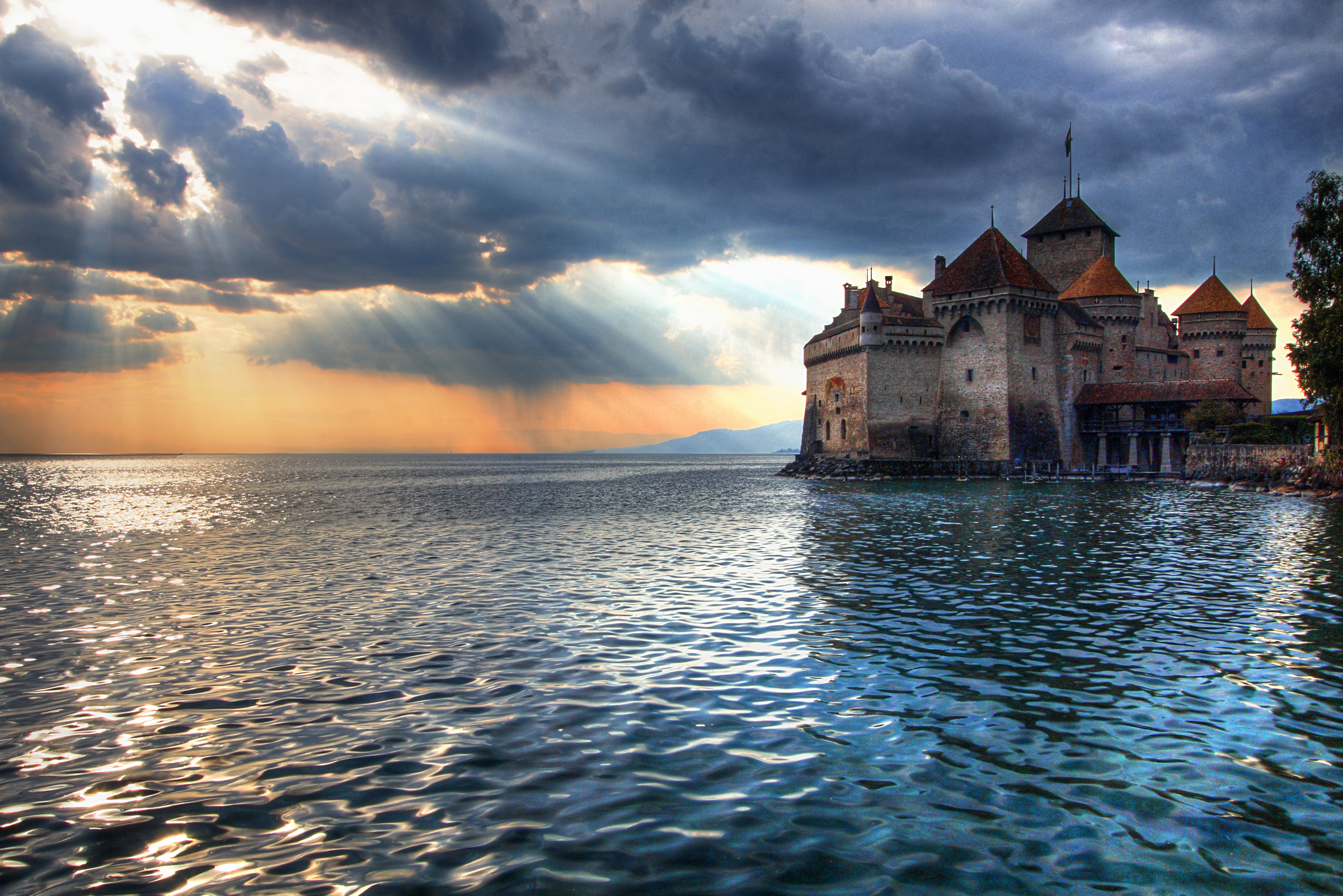
Castle of Chillon, on the shores of Lake Geneva.
Hotel Belvidere ~ Our windows at Grindelwald looked out upon the {Mittenberg} mountain and Unt glacier which descended close to us. It is a small but pretty collection of wooden houses, surrounded by mountains. The Wetterhorn Eiger, Mittenberg, and Wengern Alp all look very near. In fact, we seemed to be just under them. The Eiger is the most imposing at Grindelwald. It rises so like a needle of rock (as the Swiss call it) into the air. Its summit always clothed in ice and snow, from which the black rock shows itself in jagged points and ridges.
At ten o’clock this morning we took a carriage for Lauterbrunnen and Staubach on the way to Interlachen. The drive was a very pleasant one although it rained quite hard. The road winds between high mountains, but we could not see their summits on account of the clouds. The Staubach fall is about half a mile from Lauterbrunnen and this last place was about three miles out of our way. Still we thought it would be a shame not to see a fall so celebrated by Byron, Longfellow and other poets. At Lauterbrunnen we were forced to leave the carriage and walk under umbrellas though the wind to see this beautiful object. Our path was pointed out by the driver and after having pursued it for some time we asked a peasant to point out the fall and were told we had “just past it!” and there it was, a little meek stream trickling down from very high rocks; scarcely a teacup full of water. We had passed it without remarking it. I can however imagine its being very beautiful during the spring and summer when there is more water and of a bright day where the sun would tinge with rainbow hues the “lace veil” which the water is converted into before it reaches the earth by the action of the air. A little girl and boy seeing us staring at this “wonder work of God and Nature’s hand”! brought out an Alpine horn and sounded it there. The echo was wonderful. The air was instinct with the melody long after the instrument ceased. It is a long wooden pipe, perhaps five feet long and produces a very loud and at a distance a very melodious sound. We did not appreciate Longfellow’s fall or his chime of Bells at Bruges. The magnificent king Frau and {Monk} here rose just above us but we could not see them. We reached Interlachen at four o’clock, and after getting settled at the hotel I posted off to the “poste aux lettres” and received there a letter from Mother, our first since leaving Liverpool. Poor Alice had none and is in {} despair. Also a letter from Sidney Homer saying he would meet {} chain. In descending to Vivey we took out our Childe Harold and read the passages which have added if possible even more renown to Lake Geneva so celebrated in history, poetry, and painting. We remained for two hours at Vivey and then took a boat for Ville{men}, a little place just at the extreme end of the lake. The sail of course was delightful, the waters smooth and clear reflecting every cloud. On the other side of Vivey the shores are rather low and on the other, hills not very high just serve to shut off the view of the great mountain range behind them. The lake has no islands and is not in itself as beautiful as many of our own lakes. It cannot compare in beauty with Lake Lucerne although they can hardly be compared for one has the charms of wilderness, the other is all smiles and soft sunlit beauty. Vivey is far the handsomest Swiss city we have yet seen. The streets are wide, clean and well paved, the houses large and tasty.
Our hotel here is about a quarter or half mile from Villeneuve and quite near the Castle of Chillon. It looks much more like a gentleman’s country place than a hotel. The long avenue leading from the road to the door is shaded with high trees while a large flower garden behind, perfume in the air. English people often pass the summer here, for it is said to be a particularly healthy situation. We ordered dinner and then started the walk over a muddy road to the Castle. It is a fine looking old place, but not as picturesque as many of the Rhemish castles. Its chief interest to us consisted in the story with which Lord Byron has invested it – “the prisoner of Chillon.” The castle is of reddish stone. It is built at the waters edge so that its principal tower stands in the water. Just opposite it and quite near is the “little isle” on which the “prisoner” saw the sun beams play. It is a mere heap of stones not large enough to contain the trees spoken of. We were shown the dungeon where Bonivard was confined. The ring which had bound him to one of its stone pillars and the little path worn by his feet in the stone pavement, about three feed long, in a half circle, around the pillar showing the length of his chain. On a neighboring column Byron, Jean Jaque Rousseau, Eugene Sue, Victor Hugo, Richard Dana and others have inscribed their names. Why Dana’s name should be in such company I cannot conceive. The vaulted roof is supported by about seven of these columns. The dungeon though strong is not as gloomy and terrible as that of Baden. In one of the apartments we were shown a great slanting stone on which two thousand Jews had been strangled. In the torture room is still standing a beam to which offenders were fastened while fire was applied to the soles of their feet. The wood is still scorched. Here also is an “oubliette” A cross beam of an often used gibbet which stands or stood opposite an image of the Virgin. These relics should teach us to appreciate our days of law and order. “Chillon thy prison is a holy place and thy sad floor an altar.”
Friday, February 19, 2010
Wednesday, October 18th 1854 ~ Lungern
Hotel du Lion d’Or. ~ The fine weather lasted but a single day. This morning it rained quite hard again. We breakfasted early at Lucerne, packed our trunks and forwarded them by poste to Berne and at nine o’clock we took a boat with two rowers for Fahr. It is only a trip of two hours and a half and our boat was covered by an awning which kept off the rain nicely. At Fahr we took a carriage for Lungern, through Sarnen, Sachseln and over the mountain called the Kaiser Stuhl. The road conducts along the borders of the little lakes Sarnen and Lung, which lie cradled among high hills and much above the level of Lake Lucerne. It is a highly picturesque road. The hills above it and among which it winds are as high as to be (many of them) covered with snow. The Swiss valleys along it are beautiful. In them we saw more of the real Swiss cottages than we have seen elsewhere, with their covered balconies, one above the other. We arrived here at four o’clock and find our hotel very comfortable. Lungern is a peasants’ village, surrounded on all sides but one by hills and here the carriage road ceases. Two men followed our carriage for some distance, to be engaged for tomorrow.
Thursday, January 7, 2010
Thursday, October 12th 1854 ~ Kreutzstrasse, Switzerland
Hotel du Lion d’Or ~ The morning opened with fog rain and mud, but as we had arranged with a “witurier” to carry us on to Lucerne we started from Basle this morning at nine o’clock. Our carriage is very comfortable and roomy one, and our driver a person who speaks French seems quite honest and obliging. We have of course the entire carriage to ourselves. It rained pretty steadily all the morning and the country under those auspices did not seem particularly interesting. At half past two o’clock we dined at Buklen and at three were again “en route.” From there our drive was delightful; the clouds broke away just enough to enable us to see something of the road, but still resting on the tops of the highest hills, and occasionally forming rainbows of all colors. Just before reaching Olten the road conducts over a chain of hills, from which in fine weather a good view is obtained of the Alps, and then crosses the Aar at Aarburg. We are now à moitié chemin [halfway] to Lucerne. Our driver owns his carriage and horse, and seems to be a person quite well off. We should not forget that we are now again on republican soil, where every man is equal.
Wednesday, October 11th 1854 ~ Basle, Switzerland
Hotel du Laurage ~ I talked with some Frenchmen in the cars yesterday who gave me some very valuable information in relation to the charges on foreigners at the hotels. I found out from them that our bills were always higher than those of the natives, and obtained a list of charges for this section of country. I called on my bankers here last evening and obtained a little of the root of all evil. The post office is nearly opposite the hotel and no better are to be found. Of course we are very much disappointed for we have not heard since leaving London from home. We are now in Switzerland. Basle is just within the line. It is quite an uninteresting place, large but not possessing anything remarkable. The houses are very much in the same style as all those we have seen since leaving England, but occasionally we see one with a distinctive Swiss character. The day has been spent in making arrangements for a journey by carriage and looking out for a “return witurier.” That is a carriage which belongs to the part of country to which we want to go and which will therefore be lower in price than if we took a Basle carriage which would have to return here. We dined at five “à la carte” (by bill of fare) in private. After dinner bought a map and chose our course through Switzerland.
Saturday, January 2, 2010
Wednesday, September 27th 1854 ~ Ghent, Belgium
Hotel Royale ~ We breakfasted in London at half past six this morning and at seven took a carriage for the South Eastern railway, and at eight we were en route for the Continent. Hack hire in London is regulated according to distance, a hackman having a right to charge six pence for each mile if only two people ride, if more than two then an additional 6 d is charged for each additional person for the whole trip, not per mile. The miles of an English drive are always very short!! We have purchased tickets right through to Cologne and begin to feel quite like travelers. The ticket is given in a book of checks which the conductor tears off a leaf from, from time to time. An English Railway car is a very different thing from our own – they are long nearly as long as our own, but subdivided so that there are only two seats in each car, or rather in each partition. These seats run across and hold four persons each, so that four ride backward and four ride forward in stage coach fashion. The first class cars are nicely lined with cloth or leather and the seats and backs well stuffed, but the second class which are made just as well in every other respect have no cushions either for the back or seat and are therefore of course much more fatiguing. The third class are generally uncovered. Many gentlemen travel in the second class cars and sometimes ladies take them but not so often. The prices for second class in England is about the same as for first class at home. The ride to Dover is tolerably pleasant, but not as much as that from Liverpool to London. The country not as fine though having the same characteristics, until near Dover where it is more barren and where there are several long tunnels in which the road is carried through the chalk cliffs. Arriving at Dover at eleven o’clock we took the boat immediately for Calais. The water was perfectly smooth and although the boat was very small there was no motion. In two hours we landed in Calais and at halfway we could distinguish the land on either side. At first the French language sounded very strange and incomprehensible to us, but we are gradually getting accustomed to the sound and able to understand conversations. We walked to the custom hous and passport offices between a file of French soldiers in their brick red pants and blue coats. This is a great place for imposition on English and Americans where we experienced a small degree. We dined here and then took our place in the cars for Lille and Ghent. Between these two places by the way we came very near being left by the cars. For on crossing the frontier of Belgium I did not know what was going on and therefore did not get out and have any trunks opened and examined until just as the train was ready to start again and then they waited it for me some moments until a hasty custom house examination could be made. Our passports have been [visiid?] three times today, and it is a great nuisance, this being our first experience with a passport. The country here (France) has entirely a different appearance from that of England. There we saw generally beautiful meadowland divided by live hedges. Here one sees nothing but ploughed land. The houses are poorer, built mostly of stone or brick, and not picturesque, while men and women in queer costumes are working the ground. We arrived at Ghent at eight o’clock and were very much struck by its odd appearance in our drive to the hotel. The streets are narrow, entirely without sidewalks and paved with round stones. The houses are all tiled (at least the roofs of the houses) and this is entirely new to us. The tiles are made of red clay. Our rooms look out on a canal, one of several that run through the city.
Friday, January 1, 2010
Monday, September 25th 1854 ~ London

A horsedrawn "Handsome" carriage (Bettman archive).
London ~ This morning when the Doctor came he gave me permission to go out for a little drive, so Lizzie and myself got into a “Handsome” which is a one horse conveyance like a chaise except that there is a seat for a driver behind and above so that the reins pass over the chaise top, and the house (to those inside) seems to be without guidance. We saw the outside of St. James Palace of Buckingham Palace, drove around Hyde Park, St. James Park, saw “Temple bar” where the right of the Sovereign bows to the authority of the municipal authorities. Temple Bar was one of the gates of London and it still marks the terminus of the ancient city. It looks not unlike a small and somewhat defaced triumphal arch. The Dr. had forbidden me to breathe the atmosphere of the old city, so Temple Bar was an effectual bar to me. It seems a great pity. I should be thus laid up where there is so much to see, where every foot of ground, the name of every street recalls some story or history.
Subscribe to:
Posts (Atom)