Showing posts with label Waterloo. Show all posts

Sunday, January 3, 2010

Sunday, October 1st 1854 ~ Brussels, Belgium

A Canal near Brussels in 1871 Claude Monet
"A canal near Brussels in 1871" (C. Monet).

Hotel de l’Univers ~ We all went to an English chapel this morning and heard the service badly performed. After church I wandered about the city and saw the Place Royale in the centre of which is a beautiful equestrian statue in bronze of Godfrey of Bouillon of enormous size. This square is in the very best part of the city at the upper end of the Park. I walked around the Park, seeing in passing the Palais Royal, the Palais de la Nation and the Museum or Palais des Beaux Arts. This last I went into, but was unable to see anything but ordinary paintings. Those by Rubens and Van Dyck being closed for the season. The public buildings are large and handsome and the whole city wears an air of fite. It is clean, has nice, broad sidewalks, wide streets and a gay mirth seeking population. Brussels is said to imitate Paris closely, at least as closely as a place of this size can. All the shops are open today and many places of amusement which are open once each week. Even during the morning the shops were all open. Many English people come here to enconomize, so many that Brussels has ceased to be a cheap place to live in. The Park is truly beautiful. It is made into hill and dale, and ornamented with statuary. It is well shaded with large trees and contains several little ponds of water. There was one that took my fancy very much, with a grotto at one end and in it a reclining nymph. The whole shaded with high trees and the grounds about covered with the greenest grass. Brussels like Paris boasts here Boulevarts, which are long wide avenues shaded with trees, not paved, but macadamized. These were originally the top of the walls of the city, but as the city grew, they have in some places become almost its centre. The boulevards today are crowded with ladies and gentlemen showily drest, walking and driving. Young men in handsome military uniforms form a large part of the assemblage. The stately trees, the gay looking people, the bright uniforms, the foreign intonation, the military bands, makes this to me a scene of enchantment. This city is more lively and strikes me as more beautiful than London. In this fashionable part of the town each house is a palace. I past the house in which the Dutchess of Richmond gave a ball the night before the battle of Waterloo. “There was a sound of revelry by night.” This house is close to the great conservatory. One of the largest in Europe. The weather is fine, too warm for an overcoat, and the trees have not yet lost their verdure.

Saturday, January 2, 2010

Saturday, September 30th 1854 ~ Brussels, Belgium

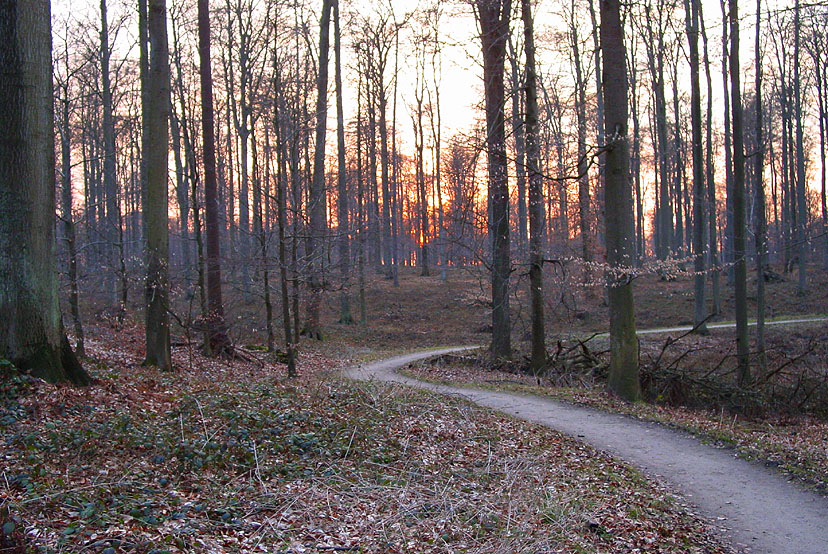
File:ForetDeSoignesSunset.jpg
The Sonian Forest or ForĂȘt de Soignes (photo: D. Edgar).

Hotel de L’Unions ~ We find we made a mistake in selecting our hotel. It is a good house celebrated for its table d’hote but in a bad location, not near the park and decidedly “down town”. Here, and indeed all through Germany, there are no double beds, two good sized single beds being invariably used instead. They have always full white curtains descending from a round head piece. The beds are low and in what we call the French style. I took the stage at ten o’clock this morning for Waterloo, leaving Lizzie and the girls to do some shopping for lace etc. in the city. The road to Waterloo is a very fine one, graded almost as well as one of our railways. The county, for the most part, would be considered uninteresting; but some parts of it are beautiful. The distance is thirteen miles and the road is paved with round stone all the way. It passes for several miles through the forest of Soigne and over it the British troops past on their way to the great battle field. This wood Lord Byron alludes to in the beautiful lines commencing “And Ardennes waves above them her green leaves, dewy with Natures tear drops as they pass.” Here the road is truly beautiful, the trees are immense and entirely shade it, and the wood is very thick. In all this level expanse of country there is not a fence or hedge or any other perceptible line to divide a man’s land from his neighbors’. The effect of this view of highly cultivated, unbroken prairie land is very fine, extending as it does, as far as the eye can reach. The field of Waterloo is only marked by a great mound of earth, on the top of which the Belgic lion, in bronze, puts his paw on a small marble world, and looks defiant. The ground the two armies occupied would not seem to give either a great advantage. It is merely a swelling meadow land. The little vale between the foes seems much too small to give either a great advantage. Wellington’s strength of position seems to have consisted entirely in having his extreme wings supported by the brick walls, which surrounded two old farm houses, so protected by clumps of trees that the French could not us their artillery against them and could not therefore get at the English from the rear on account of these temporary forts. They are called “Hougoumont” and “La Haye Sainte.” The walls of the Houngoumont are still standing and are all battered up on the outsides by musket balls fired at the loop holes. I stood upon the spot where Wellington gave his orders and to which the imperial gard almost penetrated during their final charge. The village is in plain sight, and about two miles distant, from which late in the afternoon the Prussians emerged. Our guide was an English officer of low grade who served under Wellington in the battle. He is a very smart fellow in that he does not boast of his courage but says he felt much relieved when his company were withdrawn from the fire. One cannot help feelings of sadness at the remembrance of the misery caused here and I believe we all left the place with subdued feelings and quiet faces. I got back to Brussels at four o’clock just in time for the table d’hote. Dinner in the French style. Nothing on the table, but dishes handed around, already carved and no two things placed on the same plate. Soup, corn beef, roast beef liver, fricandeau of veal larded, roast veal and baked pears, bread and cheese, jelly, pudding, pears, peaches etc. Each kind of meat constituted a separate course. The waiters are drest in black frock coats and white gloves and are generally gentlemanly looking young men speaking two or more languages.