Showing posts with label money. Show all posts

Wednesday, March 31, 2010

Friday, October 27th 1854 ~ Geneva

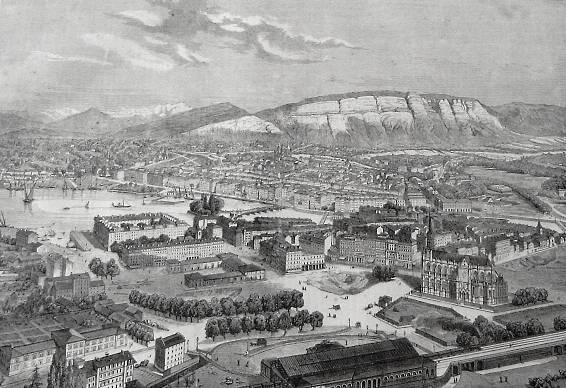
File:Geneve panorama 1860.JPG
Geneva, ca. 1860.

Hotel de l’Eau ~ This is indeed a beautiful city, clean, modern, and enjoyable. The houses are large and handsome – almost every second one bears the sign “horrologerie” (watchmaking). The watchmakers shops are large and handsome besides being thick as blackberries. Mount Blanc has not shown himself today. I passed the morning in shopping and have seen so many watches as perfectly to confuse me. I give the preference to two that I have seen. One for 280 francs ($56), a fine gold watch, lepine, or “echappement a cylindre” with eight holes in rubies. It is the quality sold in Boston for 75 or 80 dollars I think. The other is a compensated lever (“ichappement a l’ancre”) or half chronometer with fifteen holes in rubies, splendid workmanship, and costs 380 francs or 76 dollars. It would be worth in Boston from $125 to $150. On our arrival yesterday I posted off to the post office immediately and found a long and pleasant letter to me from Mother, one from Kitty to Lizzie, and several more indifferent ones. Alice had none and feels very badly. Poor girl, her last was received at London. We dined at four today on broiled chicken, dessert and “vin du pays.” The Swiss silver is much mingled with copper so that their size is large for value. Pieces of from 5 to 50 centimeters - 8 Francs, with gold Napoleon always {} Francs.

Thursday, January 7, 2010

Wednesday, October 11th 1854 ~ Basle, Switzerland

Hotel du Laurage ~ I talked with some Frenchmen in the cars yesterday who gave me some very valuable information in relation to the charges on foreigners at the hotels. I found out from them that our bills were always higher than those of the natives, and obtained a list of charges for this section of country. I called on my bankers here last evening and obtained a little of the root of all evil. The post office is nearly opposite the hotel and no better are to be found. Of course we are very much disappointed for we have not heard since leaving London from home. We are now in Switzerland. Basle is just within the line. It is quite an uninteresting place, large but not possessing anything remarkable. The houses are very much in the same style as all those we have seen since leaving England, but occasionally we see one with a distinctive Swiss character. The day has been spent in making arrangements for a journey by carriage and looking out for a “return witurier.” That is a carriage which belongs to the part of country to which we want to go and which will therefore be lower in price than if we took a Basle carriage which would have to return here. We dined at five “à la carte” (by bill of fare) in private. After dinner bought a map and chose our course through Switzerland.

Sunday, January 3, 2010

Monday, October 2nd 1854 ~ Cologne, Germany


"Cologne: Arrival of a packet ship: evening" (J. Turner).

Hotel Royale ~ We left Brussels this morning at half past six and arrived here at half past one, after an uninteresting ride of seven hours. The country in Belgium is highly cultivated, very fertile, thickly populated, and abounding picturesque villages. Our hotel turns out not to be the crack house. The Hotel de Hollande, next door, is better. This is however a good comfortable house and first class. Our windows look out on the waters of the Rhine and very beautiful they are, seen by moonlight. The steamers are at a wharf just under the window and the fridge of boats is only a few steps below. The city is dirty and mean looking and celebrated for its bad smells, while the river here is not as wide as the Hudson at Albany, and its banks are low and not picturesque. Cologne has no sidewalks and is a large bustling place. The streets are paved with round stone. Every second shop is a “Jean Marie Farina”! The currency changed again today and now we are handling Thalers, Groschen, and Pfennigs. The Prussian double headed Eagle covers us with her wings. The language is German, and English is about as much spoken as French here. A thaler is about 75 cts, a groschen about 2 ½ cts., and a pfennig about 1/5 of a cent. The custom house is strict but civil.

Friday, January 1, 2010

Tuesday, September 26th 1854 ~ London

File:St Paul's - the final design.jpg
St. Paul's Cathedral.

London ~ My physician called again this morning and told me I had better leave London as soon as possible and breathe a purer air and there in accordance been making preparations to leave tomorrow. Today we visited St. Pauls cathedral, one of the largest buildings in the world. It is cruciform and of stone which time has made of a reddish brown color. The outside of St. Pauls is far more imposing than the interior. It requires 20 minutes to half an hour for driving around it and gives one a fine idea of the greatest of architectural wonders of past centuries. One does not obtain as good an idea of it however as if it stood in an open space instead of being shut in and encompassed by narrow struts. The interior is of course very magnificent from its vast proportion but is devoid of ornament and is somewhat broken by columns so that the size does not take in all at once. The dome is enormous, its highest point is 350 feet above the pavement of the church. The building is well lighted and has not the solemn grandeur that a soft light united with such vastness must give. In the crypt lies the body of the Iron Duke. I changed some of my English gold for French today at h 86 Cheapside.

Thursday, December 24, 2009

Wednesday, September 20th 1854 ~ London


Pasture in Gumley, UK (photo: pdeee454 via flickr)

Miss Ayers boarding house, 29 George St Hanover Sq. ~ This is a boarding house in the American style, or at least it is called the American style but is in fact a poor imitation. She has a common parlor and charges by the week, but has a different price for brand varying with the size and situation of her rooms. This is a great place of resort for Americans who always prefer living together at a boarding house to living shut up in their own apartments at a hotel. At an English hotel a party of gentlemen and ladies are obliged to take a private parlor, in which they dine and from which they never emerge except to go to their bedrooms, or out of the house. There is no public saloon and no table (d’hote). Then the charges are made in accordance with each separate convenience or necessary one has. For instance – bedrooms so much, parlor so much, breakfast so much, tea so much, dinner so much, candles and fire are another charge. Even the dinner has no regular price, it depends upon what one orders. Being at a first class English hotel costs a party containing ladies from $3 to $6 per day each. $3 would be living with great economy. --- At half past nine this morning we started from Liverpool and reached London at half past four. We left our sea chests at the hotel in Liverpool, to be called for on our return there, in route for home. It is a great deal of extra trouble to carry much baggage in traveling abroad and a very great expense as well, for the allowance of baggage is very small to each person in public conveyances. In England it is about 60 pounds and in some places on the continent I believe every pound is charged for. We passed through an extremely beautiful country today and its is a beauty never seen with us- one arising from a state of high cultivation. The land is generally level, and almost all of it in grass, pasture or meadow, along this route, so that the effect is very beautiful. You ride for hours through a country covered with the greenest, cleanest looking grass, shaded with fine looking old trees. One almost imagines himself in a gentleman’s park for the whole distance. The houses of the cultivators are scarcely ever seen from the railroad – in a word it is a perfect garden scene, unlike anything one sees in America, where nature wild, beautiful, but uncultivated in this degree, invites labor and promise plenty. The white cows and droves of sheep look very picturesque. The depots have little flower gardens in front, are built in cottage style, and have neither the air of business or the cake and gingerbread look that ours have. Then English when they travel are not always eating cakes and pies. Both are almost unknown.
Wednesday, December 23, 2009

Monday, September 18, 1854 ~ Liverpool, U.K.

oil painting showing sailing ships tied at a busy dockside, with men and horses loading and unloading cargo.
Liverpool docks, ca. mid 1800's (painting by R. Dudley)

Queens Hotel ~ Captain Knowles dined with us yesterday at six o’clock. Prof. Treadwell* undertook to do the honors of the table. He ordered the dinner and had the general getting up of the whole affair. Dr. Gallup and Dr. Spooner dined also with us. We had a very fair dinner – an immense piece of roast beef in real English style, so large that it took my appetite away to look at it, but the Prof. did not provide properly in the way of wine, and before dinner was over we had to look at empty bottles, and no more was ordered. I should have taken the matter into my own hands, but did not do it. Thus far I have not been particularly pleased with the English, with whom we have come in contact. They have shown themselves somewhat extortioners and unjust in little ways, however we are still green, verdant in the ways of the old world. Professor Treadwell has been joking Dr. Gallup so much at the table and elsewhere about Alice, that the little gentleman has evidently been persuaded that he is in love. Unfortunately Alice at such times could not always refrain from a blush, which of course greatly encouraged the Dr. I fear we shall have some little trouble in getting rid of the fellow, or keeping him quiet. He is in many respects a fine man but this time “can not come in”. Our rooms are in the third story and look out on a large square, in which is the great St. Lawrence Hall just being finished; an immense stone building to be used (I believe) for municipal purposes. Most Americans go to Mrs. Blodget’s boarding house, we called there yesterday but it was full. The “Queens” is not the crack house, but it was the best we could get into yesterday, all are full. It is however first class and very comfortable. This morning I went dawn to the custom house with Prof Treadwell; there we met Capt Knowles and had our baggage passed with but a slight examination. Capt Knowles brought it in, with the emigrants and their effects on a steam tug. They are particular here in searching Americans for Segars and tobacco in every form, for there is a very high duty on it, $2.25 I think on every pound. By the way it is the custom for American ships to give a pound paper of chewing tobacco to the pilot when he boards them. The custom house are careful to see that no reprints of English books are brought into the country. I called on Brown and Shipley, and took a letter of credit on the London house. Received a delightful letter from Mother. Mr. and Mrs. Treadwell left today for the Chester and London also Dr Spooner. I presented letters of introduction to Chas Humbertson** and others. He wears a threadbare coat and is a plain enough man for one so well known.

--------------------
*Prof. Treadwell may be the inventor and Harvard professor Daniel Treadwell (1791-1892). He was a friend of Longfellow and the inventor of the first mechanized printing press and rope spinner!!

**A newspaper in Liverpool references Charles Humberston as a "commission merchant," which was also C.K. Cobb's trade at the time.