Showing posts with label children. Show all posts

Monday, March 29, 2010

Saturday, October 21th 1854 ~ Interlochen


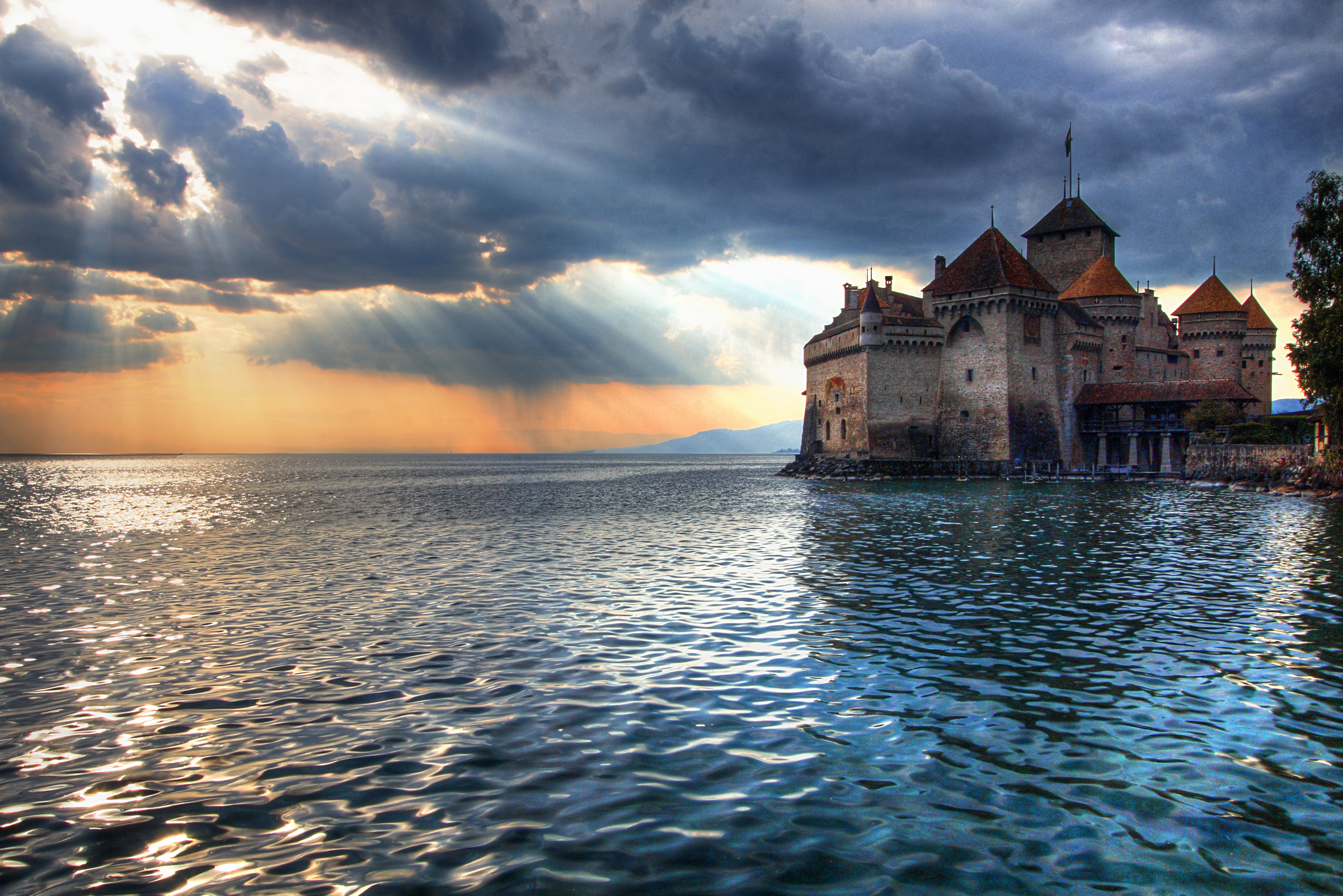
File:The Sun Sets on Château de Chillon.jpg
Castle of Chillon, on the shores of Lake Geneva.

Hotel Belvidere ~ Our windows at Grindelwald looked out upon the {Mittenberg} mountain and Unt glacier which descended close to us. It is a small but pretty collection of wooden houses, surrounded by mountains. The Wetterhorn Eiger, Mittenberg, and Wengern Alp all look very near. In fact, we seemed to be just under them. The Eiger is the most imposing at Grindelwald. It rises so like a needle of rock (as the Swiss call it) into the air. Its summit always clothed in ice and snow, from which the black rock shows itself in jagged points and ridges.

At ten o’clock this morning we took a carriage for Lauterbrunnen and Staubach on the way to Interlachen. The drive was a very pleasant one although it rained quite hard. The road winds between high mountains, but we could not see their summits on account of the clouds. The Staubach fall is about half a mile from Lauterbrunnen and this last place was about three miles out of our way. Still we thought it would be a shame not to see a fall so celebrated by Byron, Longfellow and other poets. At Lauterbrunnen we were forced to leave the carriage and walk under umbrellas though the wind to see this beautiful object. Our path was pointed out by the driver and after having pursued it for some time we asked a peasant to point out the fall and were told we had “just past it!” and there it was, a little meek stream trickling down from very high rocks; scarcely a teacup full of water. We had passed it without remarking it. I can however imagine its being very beautiful during the spring and summer when there is more water and of a bright day where the sun would tinge with rainbow hues the “lace veil” which the water is converted into before it reaches the earth by the action of the air. A little girl and boy seeing us staring at this “wonder work of God and Nature’s hand”! brought out an Alpine horn and sounded it there. The echo was wonderful. The air was instinct with the melody long after the instrument ceased. It is a long wooden pipe, perhaps five feet long and produces a very loud and at a distance a very melodious sound. We did not appreciate Longfellow’s fall or his chime of Bells at Bruges. The magnificent king Frau and {Monk} here rose just above us but we could not see them. We reached Interlachen at four o’clock, and after getting settled at the hotel I posted off to the “poste aux lettres” and received there a letter from Mother, our first since leaving Liverpool. Poor Alice had none and is in {} despair. Also a letter from Sidney Homer saying he would meet {} chain. In descending to Vivey we took out our Childe Harold and read the passages which have added if possible even more renown to Lake Geneva so celebrated in history, poetry, and painting. We remained for two hours at Vivey and then took a boat for Ville{men}, a little place just at the extreme end of the lake. The sail of course was delightful, the waters smooth and clear reflecting every cloud. On the other side of Vivey the shores are rather low and on the other, hills not very high just serve to shut off the view of the great mountain range behind them. The lake has no islands and is not in itself as beautiful as many of our own lakes. It cannot compare in beauty with Lake Lucerne although they can hardly be compared for one has the charms of wilderness, the other is all smiles and soft sunlit beauty. Vivey is far the handsomest Swiss city we have yet seen. The streets are wide, clean and well paved, the houses large and tasty.

Our hotel here is about a quarter or half mile from Villeneuve and quite near the Castle of Chillon. It looks much more like a gentleman’s country place than a hotel. The long avenue leading from the road to the door is shaded with high trees while a large flower garden behind, perfume in the air. English people often pass the summer here, for it is said to be a particularly healthy situation. We ordered dinner and then started the walk over a muddy road to the Castle. It is a fine looking old place, but not as picturesque as many of the Rhemish castles. Its chief interest to us consisted in the story with which Lord Byron has invested it – “the prisoner of Chillon.” The castle is of reddish stone. It is built at the waters edge so that its principal tower stands in the water. Just opposite it and quite near is the “little isle” on which the “prisoner” saw the sun beams play. It is a mere heap of stones not large enough to contain the trees spoken of. We were shown the dungeon where Bonivard was confined. The ring which had bound him to one of its stone pillars and the little path worn by his feet in the stone pavement, about three feed long, in a half circle, around the pillar showing the length of his chain. On a neighboring column Byron, Jean Jaque Rousseau, Eugene Sue, Victor Hugo, Richard Dana and others have inscribed their names. Why Dana’s name should be in such company I cannot conceive. The vaulted roof is supported by about seven of these columns. The dungeon though strong is not as gloomy and terrible as that of Baden. In one of the apartments we were shown a great slanting stone on which two thousand Jews had been strangled. In the torture room is still standing a beam to which offenders were fastened while fire was applied to the soles of their feet. The wood is still scorched. Here also is an “oubliette” A cross beam of an often used gibbet which stands or stood opposite an image of the Virgin. These relics should teach us to appreciate our days of law and order. “Chillon thy prison is a holy place and thy sad floor an altar.”

Thursday, January 7, 2010

Friday, October 13th 1854 ~ Lucerne, Switzerland


"The Lake of Lucerne: Mont Pilatus in the Distance" (1857) by J. Inchbold.

The morning was chilly, cold, and disagreeable, but promised to be more pleasant than yesterday. The sun peeped out at intervals and seemed to be making efforts to redeem the character of a Swiss autumn. We left Kreutzstrasse at half past eight this morning and arrived at Lucerne at four o’clock this afternoon. The country is generally level and does not possess much that would be interesting to old European travelers, but we were delighted with the picturesque dresses of the peasantry, the brown cows, eight harnessed to a plow. The peculiar houses, generally of wood, pretty at a distance but dirty and uncomfortable when closely inspected. The occasional ruins of castles each on its high rock, the pleasant manners of the peasants, who all touched their hats to us as we passed etc. Our road lay through Sursee and along the borders of the pretty little Lake Sempach. When our witurier stopt to find his horses at noon Lizzie and myself walked on, leavin the carriage to come up in an hours time. During our walk we met an old priest, drest in the rusty brown cloth frock of a monk, with a rope girdle. Around him were grouped a dozen children with whom he was talking. We joined him and in conversation he informed us that he no longer exercised the holy office. The reason why was apparent from the state of his breath. He was without a hat and had a rosary hung from his rope belt. On this road I first saw an English walnut tree. We stopt and partook of its fruit which some little boys were shaking down. One seems to see infinitely more of the country when walking and of the people. Indeed I think it is the only way to become well acquainted and enjoy a European country. If I could I should much prefer traversing Switzerland on foot. The peasants of the Northern and Eastern cantons speak bad German. In the neighborhood of Geneva the language is French, but not Parisian French. Our breakfasts since we have been in Switzerland have been peculiar. We have always honey, good butter, rich cream, French rolls or “petit pains” as they are called here. These “petit pains” are only found in the hotels, the Swiss bread tastes like our home made except that it is always a little acid and darker in color. Fresh eggs are plenty. Mutton chops are very nice here. As we approached Lucerne the country became more hilly as if to give us a foretaste of the glories to be revealed.

Monday, October 9th 1854 ~ Strasbourg, France

File:Hohenbaden hb.JPG
View from "Das alte Schloss," the Old Castle.

Hotel de la Ville de Paris ~ We left Baden at one o’clock this afternoon and arrived here at four by rail. The country is somewhat uninteresting but the cars are good and very comfortable. In the cars we met an English family who came also from Baden, the man a great fop and fool, the lady more sensible. They had lived so long in Germany that they spoke English with a decided accent. Their child (a little girl) was quite a prodigy. She was but five years old and spoke about equally well English, French, German, and Italian and all very well. Before leaving Baden this morning Lizzie and myself walked to “das neue Schloss” the present summer residence of the Dukes of Baden. This castle is rather a modern looking gothic building, founded in 1471 but which has built and demolished several times since, so that now only the foundation of the edifice remains. We were taken into the cellars by the castellan and found ourselves at a great depth in chambers hewn out of the solid rock on which the castle is placed. The first room we entered was a Roman bath, then followed a succession of cells, closed by doors of stone two feet thick, which led us into the judgment hall, where still are the stone seats of the judges of the secret tribunal. Out of this chamber opens a small room called the chamber of torture. Here stood the rack, rows of iron rings still remain in the walls, part of the paraphernalia of the dreadful apparatus. On one side of this room is a narrow passage terminated by an image of the Virgin. Just before reaching this image is a deep well called the “oubliette,” ninety feet deep, armed at the bottom by knives etc. and covered with a trap door. Along this passage the trembling victim is told to pass to kiss the image of the Virgin. Before he reaches it, the “oubliette” receives its victim. All these apartments are about 8 feet in height and perfectly dark, that is the light of day does not penetrate at all.


From these subterranean passages we again ascended to the realms of day, and visited the gorgeously furnished apartments of the Duke. These were the handsomest rooms we have thus far seen. The walls and ceiling are principally of oak, heavily carved and richly gilded. The floors of colored woods inlaid and highly polished, of course without carpets. In the state rooms were portraits of all the Dukes of Baden full length and in complete armor. The Protestant dukes on one side and the catholic on the other. From this chateau we ascended to “das alte Schloss,” a ruin on a high neighboring hill. Lizzie took an ass for the trip with a pretty little boy to lead him, while I went up on foot. The path wound through thick woods and was extremely pretty, to the old castle. This is a highly picturesque ruin which was the residence of the Dukes of Baden until somewhat more peaceful times, when they ventured down from their inaccessible cliff, to a strong castle below. The view from here is superb. At our feet is the beautiful little village of Baden, its tiled roofs glittering in the sunlight. To the west may be traced the course of the Rhine, in the distance looking like a thread of light in the green meadows. Behind us is seen the commencement of the great “black forest.” Beautiful walks wind through the woods.

Monday, January 4, 2010

Wednesday, October 4th 1854 ~ Koblenz, Germany


Drachenfels Castle as it looked in the 21st and 17th centuries (photo: S. Mense, engraving: M. Merian).

Hotel Du Géant ~ Last evening at six o’clock we left Cologne for Bonn by rail and past the night there. It is only one hours ride. Bonn is a lovely place, just upon the river, where it begins to be picturesque and commands a fine view of the seven hills, with the Drachenfells castle in the distance. We saw the river by moonlight last evening. Bonn is a fine looking city, looking somewhat like an American watering place, handsome houses, unpaved streets, large trees on either side etc. It contains a celebrated university in which Prince Albert was educated. The house is still shown there in which Bethoven was born. At ten o’clock we took an open carriage provided by our hotel and left Bonn en route up the river. The drive is delightful to Godesberg, a hill overlooking the river, crowned by a ruined castle built by one of the Archbishops of Cologne in the 13th century, on the site of a Roman fort. We made the ascent on Donkeys in about 15 minutes. Our donkeys were each led by little boys. The view from the top is magnificent, finer much than that from the Drachenfells. It is a hard scrambling ride but the view repays the trouble. Our little guides, when we arrived at the top, picked little bouquets for us, in hopes to increase their “drink geld.” The little asses seemed quite disproportionate to the load they bear. My feet almost touched the ground, on either side, when seated on one of them. They walk with great elasticity and force but do not like to trot. They seem to posses more sagacity than a horse and make a loud crying when displeased, which is very painful to unaccustomed ears. Continuing our drive up the river, we found we were traversing a road founded by Marcus Aurelius of Lucius Verus, 160 years after Christ. A few miles brought us to the foot of the Drachenfells, which we ascended on mules. The hill is very steep indeed and the road winds up through vineyards almost all the way. The ruined towers at the top and the view is not as fine as in many other places on the Rhine. Still it is beautiful. We took out Childe Harold and read the passages relating to this part of the river. At half past one we took a steamer and were soon sailing rapidly up the river, between very high and irregular banks. Just above Konigswinter on the opposite side rises a steep hill on which is the ruin of the castle of Rolandseck. The nephew of Charlemagne (Roland) built it to command a view of the convent where his betrothed had taken the veil. From a point a short distance above this the prospect is charming. One may see the ruins of the Drachenfells, Rolandseck Castle, on their separate heights and the convent below, besides several less important castellated summits. Farther up the river are the ruins of Hammerstein Castle, on a high rock just over the water. It was built in the 10th century and was besieged by the Swedes in the 30 years war. Still farther up we passed the white tower which marks the spot where Caesar crossed the Rhine when leading an army against the Sicambri and also where General Hoche crossed in 1797 in spite of the opposition of the Austrians. All these Rhemish hillsides are covered with grape vines which grow on terraces and which seem to be inaccessible to mortal foot. Many of these terraces are cut out of the solid rock and the soil has been carried up to them in baskits, on the heads of the peasants. The vines did not seem to us to add to the landscape as they are trained on straight poles only about four or five feet high, which appear merely like scrub bushes from the river below. We have been perfectly enchanted with our days voyaging. The Rhine is beautiful beyond description, more beautiful by far than the Hudson (setting aside the ruins) although there are some small portions of the Hudson that more than equal it in natural beauty. This part of the Rhine is narrower than the Hudson and the banks are far more precipitous, rocky, and the general scenery wilder. The white and red wines are very agreeable to one who is a little used to them. They are entirely without adulteration and admixture of alcohol here, that these wines always have in America and possess a purer taste. Lizzie and the girls do not like them because they are not accustomed to any acid wine. The price on board the Rhine boats is one franc to one and a half per bottle (20 to 30 cts). Last evening at Bonn we all went to a concert because Alice said she “wanted to hear some German music in a German land.” But the concert turned out to be only a four Tyrolian songs given by three or four natives in costume. It would have been decidedly common in America. The audience looked just as any well dressed one would in America. Thus far life seems much the same all over. At the hotels they always give us here a square pillow (about two feet square) stuffed with down as an extra covering. It is a very peculiar arrangement because it only covers half the body, and that only for half the night, for at the first turn it rolls off. We have not seen a double bed for a long while. We arrived this evening at Coblentz. Our rooms look out upon the river.