Showing posts with label Allen H. Knowles. Show all posts
Showing posts with label Allen H. Knowles. Show all posts
Thursday, December 24, 2009
Tuesday, September 19th 1854 ~ Liverpool, U.K.
Liverpool ~ The Doctor (Gallup) finally bid us good bye today and started for London. He had become, in his character of suitor to Alice, a little in the way. It would have been amusing to me, if I had not felt a little badly for him in his disappointment. We bought for him yesterday a cane with a compass in the top, a very odd affair, as a little memento of our friendship and voyage. He said goodbye to us just as we were getting into a carriage to take us to the railway for Chester, which ancient city we visited today in company with Capt Knowles. Starting at ten this morning and returning at seven o’clock in the evening – as soon as we arrived in Chester we went to a hotel and ordered dinner prepared at a certain hour and then walked out to see the place. This is the oldest town in England, or rather the oldest looking town- its walls are still perfect and most of their watch towers standing, all of course covered with moss and ivy. The walls cannot be over 12 feet high and have a very antique bow and arrow look. They extend completely around the city and upon them is a very pretty walk presenting picturesque views. This being the first walled town we have seen delights us much – the streets are narrow; the houses queer and old fashioned, and the people primitive looking for England. The chief object of interest in this place is the fine old cathedral, which with a few alterations since, was completed in the 12th century and is still perfect. It is a most venerable looking pile of blackened stone, weather worn on the outside and its carving much defaced. Like almost all catholic cathedrals it is cruciform – one enters by the (nave) which is empty and unadorned, except by a few plain marble tablets to the memory of men who died in the 18th century. From the end of the nave opens the Choir, which is beautifully fitted up for service. The lower part is lined with tier above tier of carved oak in gothic spires – the seats, or rather their arms, are also elaborately carved and this work is very curious. It was done in the middle ages and is taken from scriptural history. Of course the designs are somewhat rough and uncouth – one is the “root of Jesse, he is represented as an old man with a tail and to this tail are attached several other old men and women, his descendants in single file. Many feet above us and running around the building is a very narrow stone gallery – so narrow that two persons could not possibly walk abreast in it. It is arched and that so low that a man of the usual size cannot stand upright in it. Here, eight hundred years ago, in each of these arches, stood a veiled nun and chanted the Te Deum, in concert with the monks who were placed in a similar gallery just above this. The Captain became wedged in one of the passages and it was really several minutes before he could extricate himself. In the transepts are the “parish chapel”, the “chapter house”, school room and monks refectory. The transepts being thus divided up, break the cruciform appearance of the cathedral. In the chapter house are preserved some torn flags borne at Bunker Hill. In one of the passages a Norman crypt was pointed out to us, where many of the dignitaries of church and state in the times of the first English Normans were laid. We saw it through a grated window. In passing we noticed a monument about two feet high of stone and somewhat carved of an Abbot that landed in England with William the Conqueror – this is in one of the side isles. There are many monuments here that were much defaced in the time of Cromwell who made the cathedral a vast stable for his horses. We now returned to the hotel and dined, after dinner we returned and heard service here. The chanting was done by a choir of eleven boys of different sizes and it was very sweet indeed. They were all robed in white and looked very devotional and withal made a perfect picture standing in the midst of the gothic spires of dark oak, in this venerable and massive building. The shadows of a thousand years seemed looking down upon us. These sang sweetly and the whole service was most impressive. We walked to the barracks and on the wall of the city and then returned to Liverpool.


Wednesday, December 23, 2009
Saturday, September 16th 1854 ~ At sea
At sea ~ The weather is very misty. At three this morning we were off Tuskan light opposite Wexford, from there we ran in the fog to Holyhead reaching it at one this afternoon. The fog lifted just in time to show us its rocky shore, only a few hundred yard ahead of us, and this rather startling one, was the first glimpse we got of merry England! We are now only forty miles from Liverpool and we expected to be there today.
Soon after passing Holyhead the Liverpool pilot came onboard and informed us that he could only take us to the entrance of the harbor where we should have to “lay to” for the night the water being too low to admit of our crossing the bar until another tide. So here we are under easy sail to use up the time. We have been hailed lately by several pilot boats and some towboats. When the pilots see us on board, the usual salutation is, “how many feet have you got?” It appears it depends on the number of feet of water the vessel draws, what price can be claimed for pilotage. Captain Knowles is much relieved in being able to resign the charge of his vessel to the pilot. He is worn out with the toil and anxiety of directing the course through this fog.
Soon after passing Holyhead the Liverpool pilot came onboard and informed us that he could only take us to the entrance of the harbor where we should have to “lay to” for the night the water being too low to admit of our crossing the bar until another tide. So here we are under easy sail to use up the time. We have been hailed lately by several pilot boats and some towboats. When the pilots see us on board, the usual salutation is, “how many feet have you got?” It appears it depends on the number of feet of water the vessel draws, what price can be claimed for pilotage. Captain Knowles is much relieved in being able to resign the charge of his vessel to the pilot. He is worn out with the toil and anxiety of directing the course through this fog.
Tuesday, December 22, 2009
Tuesday, September 12, 1854 ~ At sea
At sea ~ We had a severe blow again last night, which kept poor Captain Knowles on deck nearly all night. He has but two hours sleep, this morning the wind is not as high but the weather still unsettled. The ship rolled so as almost to preclude sleep during the night, and everything not fastened was thrown about with much noise, for an example, Dr. Spooner’s trunk slid out of his state room crossed the cabin and was found in Professor Treadwell’s room in the morning. It was impossible to keep in one’s birth and escape hard knocks, without holding on. Mrs. Ashenden was much frightened and made her appearance in the Captain’s room at one o’clock, just as he had “turned in” for an hour, to know “if he thought we should live out the night.” She reminded him, he says, at that moment of the ship, on account of the “scantiness of the upper rigging.” Altogether we had quite a funny time! In the evening I fell asleep on a sofa, and during a heavy lurch, found myself seated on the floor, with all laughing at my confusion. The ship creaks as if every plank was being slowly dissevered from every other. We are directly before the wind and therefore do not feel the sea, as we should, if we were facing it, or had it on the beam, still it is very hard to keep one’s place whether seated or standing, even with our present experience. The waves are now really magnificent and we enjoy above all things standing on the deck and looking up to them. We are often in a vale from which high hills of water rising on either hand bound our view, and them mounting a sea, we have a view as from a mast heads. We have seen several school of porpoises about the ship, springing out of water in their gamols around us. “Mother Cary’s Chickens” are following us constantly, and we see many gulls. Time passes very fast and French and readings do not prosper well.
Monday, September 11, 1854 ~ At sea
A Sea ~ We had a severe gale in the night, which kept Captain Knowles up until daylight, our great ship was tossed about like a bubble and I confess I had no idea of a blow at sea until I heard the roar of the wind through the rigging last night. I went on deck at nine o’clock, and then it was so dark I could not see my own hand before my face, and the wind was so high that I couldn’t stand on the deck without holding on to some stationary object – it was from the Westward and we ran before it under double reefed topsails. All the cabin passengers slept in their clothes last night. As the storm was commencing a poor fellow, one of the steerage passengers, was dropt into his watery tomb, he died at five in the afternoon, and about eight the body was sewed up in its bedclothes and thus consigned to the sea. He was a Catholic and had friends on board who would have no service performed. We in the cabin did not hear of the death until all was over. This morning the wind blew hard, but the waves were not particularly high, owing to its having changed in the night. This morning we ran 70 miles along side of a large ship, bound for Liverpool, our relative positions in that run only changing a quarter of a mile. She is still this evening as near us as ever. Professor Treadwell and the Captain have been marking her progress by the compass. Captain Knowles informs us that he never knew such close sailing before. Our cabin is veneered on all sides beautifully, but when there is much motion it is really hard to make one’s self heard there, the creaking of the wood is so great. In a palace this cabin would make a perfect gem of a boudoir, but here it seems to us decidedly out of place. The walls are veneered throughout with mahogany inlaid with (white) satin wood, and the ceiling is handsomely gilded. It is painful to contemplate the possibility of its becoming in a few years the resort of a merry whalemans crew. To what base uses do we come at last! Mrs. Treadwell, and other ladies of the passengers are laying about the cabin floor again on mattresses, reading etc., the rough weather makes them feel a little inclined to be sick again. And how miserably they look!
Monday, December 21, 2009
Saturday, September 9th 1854 ~ At sea
At sea ~ Lizzie is quite unwell today, she has a bad headache and bilious attack. Alice is much better, after dinner she was able to leave her birth and go up on deck. Last night was very rough, but the wind just astern, and very high, so that we made at one time fourteen knots per hour. Capt. Knowles says he never made better time. The wind has been very strong all day and the sea much higher than we had before seen it, many of the waves swelling up as far as the top of the hurricane deck. I spent several hours looking over the stern at the hills and plains of water, they have today realized my idea of ocean waves. Everything not lashed is flying about the cabin floor. We made 260 miles from noon yesterday to noon today, and are now just halfway between Boston and Liverpool, having been out 14 days, could we proceed at this rate one week more would see us ashore. This afternoon we signalized a New York ship bound West and gave name.
Thursday, September 7th 1854 ~ At sea
At sea ~ Just a year ago today Lizzie was taken with her brain fever at Saven Hill. To what a train of recollections does this lead! The Captain started us from our slumbers this morning, by knocking at our state room door, and asking if we wanted to see a ship of war! Of course Lizzie and I were drest (after a fashion) in a moment, and on deck, and there in plain sight were two French frigates just astern, and near enough to read our name. They were under full sail and bound West, with colors flying. They looked splendidly, very unlike in rig and general appearance to merchantmen, the masts were straighter, “taughter”, firmer, more raking, and the hull less crank. We ran up our flag and passed without hindrance, but our neighbor the ship New York was less lucky. She was about a mile on the other side of us, but as she was a new ship and a little tardy about showing her colors, the Frenchman determined to over haul her. By this time we were both well ahead, so one of the French frigates rounded to and gave chase. Her yards were alive with men to effect this maneuver, crowd all sail etc. It was indeed a most beautiful sight. A stern chase is always a long one and so it proved in this instance for it was only after three hours of close sailing that the Yankee was overtaken and boarded. We had preserved the same relative distance between the pursuer and the pursued, but now of course we left our competitor behind, the result of the examination was favorable and she was soon allowed to proceed. This was a highly exciting scene and one I suppose that rarely falls to the lot of mere land-lubbers - the breeze was strong and the American ship laid down to it until her hull seemed nearly out of water, while the frigate maintained a perpendicular position. Every short time after the chase began the second frigate was lost in the distance. Alice is ill today was taken with cramp last night and has not been able to bear her birth. This afternoon the weather became thick and we are once more alone on the ocean.
Sunday, December 20, 2009
Wednesday, September 6th 1854 ~ At sea

A Whist Marker, used in the English card game "whist."
At Sea ~ Wind still from the East. We passed another Bark bound West this morning, and signalized her. There is very little sea today and we all are not only feeling well, but bright and in high spirits. My health seems to have improved already under the influence of the invigorating sea air. Dr. Gallup has made 36 pills for Lizzie, of monstrous size, all to be taken in four days! For general debility. She is about as well as usual and rather rebels at such a fare. Lizzie and Mary have begun writing home but as we have not yet reached the “banks”, there is but little chance of the letters being sent under two weeks.
About noon today we discovered a new ship on our lee quarter and have been racing with her all day. At present she is about two miles behind. She is about 2000 tons clipper built and Captain Knowles thinks she is the “New York”, on her first trip from N.Y. for Liverpool. If so she left N.Y. on the 25th one day before we left Boston. Which will reach England first? The Capt. Signalized her but she refuses to tell her name. We are both close hauled. We read today 11 weeks in Europe by Clark and had a game of whist in the evening.
Tuesday, September 5th 1854 ~ At sea
At sea ~ The wind is again light and poor Captain Knowles sees but a small chance of returning to the bosom of his family for a long while to come, it seems to make him quite blue. He says Lizzie reminds him so much of his wife but the only point of resemblance I can make out is that they are both very short. All the ladies aboard are quite in love with the Captain, with his manly face and gentlemanly bearing. I believe by the way it is quite the style at present to take a tender interest in any captain under whom one crosses the Atlantic (at least for the fair sex). Captain Knowles has some easily seen faults. His habits of command make him peremptory and overbearing toward inferiors and all those over whom he has any kind of authority. We had a polka on deck last evening to the music of the Doctor’s flute. This morning we passed a Hamburg bark, bound West, and were almost near enough to speak her, not quite, but as we signalized, we are in hopes of being reported on her arrival in America. We exchanged longitudes with her. The thermometer stands at 64 today and has ranged from 62 to 70 thus far on the voyage. We have now been out nine and a half days and have only made about seven hundred miles of our course. We breakfast at eight bells, dine at four bells and take tea at four bells. The table is a little dizzy feeling consequent upon holding onto your chair, balancing your plate etc., to say nothing of seeing the movable sack of glasses swinging over one’s head, all this is slightly unpleasant and will always remain so to me. At Breakfast we have coffee and tea, white bread, rye bread, boiled rye, ship and soda biscuit, beef steak, broiled salmon, pickled salmon, etc. At Dinner fish, roast duck, potted pigeons, meat pie, roast beef, stewed tomatoes, green corn, potatoes in all forms, Carolina potatoes, rice, plum pudding, squash pie, gooseberry pie, watermelon, cantaloupe, prunes, figs, nuts and raisins. This was today's dinner and is a fair specimen of all. We have for tea, bread as at breakfast, herrings, cold tongue, smoked beef, stewed prunes, preserved ginger, and Mrs. Venton’s best cake, all provisions either in the ice house or in exhausted-air cases and it is wonderful how fresh everything tastes even the cake seems as if just baked.
Monday, September 4th 1854 ~ At sea
At sea ~ The Captain came down to breakfast this morning in fine spirits, his good honest features beaming with pleasure for the wind is fair! And we are running due East. We were much frightened last evening by the cry “man overboard” but it was scarcely an instant before he caught a rope and was safely drawn up. He fell from a loft, struck off by the flapping of a sail. We had a squall at dinner time that carried away a spar.
Saturday, December 19, 2009
Wednesday, August 30th 1854 ~ At sea
At sea ~ This morning the wind is somewhat better but we are still further in the gulf stream and have made with our numerous tacks North and South but a very few miles of Easting. I shaved this morning for the first time since leaving home and left the upper lip. Capt. Knowles thinks I was seized with “mal de mer” just in time to check operations on that member. Lizzie and the girls are much better today, even Alice seems to have partially recovered. The Capt. and Dr. carried mattresses up on deck for their use, on which they have been reclining all day, watching the ever undulating plain around us and basking in the warm sun. It is surprising how a few days of sea sickness preys on the damask cheek and bleaches even the sweetest rose. Our ladies appear as if they had passed through a dangerous illness, all sentiment is famished and listless content the greatest good aimed at for the present. The moon has made her appearance and we are looking forward to a succession of fine moon light nights.
Friday, December 18, 2009
Tuesday, August 29th, 1854 ~ At sea

Painting: "The Chariot of Fame crossing the Atlantic from Liverpool to Boston" by M.J. Whitehead.
At sea ~ Lizzie and the girls are somewhat better today although it is still rough and the tin cups that hang to our births are in requisition sometimes. Capt. Knowles is in despair for the wind comes from the old quarter and we are much out of our course. We have seen a whale in the distance, but as yet no other fish. Time is divided into watches and bells – there are six watches in the 24 hours of 4 hours each, beginning at noon, at half past twelve the steersman strikes one bell, at one o’clock he strikes two bells, at half past strikes three, at two he strikes four bells, at half past, five bells and so on until four o’clock when the number of bells reaches eight. Here the second watch comes on, and the sublimity of the ocean does not strike me as I supposed it would were I out at sea. I am disappointed in the heighth of the ocean waves, they seem higher when one is seated on the rocks at Sahant or the beach at Newport – perhaps it is that the land is an obstacle that shows to advantage their force. Our great vessel looks smaller contrasted only with this vast expanse of water – and the effect of the waves upon her have ceased to cause wonder.
Monday, August 28th, 1854 ~ At sea

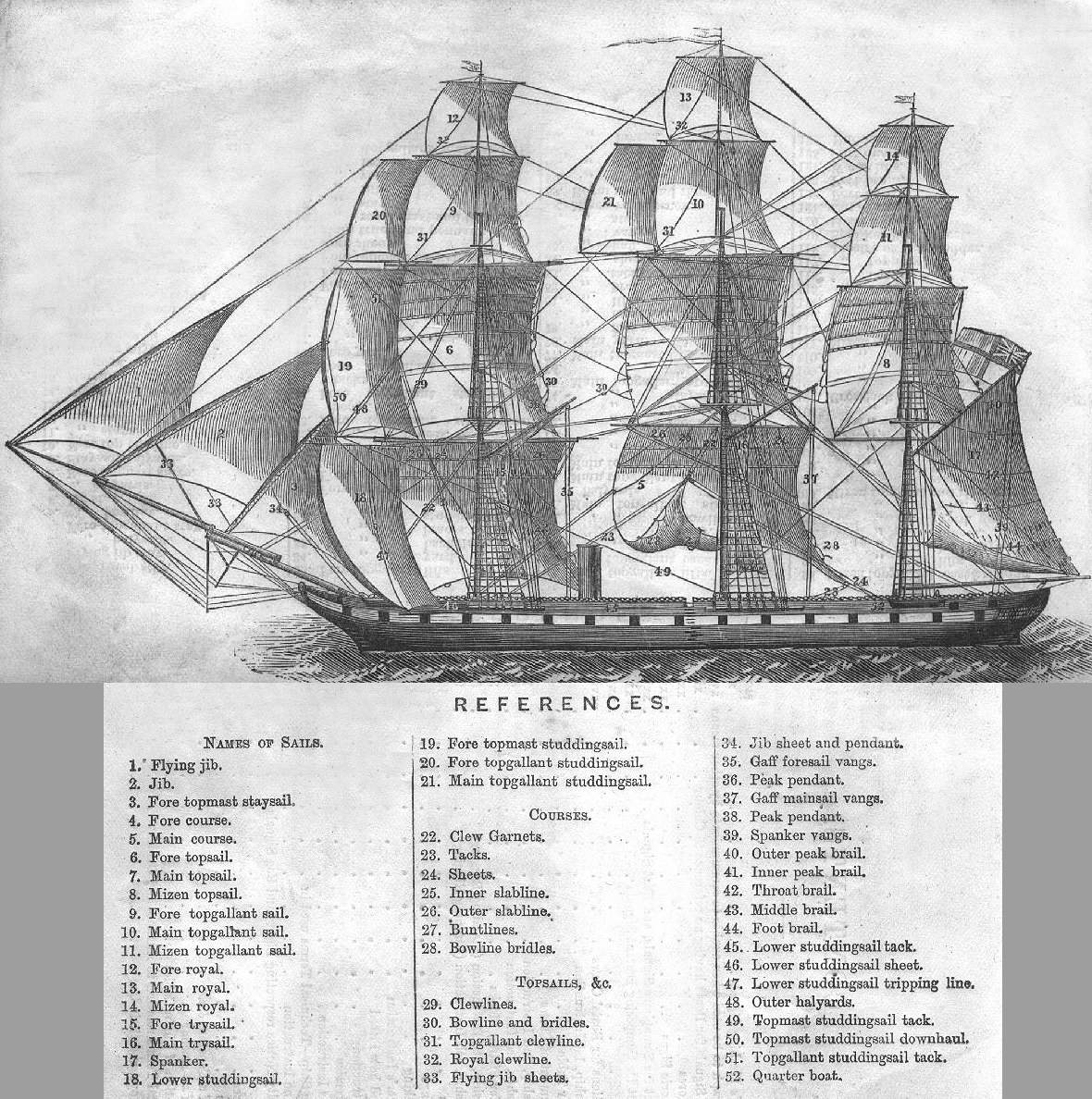
At sea ~ I slept well last night, and awoke this morning to find the wind as yesterday high and unfavorable. There is even more motion, the vessel moves fast but not in the right direction. I found it very difficult to dress but accomplished it by holding on to the fixtures of the state room. All our lady passengers are still sick, but Alice suffers more than any one else. We are getting into the gulf stream and see much floating sea weed about us, the air is damp and mild, so much so that an overcoat is uncomfortable. I am becoming quite well acquainted with the Captain, he is a tall large set man, quite good looking, and withal very much of a gentleman. He has a wife and family on Cape Cod and has evidently very strong domestic feelings, dislikes to leave his little wife, but as she is a bad sailor, he makes his voyage alone. I have learnt the names of the masts, the first forward is called the “fore-mast”, the second, the main-mast, the third the mizzen, the lower sail on each is called after it as main-sail, fore-sail, mizzen-sail. The second sail is the “top-sail” with the name of mast, as “fore top-sail” etc. The third is called the “top-gallant” with name of mast, the fourth is the “Royal.”
Sunday, August 27th, 1854 ~ At sea

Is Mother watching the weather at Saven Hill, or at Newport? It will be long before we can know.
Saturday, August 26, 1854 ~ Ship Chariot of Fame
The day is cloudy, the wind unfavorable, being light and from the North East, so that we are close hauled and moving slowly. We have 150 steerage passengers on board, most of them paupers sent home to
Subscribe to:
Posts (Atom)