Showing posts with label small boats. Show all posts
Showing posts with label small boats. Show all posts
Thursday, May 27, 2010
Saturday, November 4th 1854 ~ Milan
Hotel de Ville ~ We breakfasted this morning at Como and after much discussion we decided to make an excursion on the lake; so we took the little steamer at eight o’clock for Bellaggio arriving there after a delightful sail of an hour and a half. The lake is long and narrow, bounded by quite high hills on either hand, along the base of which are beautiful Italian villas in great profusion, with their terraced gardens still clothed in summer verdure. These villas are generally white square houses, having an air of wealth and elegance. The houses at Longwood resemble them very much. We have struck up an acquaintance with an English family aboard, a father, mother and grown up son, bu speedily found them, like all the other specimens of their race that we have met, reserved, uncommunicative, and purse-proud. They were talking continuously about their courier, their servants from England etc. etc. We left our shawls etc. at a hotel in the village and ascended a hill on which is placed the Villa Serbilloni, from the garden of which we obtained some magnificent views of the lake and surrounding country. Bellaggio is on a spur of land running into the lake so that here we had water on both sides, indeed all sides but one. This garden is a succession of terraces, which shelter almost tropical fruits and flowers. Here again we met the English party, the lady riding in a sedan chair carried by two men. We dined at Bellaggio and found the names of J.V.C. Smith {mayor of Boston} and party on the books. Mrs. Smith had written a warm commendation of the hotel, and had added a note in which she says that after having received the bill she found herself obliged take back all her previously expressed praise!! We left at two for Como again, and had to row off to the steamer in a little boat. There was considerable wind and the ladies of the party found a sad pleasure in looking over the side of the little boat! Arrived at Como we had just time to get our passport and baggage in order to take the six o’clock train for Milan. At the depot no one spoke a word of French or German and I was obliged to use signs. It is very disagreeable. The money is still francs (called by another name) and I know the Italian numbers, still it is hard work. The cars are good and the comfort of passengers well attended to. As we crossed the boundary line between Switzerland and Italy (the Alps), the language, manners, customs, as well as climate seemed to change in a moment. Our baggage was again examined on entering this city. Officials are plenty and very strict, but civil.


Tuesday, May 25, 2010
Friday, November 3rd 1854 ~ Como
Hotel de l’Angello ~ We took tea last evening at Domo d’Ossola last evening and then took the diligence again in route. There being none but night conveyances. The conductors and all the other officials were Italians; it was a crowded, uncomfortable conveyance. Mary was perhaps the greatest sufferer having if possible the worst seat. I slept well all night awaking only when horses were changed, or when someone came to the window and roused us all up to pay 5 centima (one cent) each for toll. We arrived at Barina on Lake Maggiore at five o’clock this morning and were dropt at the Hotel de la Poste before day break where we made ourselves comfortable with a good wood fire and a meat breakfast. About seven o’clock we took a row boat with two rowers and started out over the Lake for Laveno on the opposite side by the way of the Borromean Islands. It seemed very strange to us to be driving last night over a great level expanse after the mountainous country we have left. At half past eight we landed at Isola Bella having past by the other little islands of the group, Isola Pescatori, and Isola Madre. Isola Bella is square; rises in formal terraces from the water and is devoted to what was once a magnificient palace and a splendid garden. The garden is still a curious monument of Italian art and taste. It is in fact a great greenhouse, the greater part of it being covered in during the winter. We were shown through the upper rooms of the palace, which did not seem to us very remarkable. Napoleon lodged here at one time during his great Italian campaign and of course his bed room is still shown. Also a tree in the garden on which he cut with his knife the word “battaille” {“battle”}. We were carried down to the “grottoes” under the palace. They are quite handsome small rooms, with roofs, walls and floor of pebbles of different colors in mosaic patterns. Many of them open to the lake and some admitting its waters. In one of them Napoleon had dined previous to the battle of Marengo. We were shown all over the garden, we spent some time walking over its terraces, under lemon and orange trees, full of the ripe fruit, where the century plant grows wild and tropical vegetation flourishes in the open air and this within twelve hours ride of the Alpine snows, and eternal glacier, which by the way are in plain sight from these orange trees. From a little little distance it has a very square pyramidal appearance. The view over the lake is superb. The great Alps to the Northward, the smiling level lands of Italy on the south. At Isola Bella the American pine and the orange bloom almost side by side. At half past eight we started again in our boat for Laveno, reaching there at a little past ten. The moment we landed we were marched to the custom house and passport offices where we underwent quite a rigid examination, for we were within Austrian jurisdiction, perhaps the strictest government in Europe. Our boatmen were very extortionate in their charges and {Ienchnid} to resist so we had quite a quarrel and having lost the diligence were forced to take a very miserable voiturier, who at half way turned us over to another with an inferior carriage besides damaging our trunks by bad loading etc. etc. Our first impressions of Italians are not agreeable. The latter part of our drive was delightful. In it we saw our first Italian sunset which was superb; so mellow yet so brilliant. The country so level as almost to pain the eye, perfectly Italian in its characteristics, stretching in an unbroken surface as far as the eye can reach. We arrived at our hotel in Como at six o’clock this evening, having left our baggage in passing at the “Strada della Ferrata” (Railway) where no one spoke English. It is a little out of the city proper. Our driver knows no English or French, we no Italian, so had to make signs to him, which he obeys pretty well. All but the command to drive more quickly! Alice’s presto’s were useless.
Wednesday, March 31, 2010
Thursday, October 26th 1854 ~ Geneva

Mount Blanc.
Hotel de l’Eau ~ We became quite attached to the Hotel Byron. It was so neat orderly and pleasant. In fact I suppose it might be called a “pension” more than a hotel. We dined there yesterday as they had us table d’hote on broiled chicken, vin du pays, and dessert. At ten o’clock we took the little steamer at Villeneuve for Geneva. (Some palpitations about the Treadwells!) The lake struck us as beautiful but not remarkably so, for the end toward Villeneuve alone commands a view of the mountains and the shores elsewhere and low and ordinary looking. On the trip we made the acquaintance of the English ladies, residents of Vivey, going also to Geneva and to Italy afterward by the Mount Cenis. They cautioned us against the snows of the Semplon, the elder of the two having met with some accident there. We arrived here at three in the afternoon and were obliged to give up our passport on landing to a Swiss soldier on the g-way. Geneva is built around the bay so that its finest streets face the water and face Mt. Blanc in the distance looking over the lake. A great snow capt dome seems from here merely the highest of a high chain of mountains, nearly equal in majesty. The range must be superb from here in Summer for they are always white with snow.
Monday, March 29, 2010
Saturday, October 21th 1854 ~ Interlochen
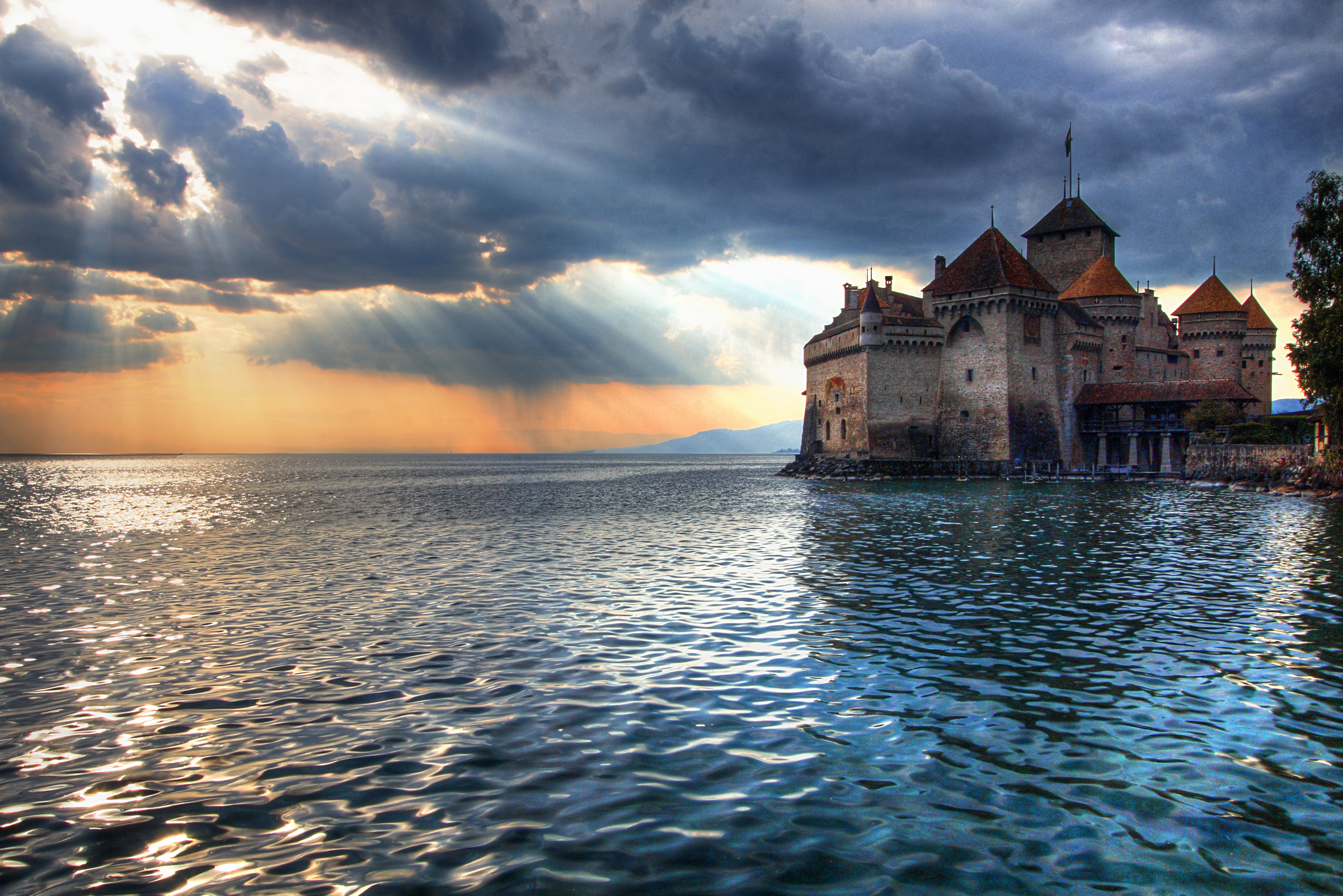
Castle of Chillon, on the shores of Lake Geneva.
Hotel Belvidere ~ Our windows at Grindelwald looked out upon the {Mittenberg} mountain and Unt glacier which descended close to us. It is a small but pretty collection of wooden houses, surrounded by mountains. The Wetterhorn Eiger, Mittenberg, and Wengern Alp all look very near. In fact, we seemed to be just under them. The Eiger is the most imposing at Grindelwald. It rises so like a needle of rock (as the Swiss call it) into the air. Its summit always clothed in ice and snow, from which the black rock shows itself in jagged points and ridges.
At ten o’clock this morning we took a carriage for Lauterbrunnen and Staubach on the way to Interlachen. The drive was a very pleasant one although it rained quite hard. The road winds between high mountains, but we could not see their summits on account of the clouds. The Staubach fall is about half a mile from Lauterbrunnen and this last place was about three miles out of our way. Still we thought it would be a shame not to see a fall so celebrated by Byron, Longfellow and other poets. At Lauterbrunnen we were forced to leave the carriage and walk under umbrellas though the wind to see this beautiful object. Our path was pointed out by the driver and after having pursued it for some time we asked a peasant to point out the fall and were told we had “just past it!” and there it was, a little meek stream trickling down from very high rocks; scarcely a teacup full of water. We had passed it without remarking it. I can however imagine its being very beautiful during the spring and summer when there is more water and of a bright day where the sun would tinge with rainbow hues the “lace veil” which the water is converted into before it reaches the earth by the action of the air. A little girl and boy seeing us staring at this “wonder work of God and Nature’s hand”! brought out an Alpine horn and sounded it there. The echo was wonderful. The air was instinct with the melody long after the instrument ceased. It is a long wooden pipe, perhaps five feet long and produces a very loud and at a distance a very melodious sound. We did not appreciate Longfellow’s fall or his chime of Bells at Bruges. The magnificent king Frau and {Monk} here rose just above us but we could not see them. We reached Interlachen at four o’clock, and after getting settled at the hotel I posted off to the “poste aux lettres” and received there a letter from Mother, our first since leaving Liverpool. Poor Alice had none and is in {} despair. Also a letter from Sidney Homer saying he would meet {} chain. In descending to Vivey we took out our Childe Harold and read the passages which have added if possible even more renown to Lake Geneva so celebrated in history, poetry, and painting. We remained for two hours at Vivey and then took a boat for Ville{men}, a little place just at the extreme end of the lake. The sail of course was delightful, the waters smooth and clear reflecting every cloud. On the other side of Vivey the shores are rather low and on the other, hills not very high just serve to shut off the view of the great mountain range behind them. The lake has no islands and is not in itself as beautiful as many of our own lakes. It cannot compare in beauty with Lake Lucerne although they can hardly be compared for one has the charms of wilderness, the other is all smiles and soft sunlit beauty. Vivey is far the handsomest Swiss city we have yet seen. The streets are wide, clean and well paved, the houses large and tasty.
Our hotel here is about a quarter or half mile from Villeneuve and quite near the Castle of Chillon. It looks much more like a gentleman’s country place than a hotel. The long avenue leading from the road to the door is shaded with high trees while a large flower garden behind, perfume in the air. English people often pass the summer here, for it is said to be a particularly healthy situation. We ordered dinner and then started the walk over a muddy road to the Castle. It is a fine looking old place, but not as picturesque as many of the Rhemish castles. Its chief interest to us consisted in the story with which Lord Byron has invested it – “the prisoner of Chillon.” The castle is of reddish stone. It is built at the waters edge so that its principal tower stands in the water. Just opposite it and quite near is the “little isle” on which the “prisoner” saw the sun beams play. It is a mere heap of stones not large enough to contain the trees spoken of. We were shown the dungeon where Bonivard was confined. The ring which had bound him to one of its stone pillars and the little path worn by his feet in the stone pavement, about three feed long, in a half circle, around the pillar showing the length of his chain. On a neighboring column Byron, Jean Jaque Rousseau, Eugene Sue, Victor Hugo, Richard Dana and others have inscribed their names. Why Dana’s name should be in such company I cannot conceive. The vaulted roof is supported by about seven of these columns. The dungeon though strong is not as gloomy and terrible as that of Baden. In one of the apartments we were shown a great slanting stone on which two thousand Jews had been strangled. In the torture room is still standing a beam to which offenders were fastened while fire was applied to the soles of their feet. The wood is still scorched. Here also is an “oubliette” A cross beam of an often used gibbet which stands or stood opposite an image of the Virgin. These relics should teach us to appreciate our days of law and order. “Chillon thy prison is a holy place and thy sad floor an altar.”
Sunday, February 14, 2010
Tuesday, October 17th 1854 ~ Lucerne

View from Mt. Rigi (Photo: P.R. Lloyd)
Hotel du Cygne ~ I awoke at four o’clock this morning and sprang out of bed with delight at the sight of the moonbeams on the floor; the stars were out and not a cloud in the sky. I could not get asleep again and at five the porter knocked at my door and announced the hour, with the cheering words “il fait bien tempis monsieur.” [“it’s about time sir.”] To us who had waited so long for this sound, that we might see one of the finest views of Switzerland, it was welcome indeed. At six o’clock, we were on our way to “Weggis”, in the little “beautean a vapiur,” from thence to ascend the Rigi. The morning was charming; the tops of the mountains were covered with freshly fallen snow, which was silvered by the rising beams of the sun. The mists of the Lake curled up from the water and hung in the fleecy clouds below the mountain summits, dyed by the sun in rainbow hues. The lake is very narrow and makes very picturesque windings between its high and verdant banks. I shall never forget this scene, the rainbow mist, the shadows of the clouds on lake and mountain, the verdure below and the snow above! One hours steaming brought us to Weggis, where we breakfasted and took horses for the ascent of the mountain. Each horse accompanied by a man to lead him. The path up was conducted along the side of the mountain and gave splendid views of the lake and adjoining mountains at every step. The soil was very fine and vegetation abounded, but as we advanced, it gradually became less fourishing until at the summit we rode through snow six inches deep. The Rigi is only 5600 feet high and therefore never takes snow in the summer. Still the change of temperature is very marked between it and the valley. Below we had summer weather (too warm for overcoats), above they were greatly needed. The view from the Rigi-kulen was magnificent beyond description. Looking Southward a mass of snow covered peaks met our gaze, rising into the air like waves of some polar sea charmed by the cold while in full careen. Among them our guides pointed out the Jung Frau, the Silberhorn, the Bright-horn, the Monk etc., some of the highest mountains in Europe. Looking north a great extent of level country is visible extending as far as the Lake of Zurich, whose waters we saw a shining surface set in green. There is a good hotel on the top of the Rigi, when we took a lunch of petit pains and butter with hot milk punch, a beverage our landlord had never heard of before. We rested there an hour, had a polka in the drawing room and then took up our winding way downwards. We often see clouds below us. The lake of Zug lies on the opposite side of the Rigi from Lake Lucerne, and from the summit both are distinctly seen [louing?] either base. There are half a dozen smaller lakes quite near and within sight. From here a steamer is scarcely seen on Lake Lucerne just at our feet. It is but a mooring spot on the waters and looks like a duck on a mill pond. The ascent of the Rigi requires about two hours and the decent about the same time. We got back to Weggis at four o’clock and there took a row boat back to Lucerne propelled by two strong men. We past in skirting the shore several small islands on one of which was a little chapel dedicated to the patron saint of row boats. A man has been perfectly haunting us this afternoon to allow him to travel with us as a servant and will not take no for an answer, but we do not want him. One great nuisance in traveling on the Continent is to have to wade the importunities of guides, servants, couriers etc. that one does not want…and such importunities!
Friday, January 8, 2010
Sunday, October 15th 1854, Lucerne, Switzerland

Lake Lucerne from Mt. Rigi (photo: J. Selby, cc).
Hotel du Cygne ~ Last evening Lizzie and myself took a row boat and made a little excursion on the Lake, I rowing, but the boat was heavy and the clouds too low to enable us to see anything of the mountains. Coming back we met a party of washerwomen, rowing themselves and their linen [Lumenards] and singing so merrily that it was quite delightful. A little steamer that makes the trip over the Lake and back lies just under our windows. The day has been cloudy and rainy part of the time. We however got a little sight of the top of the Rigi for the first time. There is no English chapel here, or rather none open at present, so after watching the peasants pass the hotel on their way to church, we followed them there (the cathedral is quite near us). The dress of the female peasants was a striped skirt reaching a little below the knee, a short white apron, basque looking like a boys jacket open in front, disclosing what old fashioned people call a stomacher of black velvet and tinsel, worn with a white under handkerchief pleated. The hair generally long, braided, and hanging down the back with ribbons on the ends. We had in the cathedral some quite fine orchestral music, or rather fine music with orchestral accompaniment. European cathedrals are never provided with fixed seats, but each person, on entering, calls for a chair which is provided upon the payment of a small fee. They are used more for kneeling on than for sitting, the back of the chair being as arranged as to make a very good desk or shelf for a prayer book. All these peasants looked very picturesquely kneeling with their faces to the Alter. After church we took a walk into the country choosing a road, running along the border of the Lake, but on the hill side. We walked several miles enjoying the beautiful scenery. On the road we past an old watch tower in ruins, and were drown by a sudden shower under the forties of a large and very dirty cottage. We could not persuade ourselves to enter its hallowed precincts, and after a time were forced to walk home with umbrellas up. Ours is not the first house and we regret having come to it. It is comfortable but small, has no table d’hote, so that we are obliged to dine in private. Today we had nothing but chicken and for dessert ‘compot’ of peaches. This afternoon read the church service at home. The Switzerhof is the name of the best house; this is the first class of course but not as good.
Tuesday, January 5, 2010
Thursday, October 5th 1854 ~ Mayence, Germany

Rhine view showing Mouse Tower and Ehrenfels ruin (anonymous, after 1840).
Hotel de l’Europe ~ This morning we obtained a splendid view of the river and its scenery from Coblentz, which I think is one of the most beautiful points. Almost directly above us, on the opposite side rose the strong fortress of Ehrenbreitstein, capable of holding one hundred thousand men. Its situation is highly picturesque, being an immense stone structure on an almost inaccessible rock. Murray calls it the fortress of Germany. This scenery is beyond all my conceptions. We left Coblentz at one o’clock this afternoon by boat and reached here about nine o’clock this evening. It has been a delightful sail to us, finer I think than between Bonn and Coblentz. The deck of the steamer was quite full of English with their red covered guide books and [sules] of shawls. Ruined castles greeted us at every turn, while nature itself is most charming, wild yet soft, grand yet beautiful. High hills bound the river continuously and every few moments we pass one crowned by a fortress, most of them in ruins but some still kept up. These old castles on steep rocks give a good history of the middle ages (perhaps better than books) when no man could trust his neighbor, all were at strife and only concurred in levying contributions on the peasantry, and on the trade of the country. This river being a great highway of communication it abounds with strong holds from whence, when might made right, the noble might levy contributions on all merchandise passing up and down the river. Perhaps the most striking point we have passed today is in the neighborhood of St. Goar. Close to the water on a little hill is the great fortress of Reinfels in ruins. Just above it on a steep rock is perched the “Castle of the Cat” and below on the river, in plain sight, is the beautiful ruin of the “Castle of the Mouse.” This seems like fairy land, every few moments shows us a ruin which has some romantic history and every bend of the river discloses new natural beauties. We were much struck by the appearance of two ruined castles within a stones throw of each other, on rival peaks, which once belonged to brothers, who had the misfortune to fall in love with the same “fair” lady and who for her sake fell by each others hands. The castles and even their respective hills are exactly alike. It was moonlight long before we arrived at Mayence so that we saw it streaming through the loopholes and broken walls of these feudal towers. By night it is more easy to picture them in their strength, “when they were young and proud and banners waved on high and battles passed below,” and to people them with the mail clad men to whose tread their walls of old resounded.
Sunday, January 3, 2010
Monday, October 2nd 1854 ~ Cologne, Germany

"Cologne: Arrival of a packet ship: evening" (J. Turner).
Hotel Royale ~ We left Brussels this morning at half past six and arrived here at half past one, after an uninteresting ride of seven hours. The country in Belgium is highly cultivated, very fertile, thickly populated, and abounding picturesque villages. Our hotel turns out not to be the crack house. The Hotel de Hollande, next door, is better. This is however a good comfortable house and first class. Our windows look out on the waters of the Rhine and very beautiful they are, seen by moonlight. The steamers are at a wharf just under the window and the fridge of boats is only a few steps below. The city is dirty and mean looking and celebrated for its bad smells, while the river here is not as wide as the Hudson at Albany, and its banks are low and not picturesque. Cologne has no sidewalks and is a large bustling place. The streets are paved with round stone. Every second shop is a “Jean Marie Farina”! The currency changed again today and now we are handling Thalers, Groschen, and Pfennigs. The Prussian double headed Eagle covers us with her wings. The language is German, and English is about as much spoken as French here. A thaler is about 75 cts, a groschen about 2 ½ cts., and a pfennig about 1/5 of a cent. The custom house is strict but civil.
Subscribe to:
Posts (Atom)