Showing posts with label local dress. Show all posts
Showing posts with label local dress. Show all posts
Thursday, May 27, 2010
Sunday, November 5th 1854 ~ Milan
Hotel de Ville ~ We find ourselves in a fine situation not far from the cathedral and the Imperial Palace. Today (there being no protestant church in the city) we attended the Catholic church “San Carlo Borromeo” and heard some very fine music there. It happened to be the day of this saint and a fine opera corps had been engaged for the occasion who supplied us with music that sounded anything but devotional. After services there we went over to the celebrated cathedral or “Duomo” and were delighted with its beauties and overcome with wonder at the {minute a dommient}. Its many long graceful gothic spires of stone recall in a measure Westminster Abbey. It is unfair for me to attempt its description. As a mere item however I may mention that the outside is adorned with two thousand statues, all in marble, the size of life or greater, in niches, at different heights. As a whole the cathedral is wonderful in its beauty and imposing in its proportions. I had often read descriptions and seen prints of it but never knew it as it is. Today all the shops are closed here, as much as in one of our own New England villages, but the city lacks that aspect of quiet; for the streets are crowded. Apple, cake, and candy venders abound. People peddling portraits of saints etc. etc. At four, Lizzie and myself took a walk out to the Porte Orientale to see the “belle-monde”. This fashionable thoroughfare was crowded with ladies and gentlemen handsomely drest, Austrian officers in their gay uniforms, handsome carriages , and single turnouts, each gentleman with his footman behind etc. A fine military band way playing in the square. We returned to a five o’clock table d’hote dinner as usual in the French style. In the evening we read the Episcopal service before a wood fire in our own room. When we entered the cars at Como for Milan, an official in uniform took away our passport and gave us a receipt for it on the back of which I found that unless I called at the police office in Milan within 24 hours I should subject myself to a fine and fourteen days imprisonment etc. The arrival at the gates of the city was the signal for the receipt being demanded and shown. We had not been in the hotel half an hour when a printed blanc was sent me to be filled up with my country, age, profession, wherefrom, destination, object in traveling etc. Tomorrow I must call at the police office in propria personae to verify the description and furthermore must wait upon the gentlemen every third day after, while I remain to report myself. A government loved at home and respected abroad!


Tuesday, May 25, 2010
Wednesday, November 1st 1854 ~ Brigue
Hotel des Trois Couronnes ~ This place seems to lie just at the end of the valley of the Rhone. Mountains enclose it on all sides but one, and here the river takes its first waters from the snows of the great mountains. Just above us towards the Semplon and its great road built by Napoleon. We passed last evening at Matigny in recounting our mutual adventures. The girls met in the diligence an old lady who was a great mineralogist having her collections for the day in a bag with her. She was English and going to the salt mines for Stalactites. Also, Mrs Edward Cathy an intimate friend of Mrs Gillebran, Miss Ropes that was etc., etc. They were treated with great consideration at the Hotel Byron and altogether had a most comfortable time. We left Matigny at three o’clock and arrived here at one at night. The diligence conductors wear a uniform consisting of a blue frock coat with brass buttons, standing collar and a blue cap. Both cap and coat have a bugle embroidered on them in gold to denote the postal service. The “cocher” wears a coat which would be a dress coat if the tails were double the size. This coat boasts scarlet collar and cuffs and is mounted with gilt bugle buttons. The hat is of glazed leather having a gold band and embroidered bugle. On our arrival here we went down into the kitchen and helped ourselves to some “potage” we found on the stove. It was the only comfortable place in the house.
Friday, January 8, 2010
Sunday, October 15th 1854, Lucerne, Switzerland

Lake Lucerne from Mt. Rigi (photo: J. Selby, cc).
Hotel du Cygne ~ Last evening Lizzie and myself took a row boat and made a little excursion on the Lake, I rowing, but the boat was heavy and the clouds too low to enable us to see anything of the mountains. Coming back we met a party of washerwomen, rowing themselves and their linen [Lumenards] and singing so merrily that it was quite delightful. A little steamer that makes the trip over the Lake and back lies just under our windows. The day has been cloudy and rainy part of the time. We however got a little sight of the top of the Rigi for the first time. There is no English chapel here, or rather none open at present, so after watching the peasants pass the hotel on their way to church, we followed them there (the cathedral is quite near us). The dress of the female peasants was a striped skirt reaching a little below the knee, a short white apron, basque looking like a boys jacket open in front, disclosing what old fashioned people call a stomacher of black velvet and tinsel, worn with a white under handkerchief pleated. The hair generally long, braided, and hanging down the back with ribbons on the ends. We had in the cathedral some quite fine orchestral music, or rather fine music with orchestral accompaniment. European cathedrals are never provided with fixed seats, but each person, on entering, calls for a chair which is provided upon the payment of a small fee. They are used more for kneeling on than for sitting, the back of the chair being as arranged as to make a very good desk or shelf for a prayer book. All these peasants looked very picturesquely kneeling with their faces to the Alter. After church we took a walk into the country choosing a road, running along the border of the Lake, but on the hill side. We walked several miles enjoying the beautiful scenery. On the road we past an old watch tower in ruins, and were drown by a sudden shower under the forties of a large and very dirty cottage. We could not persuade ourselves to enter its hallowed precincts, and after a time were forced to walk home with umbrellas up. Ours is not the first house and we regret having come to it. It is comfortable but small, has no table d’hote, so that we are obliged to dine in private. Today we had nothing but chicken and for dessert ‘compot’ of peaches. This afternoon read the church service at home. The Switzerhof is the name of the best house; this is the first class of course but not as good.
Thursday, January 7, 2010
Friday, October 13th 1854 ~ Lucerne, Switzerland

"The Lake of Lucerne: Mont Pilatus in the Distance" (1857) by J. Inchbold.
The morning was chilly, cold, and disagreeable, but promised to be more pleasant than yesterday. The sun peeped out at intervals and seemed to be making efforts to redeem the character of a Swiss autumn. We left Kreutzstrasse at half past eight this morning and arrived at Lucerne at four o’clock this afternoon. The country is generally level and does not possess much that would be interesting to old European travelers, but we were delighted with the picturesque dresses of the peasantry, the brown cows, eight harnessed to a plow. The peculiar houses, generally of wood, pretty at a distance but dirty and uncomfortable when closely inspected. The occasional ruins of castles each on its high rock, the pleasant manners of the peasants, who all touched their hats to us as we passed etc. Our road lay through Sursee and along the borders of the pretty little Lake Sempach. When our witurier stopt to find his horses at noon Lizzie and myself walked on, leavin the carriage to come up in an hours time. During our walk we met an old priest, drest in the rusty brown cloth frock of a monk, with a rope girdle. Around him were grouped a dozen children with whom he was talking. We joined him and in conversation he informed us that he no longer exercised the holy office. The reason why was apparent from the state of his breath. He was without a hat and had a rosary hung from his rope belt. On this road I first saw an English walnut tree. We stopt and partook of its fruit which some little boys were shaking down. One seems to see infinitely more of the country when walking and of the people. Indeed I think it is the only way to become well acquainted and enjoy a European country. If I could I should much prefer traversing Switzerland on foot. The peasants of the Northern and Eastern cantons speak bad German. In the neighborhood of Geneva the language is French, but not Parisian French. Our breakfasts since we have been in Switzerland have been peculiar. We have always honey, good butter, rich cream, French rolls or “petit pains” as they are called here. These “petit pains” are only found in the hotels, the Swiss bread tastes like our home made except that it is always a little acid and darker in color. Fresh eggs are plenty. Mutton chops are very nice here. As we approached Lucerne the country became more hilly as if to give us a foretaste of the glories to be revealed.
Sunday, January 3, 2010
Sunday, October 1st 1854 ~ Brussels, Belgium

"A canal near Brussels in 1871" (C. Monet).
Hotel de l’Univers ~ We all went to an English chapel this morning and heard the service badly performed. After church I wandered about the city and saw the Place Royale in the centre of which is a beautiful equestrian statue in bronze of Godfrey of Bouillon of enormous size. This square is in the very best part of the city at the upper end of the Park. I walked around the Park, seeing in passing the Palais Royal, the Palais de la Nation and the Museum or Palais des Beaux Arts. This last I went into, but was unable to see anything but ordinary paintings. Those by Rubens and Van Dyck being closed for the season. The public buildings are large and handsome and the whole city wears an air of fite. It is clean, has nice, broad sidewalks, wide streets and a gay mirth seeking population. Brussels is said to imitate Paris closely, at least as closely as a place of this size can. All the shops are open today and many places of amusement which are open once each week. Even during the morning the shops were all open. Many English people come here to enconomize, so many that Brussels has ceased to be a cheap place to live in. The Park is truly beautiful. It is made into hill and dale, and ornamented with statuary. It is well shaded with large trees and contains several little ponds of water. There was one that took my fancy very much, with a grotto at one end and in it a reclining nymph. The whole shaded with high trees and the grounds about covered with the greenest grass. Brussels like Paris boasts here Boulevarts, which are long wide avenues shaded with trees, not paved, but macadamized. These were originally the top of the walls of the city, but as the city grew, they have in some places become almost its centre. The boulevards today are crowded with ladies and gentlemen showily drest, walking and driving. Young men in handsome military uniforms form a large part of the assemblage. The stately trees, the gay looking people, the bright uniforms, the foreign intonation, the military bands, makes this to me a scene of enchantment. This city is more lively and strikes me as more beautiful than London. In this fashionable part of the town each house is a palace. I past the house in which the Dutchess of Richmond gave a ball the night before the battle of Waterloo. “There was a sound of revelry by night.” This house is close to the great conservatory. One of the largest in Europe. The weather is fine, too warm for an overcoat, and the trees have not yet lost their verdure.
Saturday, January 2, 2010
Saturday, September 30th 1854 ~ Brussels, Belgium
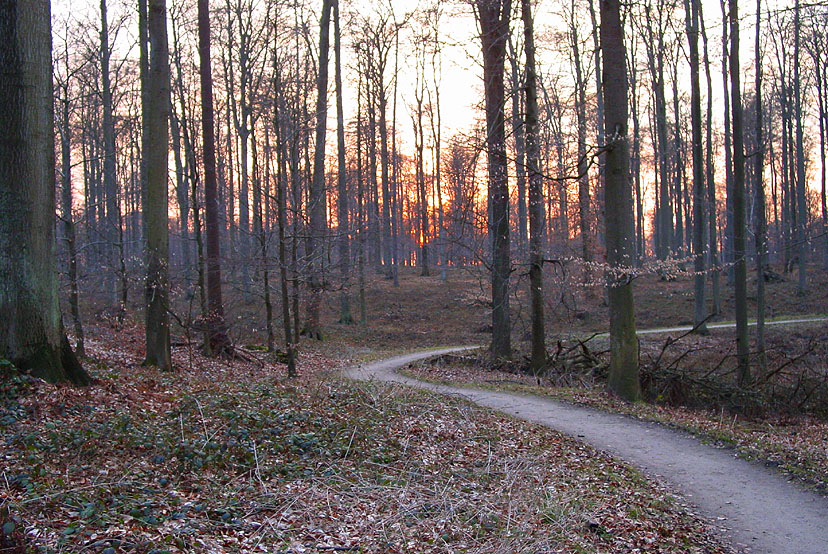
The Sonian Forest or Forêt de Soignes (photo: D. Edgar).
Hotel de L’Unions ~ We find we made a mistake in selecting our hotel. It is a good house celebrated for its table d’hote but in a bad location, not near the park and decidedly “down town”. Here, and indeed all through Germany, there are no double beds, two good sized single beds being invariably used instead. They have always full white curtains descending from a round head piece. The beds are low and in what we call the French style. I took the stage at ten o’clock this morning for Waterloo, leaving Lizzie and the girls to do some shopping for lace etc. in the city. The road to Waterloo is a very fine one, graded almost as well as one of our railways. The county, for the most part, would be considered uninteresting; but some parts of it are beautiful. The distance is thirteen miles and the road is paved with round stone all the way. It passes for several miles through the forest of Soigne and over it the British troops past on their way to the great battle field. This wood Lord Byron alludes to in the beautiful lines commencing “And Ardennes waves above them her green leaves, dewy with Natures tear drops as they pass.” Here the road is truly beautiful, the trees are immense and entirely shade it, and the wood is very thick. In all this level expanse of country there is not a fence or hedge or any other perceptible line to divide a man’s land from his neighbors’. The effect of this view of highly cultivated, unbroken prairie land is very fine, extending as it does, as far as the eye can reach. The field of Waterloo is only marked by a great mound of earth, on the top of which the Belgic lion, in bronze, puts his paw on a small marble world, and looks defiant. The ground the two armies occupied would not seem to give either a great advantage. It is merely a swelling meadow land. The little vale between the foes seems much too small to give either a great advantage. Wellington’s strength of position seems to have consisted entirely in having his extreme wings supported by the brick walls, which surrounded two old farm houses, so protected by clumps of trees that the French could not us their artillery against them and could not therefore get at the English from the rear on account of these temporary forts. They are called “Hougoumont” and “La Haye Sainte.” The walls of the Houngoumont are still standing and are all battered up on the outsides by musket balls fired at the loop holes. I stood upon the spot where Wellington gave his orders and to which the imperial gard almost penetrated during their final charge. The village is in plain sight, and about two miles distant, from which late in the afternoon the Prussians emerged. Our guide was an English officer of low grade who served under Wellington in the battle. He is a very smart fellow in that he does not boast of his courage but says he felt much relieved when his company were withdrawn from the fire. One cannot help feelings of sadness at the remembrance of the misery caused here and I believe we all left the place with subdued feelings and quiet faces. I got back to Brussels at four o’clock just in time for the table d’hote. Dinner in the French style. Nothing on the table, but dishes handed around, already carved and no two things placed on the same plate. Soup, corn beef, roast beef liver, fricandeau of veal larded, roast veal and baked pears, bread and cheese, jelly, pudding, pears, peaches etc. Each kind of meat constituted a separate course. The waiters are drest in black frock coats and white gloves and are generally gentlemanly looking young men speaking two or more languages.
Subscribe to:
Posts (Atom)