skip to main |
skip to sidebar
 Hotel de Ville ~ I began today’s labors by visiting the post office and found there a letter for Alice. The first she has had since leaving home. Of course, she is perfectly enchanted and has been clapping her hands and jumping about like a child with a new toy. I bought a hat this morning and the girls looked for bonnets. After this important business ended, we walked to the other end of the city following the lead of our friend Mr. Murray to see the celebrated painting in frescoe of Leonardo da Vinci “the last supper.” It is on the wall of the refectory of the Jesuit college Santa Maria delle Grazie, a tumble down old building of brick now used as a military barrack. The refectory itself is quite a large room, somewhat longer than it is broad and paved with brick. The painting occupies all one end of it, and is dropping off every year. Traces of the great master are still to be seen in its fading design and general conception, more than in any particular part. It has been repainted and thus greatly damaged several times and it is said that the faces of the Saviour and of Judas are the only ones which are at all perfect (whose expression has not been entirely changed by the repainting). The apostles are placed around a long table, and the scene is drawn at the moment when the servant Peter demands of his Lord “is it I?” Our Lord’s expression is most saintlike and is clothed with an almost unearthly spirituality and dignity. The faces of the group show their interest in the answer expected, and their innocence. The features of Judas are thrown a little in the shade, the better to produce a fiendish expression in which evil passions and cowardice are blended. His face alone does not ask “is it I” but retired from the light. The monks have cut a door through the lower part of the painting, thus taking off all the lower part of our Lord’s person. It’s study gave me a new idea of the effects attainable in painting. As we passed out, soldiers were practicing gymnastic exercises in front of their quarters. They had a rope suspended from the roof to the sidewalk, and were coming down on it head downwards, sitting on each other’s shoulders etc. These operations were superintended by an officer in uniform and apparently on duty. We then walked over to the castle where fifteen hundred or two thousand men were on parade, marching over the great square in front.Just at the end of this ground is the “Arco della Pace,” a very beautiful triumphal arch, modern, surmounted by bronze statues, chariot and horses and a group of figures about it. We dined at six, just after the table d’hote, and Lizzie was much incommoded by being stared at by an Englishman, who was lingering over his coffee.
Hotel de Ville ~ We find ourselves in a fine situation not far from the cathedral and the Imperial Palace. Today (there being no protestant church in the city) we attended the Catholic church “San Carlo Borromeo” and heard some very fine music there. It happened to be the day of this saint and a fine opera corps had been engaged for the occasion who supplied us with music that sounded anything but devotional. After services there we went over to the celebrated cathedral or “Duomo” and were delighted with its beauties and overcome with wonder at the {minute a dommient}. Its many long graceful gothic spires of stone recall in a measure Westminster Abbey. It is unfair for me to attempt its description. As a mere item however I may mention that the outside is adorned with two thousand statues, all in marble, the size of life or greater, in niches, at different heights. As a whole the cathedral is wonderful in its beauty and imposing in its proportions. I had often read descriptions and seen prints of it but never knew it as it is. Today all the shops are closed here, as much as in one of our own New England villages, but the city lacks that aspect of quiet; for the streets are crowded. Apple, cake, and candy venders abound. People peddling portraits of saints etc. etc. At four, Lizzie and myself took a walk out to the Porte Orientale to see the “belle-monde”. This fashionable thoroughfare was crowded with ladies and gentlemen handsomely drest, Austrian officers in their gay uniforms, handsome carriages , and single turnouts, each gentleman with his footman behind etc. A fine military band way playing in the square. We returned to a five o’clock table d’hote dinner as usual in the French style. In the evening we read the Episcopal service before a wood fire in our own room. When we entered the cars at Como for Milan, an official in uniform took away our passport and gave us a receipt for it on the back of which I found that unless I called at the police office in Milan within 24 hours I should subject myself to a fine and fourteen days imprisonment etc. The arrival at the gates of the city was the signal for the receipt being demanded and shown. We had not been in the hotel half an hour when a printed blanc was sent me to be filled up with my country, age, profession, wherefrom, destination, object in traveling etc. Tomorrow I must call at the police office in propria personae to verify the description and furthermore must wait upon the gentlemen every third day after, while I remain to report myself. A government loved at home and respected abroad!
Hotel de Londres ~ We were called at six and a half this morning and breakfasted at seven. After breakfast bid the girls good bye (I kissed Alice at parting) and started off for Sallenches. The idea was so ridiculous of our going in different directions that it put us into fine spirits. We left our trunks to the girls to take care of and at eight o’clock were comfortably seated in the coupé of the diligence and “en route.” This is the best seat. It is front, just under the driver and shut in with glass. It holds just three people and after the first two hours we had it all to ourselves. The early morning was misty so that we saw but little of the country. As we approached Sallenches the view became superb. The great chain of Mt. Blanc coming into sight, the sun gilding its summits and the mist rolling upward from the valley and creeping up the hill sides. At Sallenches, we obtained our second sight of Mt. Blanc (the first was from Geneva). We dined there and the dinner was miserable in the extreme, bad wine, bad meat, bad everything, cold room. It was market-day however and the costumes of the peasants in the great square were very pretty, standing before their booths, ornamented with ribands etc. We dined with a Polish Count and his sister, the widow of a Russian officer, and with them we took a carriage for Chamonix. They had been fellow travelers in the diligence from Geneva. By the way, on the road to Sallenches we met quantities of market people coming from and going to the fair with droves of cattle, shepherds carrying their little lambs and followed by the flock, droves of black pigs, carts of calves, in one a number of dead ones and one standing alive in their midst. The Polish Count was very deaf and did no talking but his sister did enough for both and in very glib French (which was her native tongue) and we had to keep our heads very clear to understand her rattle. She told us she had one son who was in the Russian army and to my question “how do you like the Russians and their rule” she answered with an expressive shrug “je suis Polonaise.” {I am Polish.} That told the whole story and seemed a history of a great nation’s wrongs. She seemed much interested in hearing about America and showed us by her questions that she had read much about us. The country between Sallenches and Chamonny is very beautiful. The road winds between the mountains, now ascending, now descending, passing through deep defiles, by rushing brooks and waterfalls and among snow capt hills. We had a drunken driver, who whirled us down the hills at a pace that threatened to shake the carriage to pieces; still we did not reach Chamonnix until eight o’clock. Our view as we drove through the vale of Chomonix by moonlight passes description. Mt. Blanc and his aiguilles on the one hand and lesser mountains on the other; in the half light they seemed supernaturally high and their glittering summits seemed as if cut out of solid silver. In many places they were so high that the moon rays did not reach us at all, but were arrested on the sides of the opposite mountains, daguerreotyping there the fantastic shapes of the great Alpine range. The road passes close to three arms of the great “mer de glace,” which descends from the summit of Mt. Blanc into the plain, wave upon wave of ice throwing back the moonlight. Just as the moon rose this evening the sun disappeared so that their rays were blended on the great white dome of Mt. Blanc, the moon rising over it, the sun’s last rays gulding it with rosy hues after they had for some time left us in the valley in the shades of night. Oh man, what are thy works compared with Natures wonders! We cannot help asking here “what is man that thou should’st be mindful of him! We took tea with our Polish friends and retired at midnight. We are the only people at the hotel which is about to be closed for the season.

Mount Blanc.
Hotel de l’Eau ~ We became quite attached to the Hotel Byron. It was so neat orderly and pleasant. In fact I suppose it might be called a “pension” more than a hotel. We dined there yesterday as they had us table d’hote on broiled chicken, vin du pays, and dessert. At ten o’clock we took the little steamer at Villeneuve for Geneva. (Some palpitations about the Treadwells!) The lake struck us as beautiful but not remarkably so, for the end toward Villeneuve alone commands a view of the mountains and the shores elsewhere and low and ordinary looking. On the trip we made the acquaintance of the English ladies, residents of Vivey, going also to Geneva and to Italy afterward by the Mount Cenis. They cautioned us against the snows of the Semplon, the elder of the two having met with some accident there. We arrived here at three in the afternoon and were obliged to give up our passport on landing to a Swiss soldier on the g-way. Geneva is built around the bay so that its finest streets face the water and face Mt. Blanc in the distance looking over the lake. A great snow capt dome seems from here merely the highest of a high chain of mountains, nearly equal in majesty. The range must be superb from here in Summer for they are always white with snow.

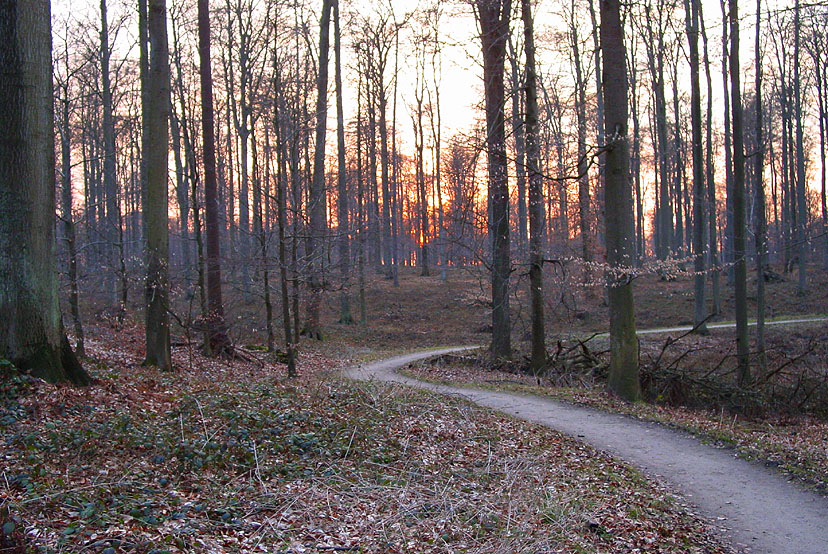
The Sonian Forest or
Forêt de Soignes (photo: D. Edgar).Hotel de L’Unions ~ We find we made a mistake in selecting our hotel. It is a good house celebrated for its table d’hote but in a bad location, not near the park and decidedly “down town”. Here, and indeed all through Germany, there are no double beds, two good sized single beds being invariably used instead. They have always full white curtains descending from a round head piece. The beds are low and in what we call the French style. I took the stage at ten o’clock this morning for Waterloo, leaving Lizzie and the girls to do some shopping for lace etc. in the city. The road to Waterloo is a very fine one, graded almost as well as one of our railways. The county, for the most part, would be considered uninteresting; but some parts of it are beautiful. The distance is thirteen miles and the road is paved with round stone all the way. It passes for several miles through the forest of Soigne and over it the British troops past on their way to the great battle field. This wood Lord Byron alludes to in the beautiful lines commencing “And Ardennes waves above them her green leaves, dewy with Natures tear drops as they pass.” Here the road is truly beautiful, the trees are immense and entirely shade it, and the wood is very thick. In all this level expanse of country there is not a fence or hedge or any other perceptible line to divide a man’s land from his neighbors’. The effect of this view of highly cultivated, unbroken prairie land is very fine, extending as it does, as far as the eye can reach. The field of Waterloo is only marked by a great mound of earth, on the top of which the Belgic lion, in bronze, puts his paw on a small marble world, and looks defiant. The ground the two armies occupied would not seem to give either a great advantage. It is merely a swelling meadow land. The little vale between the foes seems much too small to give either a great advantage. Wellington’s strength of position seems to have consisted entirely in having his extreme wings supported by the brick walls, which surrounded two old farm houses, so protected by clumps of trees that the French could not us their artillery against them and could not therefore get at the English from the rear on account of these temporary forts. They are called “Hougoumont” and “La Haye Sainte.” The walls of the Houngoumont are still standing and are all battered up on the outsides by musket balls fired at the loop holes. I stood upon the spot where Wellington gave his orders and to which the imperial gard almost penetrated during their final charge. The village is in plain sight, and about two miles distant, from which late in the afternoon the Prussians emerged. Our guide was an English officer of low grade who served under Wellington in the battle. He is a very smart fellow in that he does not boast of his courage but says he felt much relieved when his company were withdrawn from the fire. One cannot help feelings of sadness at the remembrance of the misery caused here and I believe we all left the place with subdued feelings and quiet faces. I got back to Brussels at four o’clock just in time for the table d’hote. Dinner in the French style. Nothing on the table, but dishes handed around, already carved and no two things placed on the same plate. Soup, corn beef, roast beef liver, fricandeau of veal larded, roast veal and baked pears, bread and cheese, jelly, pudding, pears, peaches etc. Each kind of meat constituted a separate course. The waiters are drest in black frock coats and white gloves and are generally gentlemanly looking young men speaking two or more languages.
Hotel Royale ~ We breakfasted early and started at nine o’clock to visit the celebrated cathedral ‘St. Bavous.” It was founded in 944 and is a fine type of the architecture of all this country during the middle ages. The inside is of white stone and the choir lined with black marble which of course presents a very strange appearance. Here Charles 5th was baptized - our guide pointed out the exact spot and showed us also the font in which the water stood. There were some (so called) fine paintings here by Rubens and Van Eyck but we did not appreciate them as much as we did the statuary on the sarcophagi. The figures of two bishops in marble reclining on their own graves seemed to us very beautiful. The perfect attitude of repose, natural position was wonderful one could almost see the marble breathe. We dined at the table d’hote at four o’clock and met there but four ladies. Almost all the guests were officers in uniform and it gave the table a very gay appearance. All drink wine. We saw scarcely a person at the table that had not his bottle. The wine are generally Rhemish. After dinner we drove to the “Marchi de Corseaux," saw the house where John of Gaunt was born. A very old looking building, narrow, and a story higher than its fellows.