Hotel de la Tour ~ We breakfasted at Chamonix this morning still with the Polish party and bid them goodbye at nine leaving them on their way to the Fligire, a mountain from which perhaps the best view of Mt. Blanc is to be had, while we started for this place over the “Tite-noire” and the “Val Orsini” on horses each having a guide to lead him. It was a clear bright day and all nature looked fresh and beautiful. Mt. Blanc from the village of Chamonix is in plain sight but looks lower than many of the other mountains because it is somewhat farther removed than they and it is only when the traveler reaches pretty high ground that the Monarch unveils his majesty and rises supreme, a great dom of snow. Our path conducted first through the Val d’Orsini, a narrow valley bounded on either side by sloping rocks, forming high shelving walls and looking like one of the sterile vales of the Arabian nights entertainments. All around us were great masses of jagged stone broken off and thrown here by the winters avalanches, many of them containing twenty and many sixty cubic feet. Between these, the mules picked their way, until the path began to ascend one of the hillsides; as it rose giving us views of the Alpine chain presided over by Mt. Blanc, unapproachable and vast, who here assumed his true rank. The road rising still, soon brought us to the “Tete Noire” which is the summit of the mountain, along whose side we had been creeping – rushing brooks from time to time appear forming beautiful cascades which are lost to view in the dark glens about us, or leaping down the precipice at our feet their voice is hushed in their distant landing. Looking down, the Swiss houses in the vale are reduced to the size of toy buildings in shop windows. Green meadows, little men and miniature cattle, sparkling brooks whose voices are lost in the distance. Now passing through a rock tunnel’d to receive the path we reached a little hotel closed to travelers for the season, but where we obtained some bread and wine and a pleasant parlor to rest in. Walking on, and leaving the mules and guides to follow, we wind through the woods on the top of the mountain picking wild flowers and obtaining beautiful views of nigh looking hillsides clothed in Autumnal verdure. A little further on the road descends and then ascends again and we recoup the frontier of Switzerland. Lizzie’s mule is the quickest walker so that she is in Switzerland while I remain’d in Savoy. A good natured gendarme came out and examined our passport and admired his own signature which allowed us to proceed.
From this point the guide pointed out the Silber-horn. The Jung Frau and before us the great valley of the Rhone almost as far as Brigue two days journey by diligence. The valley is bounded on either side by high hills between which the Rhone looks like a silver thread with the great road by its side running in a straight line through the green meadows. On the other side of the Rhone, rising above all lesser mountains, are the snowcapt mountains of the Bernese chain (which here we bid farewell to) and rich foliage of lesser mountains, makes a scene never to be forgotten. We walked a good part of the way down feeling badly at having bid farewell to our friends the Silber horn and Jung Frow, so beautiful in their majesty. We made friends with some peasants taking their flocks to Matigny which lies on the Rhone just at our feet in plain sight. Had quite a conversation with a peasant woman on her prospects. Lizzie’s guide gave her a history of his life, telling her he was still unmarried because his father wanted him to marry a rich girl that he did not like etc., etc. We found the girls already arrived when we reached the hotel in Matigny and a nice fire in rooms prepared for us. Our hostess’ first words to us were “il y a deux dames ici monsieur gui vous attend” {“there are two ladies waiting for you here, sir”} We were right glad to meet them safe and well.
Showing posts with label peasants. Show all posts
Showing posts with label peasants. Show all posts
Tuesday, May 25, 2010


Saturday, April 10, 2010
Monday, October 30th 1854 ~ Chamonix
Hotel de Londres ~ We were called at six and a half this morning and breakfasted at seven. After breakfast bid the girls good bye (I kissed Alice at parting) and started off for Sallenches. The idea was so ridiculous of our going in different directions that it put us into fine spirits. We left our trunks to the girls to take care of and at eight o’clock were comfortably seated in the coupé of the diligence and “en route.” This is the best seat. It is front, just under the driver and shut in with glass. It holds just three people and after the first two hours we had it all to ourselves. The early morning was misty so that we saw but little of the country. As we approached Sallenches the view became superb. The great chain of Mt. Blanc coming into sight, the sun gilding its summits and the mist rolling upward from the valley and creeping up the hill sides. At Sallenches, we obtained our second sight of Mt. Blanc (the first was from Geneva). We dined there and the dinner was miserable in the extreme, bad wine, bad meat, bad everything, cold room. It was market-day however and the costumes of the peasants in the great square were very pretty, standing before their booths, ornamented with ribands etc. We dined with a Polish Count and his sister, the widow of a Russian officer, and with them we took a carriage for Chamonix. They had been fellow travelers in the diligence from Geneva. By the way, on the road to Sallenches we met quantities of market people coming from and going to the fair with droves of cattle, shepherds carrying their little lambs and followed by the flock, droves of black pigs, carts of calves, in one a number of dead ones and one standing alive in their midst. The Polish Count was very deaf and did no talking but his sister did enough for both and in very glib French (which was her native tongue) and we had to keep our heads very clear to understand her rattle. She told us she had one son who was in the Russian army and to my question “how do you like the Russians and their rule” she answered with an expressive shrug “je suis Polonaise.” {I am Polish.} That told the whole story and seemed a history of a great nation’s wrongs. She seemed much interested in hearing about America and showed us by her questions that she had read much about us. The country between Sallenches and Chamonny is very beautiful. The road winds between the mountains, now ascending, now descending, passing through deep defiles, by rushing brooks and waterfalls and among snow capt hills. We had a drunken driver, who whirled us down the hills at a pace that threatened to shake the carriage to pieces; still we did not reach Chamonnix until eight o’clock. Our view as we drove through the vale of Chomonix by moonlight passes description. Mt. Blanc and his aiguilles on the one hand and lesser mountains on the other; in the half light they seemed supernaturally high and their glittering summits seemed as if cut out of solid silver. In many places they were so high that the moon rays did not reach us at all, but were arrested on the sides of the opposite mountains, daguerreotyping there the fantastic shapes of the great Alpine range. The road passes close to three arms of the great “mer de glace,” which descends from the summit of Mt. Blanc into the plain, wave upon wave of ice throwing back the moonlight. Just as the moon rose this evening the sun disappeared so that their rays were blended on the great white dome of Mt. Blanc, the moon rising over it, the sun’s last rays gulding it with rosy hues after they had for some time left us in the valley in the shades of night. Oh man, what are thy works compared with Natures wonders! We cannot help asking here “what is man that thou should’st be mindful of him! We took tea with our Polish friends and retired at midnight. We are the only people at the hotel which is about to be closed for the season.
Friday, February 19, 2010
Wednesday, October 18th 1854 ~ Lungern
Hotel du Lion d’Or. ~ The fine weather lasted but a single day. This morning it rained quite hard again. We breakfasted early at Lucerne, packed our trunks and forwarded them by poste to Berne and at nine o’clock we took a boat with two rowers for Fahr. It is only a trip of two hours and a half and our boat was covered by an awning which kept off the rain nicely. At Fahr we took a carriage for Lungern, through Sarnen, Sachseln and over the mountain called the Kaiser Stuhl. The road conducts along the borders of the little lakes Sarnen and Lung, which lie cradled among high hills and much above the level of Lake Lucerne. It is a highly picturesque road. The hills above it and among which it winds are as high as to be (many of them) covered with snow. The Swiss valleys along it are beautiful. In them we saw more of the real Swiss cottages than we have seen elsewhere, with their covered balconies, one above the other. We arrived here at four o’clock and find our hotel very comfortable. Lungern is a peasants’ village, surrounded on all sides but one by hills and here the carriage road ceases. Two men followed our carriage for some distance, to be engaged for tomorrow.
Friday, January 8, 2010
Monday, October 16th 1854 ~ Lucerne

Lucerne, Switzerland.
Hotel du Cygne ~ The morning opened gloomily enough with rain and cloud, but at noon it cleared up a little, the wind changed and dispersed the lower clouds, so that we obtained a fine view of Mount Pilatus and Rigi, their summits covered with a snowy mantle. Mt. Pilatus is the higher of the two, but is not often ascended. It is almost a perpendicular rock, in the crevices of which the snow contrasts beautifully with the dark stone of the more exposed parts. One of the finest points of view from mountain tops in all Switzerland is that on the top of the Rigi. Oh for the sun once more to enable us to enjoy it! This afternoon we all took a row upon the lake. We dined at five and ~ half and drank John’s health and happiness for it is his birthday. During our walks we meet rough wooden crosses very often, set up by the side of the public roads, in passing which the peasants cross themselves with much apparent feeling. It seems to me very proper thus to remind men during their daily avocations of the employments of Eternity.
Sunday, October 15th 1854, Lucerne, Switzerland

Lake Lucerne from Mt. Rigi (photo: J. Selby, cc).
Hotel du Cygne ~ Last evening Lizzie and myself took a row boat and made a little excursion on the Lake, I rowing, but the boat was heavy and the clouds too low to enable us to see anything of the mountains. Coming back we met a party of washerwomen, rowing themselves and their linen [Lumenards] and singing so merrily that it was quite delightful. A little steamer that makes the trip over the Lake and back lies just under our windows. The day has been cloudy and rainy part of the time. We however got a little sight of the top of the Rigi for the first time. There is no English chapel here, or rather none open at present, so after watching the peasants pass the hotel on their way to church, we followed them there (the cathedral is quite near us). The dress of the female peasants was a striped skirt reaching a little below the knee, a short white apron, basque looking like a boys jacket open in front, disclosing what old fashioned people call a stomacher of black velvet and tinsel, worn with a white under handkerchief pleated. The hair generally long, braided, and hanging down the back with ribbons on the ends. We had in the cathedral some quite fine orchestral music, or rather fine music with orchestral accompaniment. European cathedrals are never provided with fixed seats, but each person, on entering, calls for a chair which is provided upon the payment of a small fee. They are used more for kneeling on than for sitting, the back of the chair being as arranged as to make a very good desk or shelf for a prayer book. All these peasants looked very picturesquely kneeling with their faces to the Alter. After church we took a walk into the country choosing a road, running along the border of the Lake, but on the hill side. We walked several miles enjoying the beautiful scenery. On the road we past an old watch tower in ruins, and were drown by a sudden shower under the forties of a large and very dirty cottage. We could not persuade ourselves to enter its hallowed precincts, and after a time were forced to walk home with umbrellas up. Ours is not the first house and we regret having come to it. It is comfortable but small, has no table d’hote, so that we are obliged to dine in private. Today we had nothing but chicken and for dessert ‘compot’ of peaches. This afternoon read the church service at home. The Switzerhof is the name of the best house; this is the first class of course but not as good.
Thursday, January 7, 2010
Friday, October 13th 1854 ~ Lucerne, Switzerland

"The Lake of Lucerne: Mont Pilatus in the Distance" (1857) by J. Inchbold.
The morning was chilly, cold, and disagreeable, but promised to be more pleasant than yesterday. The sun peeped out at intervals and seemed to be making efforts to redeem the character of a Swiss autumn. We left Kreutzstrasse at half past eight this morning and arrived at Lucerne at four o’clock this afternoon. The country is generally level and does not possess much that would be interesting to old European travelers, but we were delighted with the picturesque dresses of the peasantry, the brown cows, eight harnessed to a plow. The peculiar houses, generally of wood, pretty at a distance but dirty and uncomfortable when closely inspected. The occasional ruins of castles each on its high rock, the pleasant manners of the peasants, who all touched their hats to us as we passed etc. Our road lay through Sursee and along the borders of the pretty little Lake Sempach. When our witurier stopt to find his horses at noon Lizzie and myself walked on, leavin the carriage to come up in an hours time. During our walk we met an old priest, drest in the rusty brown cloth frock of a monk, with a rope girdle. Around him were grouped a dozen children with whom he was talking. We joined him and in conversation he informed us that he no longer exercised the holy office. The reason why was apparent from the state of his breath. He was without a hat and had a rosary hung from his rope belt. On this road I first saw an English walnut tree. We stopt and partook of its fruit which some little boys were shaking down. One seems to see infinitely more of the country when walking and of the people. Indeed I think it is the only way to become well acquainted and enjoy a European country. If I could I should much prefer traversing Switzerland on foot. The peasants of the Northern and Eastern cantons speak bad German. In the neighborhood of Geneva the language is French, but not Parisian French. Our breakfasts since we have been in Switzerland have been peculiar. We have always honey, good butter, rich cream, French rolls or “petit pains” as they are called here. These “petit pains” are only found in the hotels, the Swiss bread tastes like our home made except that it is always a little acid and darker in color. Fresh eggs are plenty. Mutton chops are very nice here. As we approached Lucerne the country became more hilly as if to give us a foretaste of the glories to be revealed.
Wednesday, January 6, 2010
Friday, October 6th 1854 ~ Frankfurt, Germany
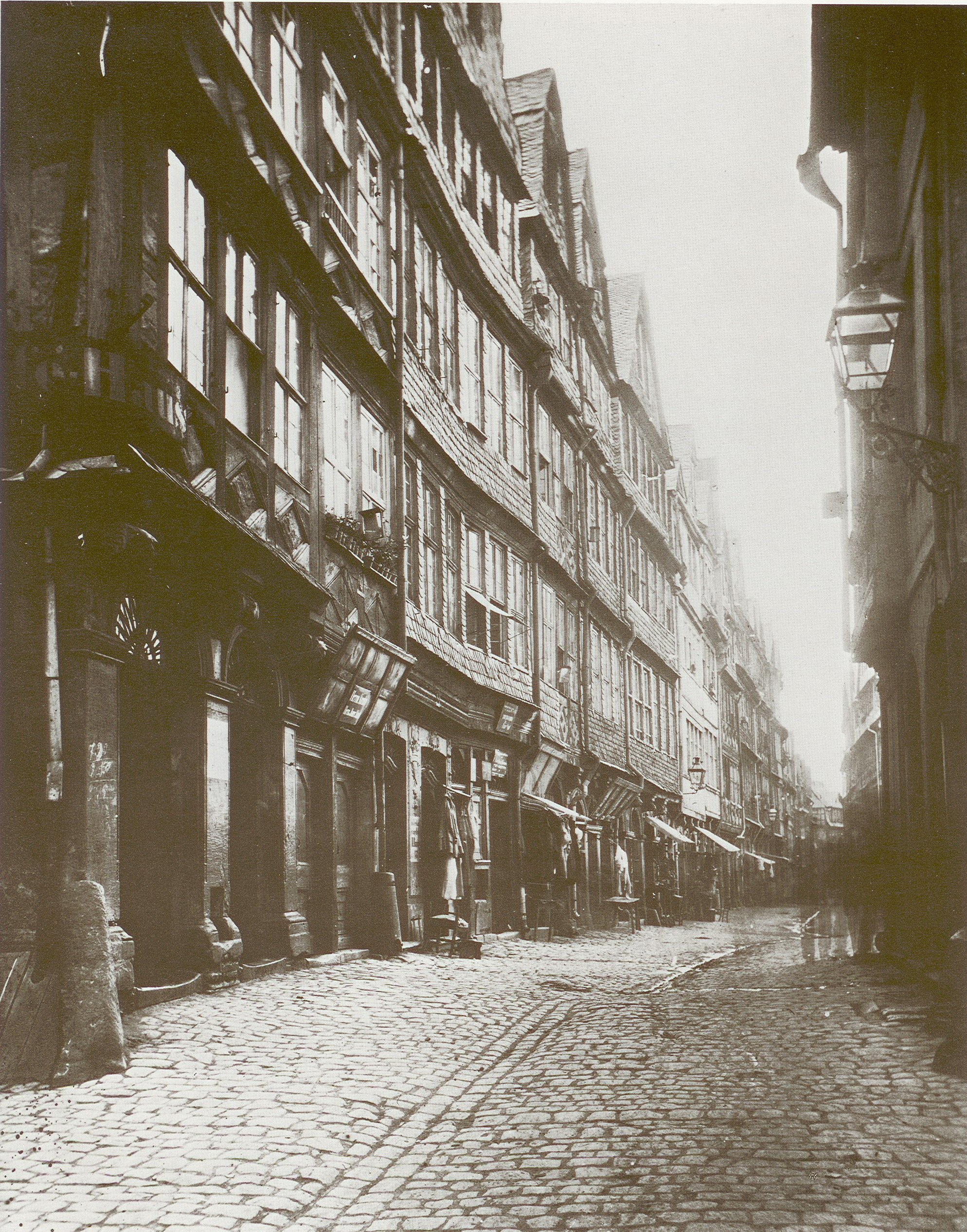
Frankfurt's "Jewish Quarter," or Judengasse in 1868.
Hotel de Russie ~ I forgot to mention that the grape harvest was being gathered in as we ascended the river yesterday. Peasants, men and women, were to be seen toiling up and down the hills, with baskets of the ripe fruit upon their heads. We left Mayence this morning. It is only about an hours ride from here. Before leaving we took a walk about the city and concluded that there was not much to be seen there. It has no surrounding high land and therefore no fine scenery. We took a walk some distance beyond its gates to a garden, on the banks of the river farther up, and obtained from there a fair view of the city besides seeing some forest trees changing color, to remind us of the scenery in our own native land. Mayence is strongly fortified by a succession of small forts, so small as and so placed among the trees that one scarcely notices them. Murray calls it one of the most important fortresses of Germany on the side of France. It suffered greatly during the 30 years war. This afternoon we took a guide from our hotel, here in Frankfort, and walked to see the celebrated Ariadni (a woman seated on a lion) and were delighted with it beyond measure. The models one sees of this in all our shop windows at home give a very good idea of it but fail to convey the exquisite “feeling” of the original, fail to impress as this. It is the prosperity of a private gentleman here, who has a building appropriated entirely to its use in his grounds. One of its beauties consists in the marble being still fresh pure and white. The statuary we have generally seen has been yellow or brown with age. Leaving the Ariadni we dismissed our guide, took a carriage and drove to see the house in which Martin Luther was born and from which the Protestant religion and the bible went out to all the worlds. We saw the house in which Goethe was born and his monument (a colossal sitting figure in marble) finely done. It was still crowned with garlands of oak leaves placed there on his last birth day. We drove through the “jews quarter” the worst in Europe. It is the vilest, darkest, dirtiest street I ever saw, without sidewalks, without the light of heaven almost, and crowded with tumble down houses. Here they were formerly shut up every night, but now they may live where they please. Frankfort has very extensive parks but is not a handsome city, cannot compare with Brussels. In the public library we saw the wooden shoes etc. Luther wore, a copy of the first edition of the bible printed in Latin and some other rare books.
Monday, January 4, 2010
Wednesday, October 4th 1854 ~ Koblenz, Germany


Drachenfels Castle as it looked in the 21st and 17th centuries (photo: S. Mense, engraving: M. Merian).
Hotel Du Géant ~ Last evening at six o’clock we left Cologne for Bonn by rail and past the night there. It is only one hours ride. Bonn is a lovely place, just upon the river, where it begins to be picturesque and commands a fine view of the seven hills, with the Drachenfells castle in the distance. We saw the river by moonlight last evening. Bonn is a fine looking city, looking somewhat like an American watering place, handsome houses, unpaved streets, large trees on either side etc. It contains a celebrated university in which Prince Albert was educated. The house is still shown there in which Bethoven was born. At ten o’clock we took an open carriage provided by our hotel and left Bonn en route up the river. The drive is delightful to Godesberg, a hill overlooking the river, crowned by a ruined castle built by one of the Archbishops of Cologne in the 13th century, on the site of a Roman fort. We made the ascent on Donkeys in about 15 minutes. Our donkeys were each led by little boys. The view from the top is magnificent, finer much than that from the Drachenfells. It is a hard scrambling ride but the view repays the trouble. Our little guides, when we arrived at the top, picked little bouquets for us, in hopes to increase their “drink geld.” The little asses seemed quite disproportionate to the load they bear. My feet almost touched the ground, on either side, when seated on one of them. They walk with great elasticity and force but do not like to trot. They seem to posses more sagacity than a horse and make a loud crying when displeased, which is very painful to unaccustomed ears. Continuing our drive up the river, we found we were traversing a road founded by Marcus Aurelius of Lucius Verus, 160 years after Christ. A few miles brought us to the foot of the Drachenfells, which we ascended on mules. The hill is very steep indeed and the road winds up through vineyards almost all the way. The ruined towers at the top and the view is not as fine as in many other places on the Rhine. Still it is beautiful. We took out Childe Harold and read the passages relating to this part of the river. At half past one we took a steamer and were soon sailing rapidly up the river, between very high and irregular banks. Just above Konigswinter on the opposite side rises a steep hill on which is the ruin of the castle of Rolandseck. The nephew of Charlemagne (Roland) built it to command a view of the convent where his betrothed had taken the veil. From a point a short distance above this the prospect is charming. One may see the ruins of the Drachenfells, Rolandseck Castle, on their separate heights and the convent below, besides several less important castellated summits. Farther up the river are the ruins of Hammerstein Castle, on a high rock just over the water. It was built in the 10th century and was besieged by the Swedes in the 30 years war. Still farther up we passed the white tower which marks the spot where Caesar crossed the Rhine when leading an army against the Sicambri and also where General Hoche crossed in 1797 in spite of the opposition of the Austrians. All these Rhemish hillsides are covered with grape vines which grow on terraces and which seem to be inaccessible to mortal foot. Many of these terraces are cut out of the solid rock and the soil has been carried up to them in baskits, on the heads of the peasants. The vines did not seem to us to add to the landscape as they are trained on straight poles only about four or five feet high, which appear merely like scrub bushes from the river below. We have been perfectly enchanted with our days voyaging. The Rhine is beautiful beyond description, more beautiful by far than the Hudson (setting aside the ruins) although there are some small portions of the Hudson that more than equal it in natural beauty. This part of the Rhine is narrower than the Hudson and the banks are far more precipitous, rocky, and the general scenery wilder. The white and red wines are very agreeable to one who is a little used to them. They are entirely without adulteration and admixture of alcohol here, that these wines always have in America and possess a purer taste. Lizzie and the girls do not like them because they are not accustomed to any acid wine. The price on board the Rhine boats is one franc to one and a half per bottle (20 to 30 cts). Last evening at Bonn we all went to a concert because Alice said she “wanted to hear some German music in a German land.” But the concert turned out to be only a four Tyrolian songs given by three or four natives in costume. It would have been decidedly common in America. The audience looked just as any well dressed one would in America. Thus far life seems much the same all over. At the hotels they always give us here a square pillow (about two feet square) stuffed with down as an extra covering. It is a very peculiar arrangement because it only covers half the body, and that only for half the night, for at the first turn it rolls off. We have not seen a double bed for a long while. We arrived this evening at Coblentz. Our rooms look out upon the river.
Subscribe to:
Posts (Atom)