Showing posts with label music. Show all posts

Monday, March 29, 2010

Saturday, October 21th 1854 ~ Interlochen


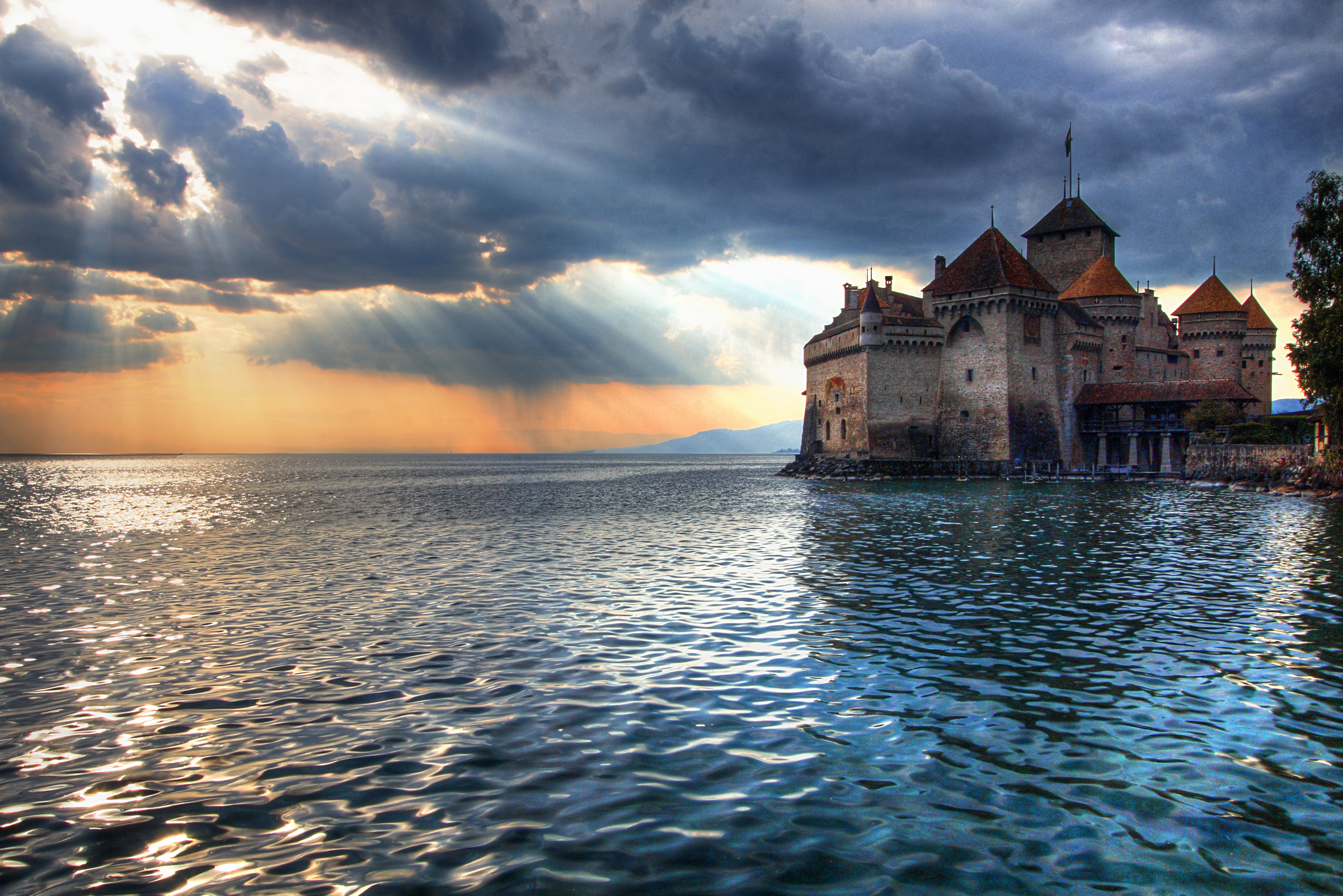
File:The Sun Sets on Château de Chillon.jpg
Castle of Chillon, on the shores of Lake Geneva.

Hotel Belvidere ~ Our windows at Grindelwald looked out upon the {Mittenberg} mountain and Unt glacier which descended close to us. It is a small but pretty collection of wooden houses, surrounded by mountains. The Wetterhorn Eiger, Mittenberg, and Wengern Alp all look very near. In fact, we seemed to be just under them. The Eiger is the most imposing at Grindelwald. It rises so like a needle of rock (as the Swiss call it) into the air. Its summit always clothed in ice and snow, from which the black rock shows itself in jagged points and ridges.

At ten o’clock this morning we took a carriage for Lauterbrunnen and Staubach on the way to Interlachen. The drive was a very pleasant one although it rained quite hard. The road winds between high mountains, but we could not see their summits on account of the clouds. The Staubach fall is about half a mile from Lauterbrunnen and this last place was about three miles out of our way. Still we thought it would be a shame not to see a fall so celebrated by Byron, Longfellow and other poets. At Lauterbrunnen we were forced to leave the carriage and walk under umbrellas though the wind to see this beautiful object. Our path was pointed out by the driver and after having pursued it for some time we asked a peasant to point out the fall and were told we had “just past it!” and there it was, a little meek stream trickling down from very high rocks; scarcely a teacup full of water. We had passed it without remarking it. I can however imagine its being very beautiful during the spring and summer when there is more water and of a bright day where the sun would tinge with rainbow hues the “lace veil” which the water is converted into before it reaches the earth by the action of the air. A little girl and boy seeing us staring at this “wonder work of God and Nature’s hand”! brought out an Alpine horn and sounded it there. The echo was wonderful. The air was instinct with the melody long after the instrument ceased. It is a long wooden pipe, perhaps five feet long and produces a very loud and at a distance a very melodious sound. We did not appreciate Longfellow’s fall or his chime of Bells at Bruges. The magnificent king Frau and {Monk} here rose just above us but we could not see them. We reached Interlachen at four o’clock, and after getting settled at the hotel I posted off to the “poste aux lettres” and received there a letter from Mother, our first since leaving Liverpool. Poor Alice had none and is in {} despair. Also a letter from Sidney Homer saying he would meet {} chain. In descending to Vivey we took out our Childe Harold and read the passages which have added if possible even more renown to Lake Geneva so celebrated in history, poetry, and painting. We remained for two hours at Vivey and then took a boat for Ville{men}, a little place just at the extreme end of the lake. The sail of course was delightful, the waters smooth and clear reflecting every cloud. On the other side of Vivey the shores are rather low and on the other, hills not very high just serve to shut off the view of the great mountain range behind them. The lake has no islands and is not in itself as beautiful as many of our own lakes. It cannot compare in beauty with Lake Lucerne although they can hardly be compared for one has the charms of wilderness, the other is all smiles and soft sunlit beauty. Vivey is far the handsomest Swiss city we have yet seen. The streets are wide, clean and well paved, the houses large and tasty.

Our hotel here is about a quarter or half mile from Villeneuve and quite near the Castle of Chillon. It looks much more like a gentleman’s country place than a hotel. The long avenue leading from the road to the door is shaded with high trees while a large flower garden behind, perfume in the air. English people often pass the summer here, for it is said to be a particularly healthy situation. We ordered dinner and then started the walk over a muddy road to the Castle. It is a fine looking old place, but not as picturesque as many of the Rhemish castles. Its chief interest to us consisted in the story with which Lord Byron has invested it – “the prisoner of Chillon.” The castle is of reddish stone. It is built at the waters edge so that its principal tower stands in the water. Just opposite it and quite near is the “little isle” on which the “prisoner” saw the sun beams play. It is a mere heap of stones not large enough to contain the trees spoken of. We were shown the dungeon where Bonivard was confined. The ring which had bound him to one of its stone pillars and the little path worn by his feet in the stone pavement, about three feed long, in a half circle, around the pillar showing the length of his chain. On a neighboring column Byron, Jean Jaque Rousseau, Eugene Sue, Victor Hugo, Richard Dana and others have inscribed their names. Why Dana’s name should be in such company I cannot conceive. The vaulted roof is supported by about seven of these columns. The dungeon though strong is not as gloomy and terrible as that of Baden. In one of the apartments we were shown a great slanting stone on which two thousand Jews had been strangled. In the torture room is still standing a beam to which offenders were fastened while fire was applied to the soles of their feet. The wood is still scorched. Here also is an “oubliette” A cross beam of an often used gibbet which stands or stood opposite an image of the Virgin. These relics should teach us to appreciate our days of law and order. “Chillon thy prison is a holy place and thy sad floor an altar.”

Friday, February 19, 2010

Thursday, October 19th 1854 ~ Meiringen

File:Meiringen um 1900.jpg
Postcard of Meiringen, Switzerland, ca. 1900.

Hotel du Sauvage ~ We breakfasted as usual this morning on mutton chops, cream, honey, bread, butter, etc. It was rainy but the clouds were broken and at all heights, as that we could sometimes see the tops of the hills which surrounded the little vale, in which the cottages of Lungern are scattered. Mountain rills come tumbling down the hillsides with a rushing sound. It partially cleared off at noon and we started then for Meyringen over the Brunig pass. The ladies each had a horse and a man to lead him while I brought up the train on foot. Our baggage was carried over the mountain with us on the shoulders of a fine looking Swiss. It weighed seventy pounds! Our party looked picturesque enough winding up the narrow path, in single file (large trees on either side) accompanied by their guides carrying long staves. At short intervals the men sang Tyrolean songs, which the echo returned seven fold. The view from the highest point of the pass must be very pretty but as we saw it (in the rain) it was not remarkably so. We arrived at Meyringen at four o’clock, and found a marriage feast in progress at the hotel. We were the only travelers in the house and were invited to join in the festivities. The young couple had been married at two o’clock and even now dancing with their guests, one hundred and fifty or two hundred in number, to the music of an orchestra of five pieces. The dresses were very peculiar; the man wearing very short tailed frock coats and the women in short skirts, velvet vests, without sleeves, displaying a long shirt sleeve (white). We found that they were the sons and daughters of Swiss farmers living in the neighborhood. They were having a real merry time; we joined the company and after a few moments I asked mine host to introduce me to one of the fair dames and was soon engaged in the mazes of the polka and schottische with a native of the land in which they originated. I was unable to say a word to my partner for she could speak no French, and I could speak no German. At eight o’clock dinner was served; the company were seated around three long tables. At the head of the middle one the bride and groom were placed under a canopy made of green leaves. He was a fine looking fellow speaking French, German and English. The bride fine looking but not pretty. Seats were allotted us at their left hands. Near them were the respective families and the Lutheran clergyman who tied the knot. He was a jolly looking German with a cigar in his mouth. The dinner was a very good but a plain one consisting of soup, several courses of meats, dessert and wine of the country. After it had been discussed the clergy man made a congratulatory address, ending with the song (joined in by all) “Sie Leben Hoch.” This was followed by some toasts and then young men went out of the room and returned with little presents (mostly articles of dress) which they presented to their respective favorites of the other sex. They were given with many jokes, holdings of mock auctions over them etc. After this everyone made some present to the bride or groom in the same gay style. Generally articles of household use, and in several instances money. One of these was an apple with gold pieces stuck in it. There were several baskets of chinaware etc. etc. It was a scene of great festivity without ceremony or restraint and we enjoyed it vastly. After dinner the company assembled again in the ball room where they danced until two in the morning. Very beautiful chessmen of carved wood are made here, but there are so many custom houses still before us that I do not dare to purchase.

Thursday, January 7, 2010

Saturday, October 7th 1854 ~ Baden Baden, Germany

Hotel de la Courde Baden ~ This certainly is a charming place. Very beautifully situated, but looking in itself like all watering places. The streets wide and unpaved, rows of trees, wooden houses etc. Baden is surrounded on three sides by high hills covered with deep woods, and having beautiful walks along their sides extending for miles in every direction. Just behind our hotel is a large flower garden filled with bright autumnal flowers, bounded by a high brick wall and behind it rises one of the three hills to a height, which would make its ascent very toilsome. At a distance of about half a mile in front is the hill which forms the opposite boundary of our little valley. It is somewhat higher than the one behind us and is crowned by an old ruin which was the earliest residence of the Dukes of Baden. This ruin is so embowered by the trees, that it is only seen through the foliage and above it, in its iron strength of other days. We attended service this morning at the English Chapel, but Alice was obliged to remain in the house on account of a bad toothache. At four o’clock Lizzie and myself took a walk to the neighborhood of the great club house, which seems to be the favorite promenade; there a band (a large and fine one) was playing polkas in the open air, while ladies and gentlemen handsomely drest were sitting or walking under thee trees. Nurses teaching children to dance to the music etc. Rather a gay scene for the Sabbath! From here we struck off on one of the paths through the hill side woods, taking religious books with us and using them when quite above society and its [voices]. After returning home we started out again to obtain some medicine for Alice and were informed that the apothecary could only sell a small quantity of landanum (too small to take life) to any one person. Baden is a place where gambling is authorized by law, and this perhaps accounts for such a regulation. In our walk before breakfast this morning, we saw a handsome house of peculiar architecture, with long piazzas, etc. which we found covered the chief springs. We went in and were served from the spring which comes up into the midst of a handsome room with frescoed ceiling. The waters are hot, have no decided taste and resemble in color water slightly tinged with milk. They spring from the ground in thirteen places at a boiling heat. I bathed in them this evening and found the bath so warm that cold water was needed to dilute.

Monday, January 4, 2010

Wednesday, October 4th 1854 ~ Koblenz, Germany


Drachenfels Castle as it looked in the 21st and 17th centuries (photo: S. Mense, engraving: M. Merian).

Hotel Du Géant ~ Last evening at six o’clock we left Cologne for Bonn by rail and past the night there. It is only one hours ride. Bonn is a lovely place, just upon the river, where it begins to be picturesque and commands a fine view of the seven hills, with the Drachenfells castle in the distance. We saw the river by moonlight last evening. Bonn is a fine looking city, looking somewhat like an American watering place, handsome houses, unpaved streets, large trees on either side etc. It contains a celebrated university in which Prince Albert was educated. The house is still shown there in which Bethoven was born. At ten o’clock we took an open carriage provided by our hotel and left Bonn en route up the river. The drive is delightful to Godesberg, a hill overlooking the river, crowned by a ruined castle built by one of the Archbishops of Cologne in the 13th century, on the site of a Roman fort. We made the ascent on Donkeys in about 15 minutes. Our donkeys were each led by little boys. The view from the top is magnificent, finer much than that from the Drachenfells. It is a hard scrambling ride but the view repays the trouble. Our little guides, when we arrived at the top, picked little bouquets for us, in hopes to increase their “drink geld.” The little asses seemed quite disproportionate to the load they bear. My feet almost touched the ground, on either side, when seated on one of them. They walk with great elasticity and force but do not like to trot. They seem to posses more sagacity than a horse and make a loud crying when displeased, which is very painful to unaccustomed ears. Continuing our drive up the river, we found we were traversing a road founded by Marcus Aurelius of Lucius Verus, 160 years after Christ. A few miles brought us to the foot of the Drachenfells, which we ascended on mules. The hill is very steep indeed and the road winds up through vineyards almost all the way. The ruined towers at the top and the view is not as fine as in many other places on the Rhine. Still it is beautiful. We took out Childe Harold and read the passages relating to this part of the river. At half past one we took a steamer and were soon sailing rapidly up the river, between very high and irregular banks. Just above Konigswinter on the opposite side rises a steep hill on which is the ruin of the castle of Rolandseck. The nephew of Charlemagne (Roland) built it to command a view of the convent where his betrothed had taken the veil. From a point a short distance above this the prospect is charming. One may see the ruins of the Drachenfells, Rolandseck Castle, on their separate heights and the convent below, besides several less important castellated summits. Farther up the river are the ruins of Hammerstein Castle, on a high rock just over the water. It was built in the 10th century and was besieged by the Swedes in the 30 years war. Still farther up we passed the white tower which marks the spot where Caesar crossed the Rhine when leading an army against the Sicambri and also where General Hoche crossed in 1797 in spite of the opposition of the Austrians. All these Rhemish hillsides are covered with grape vines which grow on terraces and which seem to be inaccessible to mortal foot. Many of these terraces are cut out of the solid rock and the soil has been carried up to them in baskits, on the heads of the peasants. The vines did not seem to us to add to the landscape as they are trained on straight poles only about four or five feet high, which appear merely like scrub bushes from the river below. We have been perfectly enchanted with our days voyaging. The Rhine is beautiful beyond description, more beautiful by far than the Hudson (setting aside the ruins) although there are some small portions of the Hudson that more than equal it in natural beauty. This part of the Rhine is narrower than the Hudson and the banks are far more precipitous, rocky, and the general scenery wilder. The white and red wines are very agreeable to one who is a little used to them. They are entirely without adulteration and admixture of alcohol here, that these wines always have in America and possess a purer taste. Lizzie and the girls do not like them because they are not accustomed to any acid wine. The price on board the Rhine boats is one franc to one and a half per bottle (20 to 30 cts). Last evening at Bonn we all went to a concert because Alice said she “wanted to hear some German music in a German land.” But the concert turned out to be only a four Tyrolian songs given by three or four natives in costume. It would have been decidedly common in America. The audience looked just as any well dressed one would in America. Thus far life seems much the same all over. At the hotels they always give us here a square pillow (about two feet square) stuffed with down as an extra covering. It is a very peculiar arrangement because it only covers half the body, and that only for half the night, for at the first turn it rolls off. We have not seen a double bed for a long while. We arrived this evening at Coblentz. Our rooms look out upon the river.

Sunday, December 20, 2009

Tuesday, September 5th 1854 ~ At sea

At sea ~ The wind is again light and poor Captain Knowles sees but a small chance of returning to the bosom of his family for a long while to come, it seems to make him quite blue. He says Lizzie reminds him so much of his wife but the only point of resemblance I can make out is that they are both very short. All the ladies aboard are quite in love with the Captain, with his manly face and gentlemanly bearing. I believe by the way it is quite the style at present to take a tender interest in any captain under whom one crosses the Atlantic (at least for the fair sex). Captain Knowles has some easily seen faults. His habits of command make him peremptory and overbearing toward inferiors and all those over whom he has any kind of authority. We had a polka on deck last evening to the music of the Doctor’s flute. This morning we passed a Hamburg bark, bound West, and were almost near enough to speak her, not quite, but as we signalized, we are in hopes of being reported on her arrival in America. We exchanged longitudes with her. The thermometer stands at 64 today and has ranged from 62 to 70 thus far on the voyage. We have now been out nine and a half days and have only made about seven hundred miles of our course. We breakfast at eight bells, dine at four bells and take tea at four bells. The table is a little dizzy feeling consequent upon holding onto your chair, balancing your plate etc., to say nothing of seeing the movable sack of glasses swinging over one’s head, all this is slightly unpleasant and will always remain so to me. At Breakfast we have coffee and tea, white bread, rye bread, boiled rye, ship and soda biscuit, beef steak, broiled salmon, pickled salmon, etc. At Dinner fish, roast duck, potted pigeons, meat pie, roast beef, stewed tomatoes, green corn, potatoes in all forms, Carolina potatoes, rice, plum pudding, squash pie, gooseberry pie, watermelon, cantaloupe, prunes, figs, nuts and raisins. This was today's dinner and is a fair specimen of all. We have for tea, bread as at breakfast, herrings, cold tongue, smoked beef, stewed prunes, preserved ginger, and Mrs. Venton’s best cake, all provisions either in the ice house or in exhausted-air cases and it is wonderful how fresh everything tastes even the cake seems as if just baked.

Saturday, December 19, 2009

Saturday, September 2nd 1854 ~ At sea

Picture of Seascape, Casco Bay, Cape Elizabeth, Maine - Free Pictures - FreeFoto.com

At sea ~ We have been aboard just one week today, and it seems quite a little lifetime since we parted with our friends at home, but time will probably pass more quickly as we become more accustomed to this quiet life. It is perfectly monotonous but still time passes very quickly and we find but little leisure for reading. It is almost impossible to keep ones eyes from the heaving plain of water, always the same, yet ever changing. The winds have moderated and the clouds have broken away, but it still proceeds from the East and we are now again in the Gulf Stream. The sailors songs still strike us agreeably – there is considerable variety in the words, but it is difficult to catch them, perhaps that is just as well as many of them are indecent to refined ears. On the whole we think they sound much better at a distance. We are hoping that the sea will subside enough for public worship tomorrow.