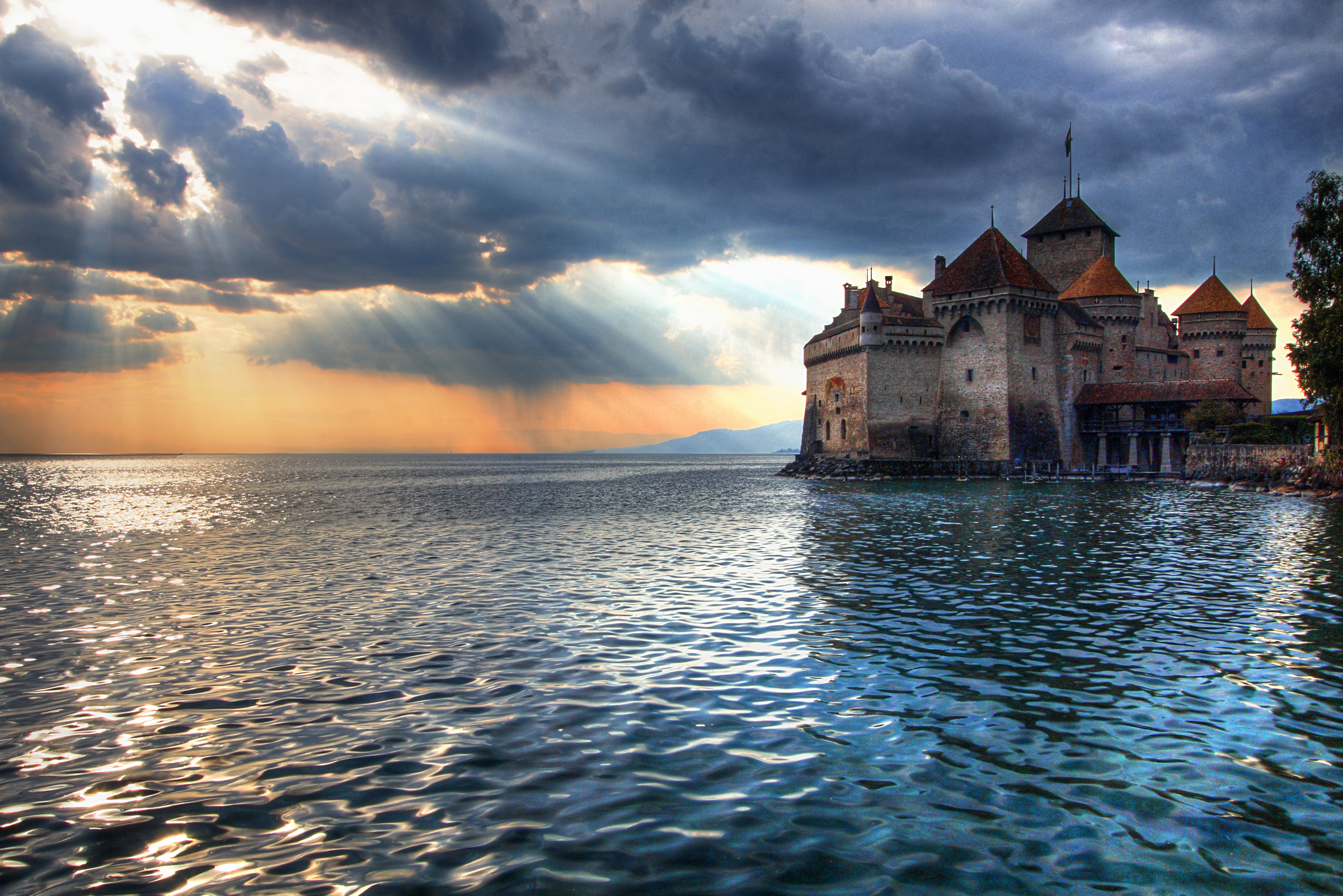
Castle of Chillon, on the shores of Lake Geneva.
Hotel Belvidere ~ Our windows at Grindelwald looked out upon the {Mittenberg} mountain and Unt glacier which descended close to us. It is a small but pretty collection of wooden houses, surrounded by mountains. The Wetterhorn Eiger, Mittenberg, and Wengern Alp all look very near. In fact, we seemed to be just under them. The Eiger is the most imposing at Grindelwald. It rises so like a needle of rock (as the Swiss call it) into the air. Its summit always clothed in ice and snow, from which the black rock shows itself in jagged points and ridges.
At ten o’clock this morning we took a carriage for Lauterbrunnen and Staubach on the way to Interlachen. The drive was a very pleasant one although it rained quite hard. The road winds between high mountains, but we could not see their summits on account of the clouds. The Staubach fall is about half a mile from Lauterbrunnen and this last place was about three miles out of our way. Still we thought it would be a shame not to see a fall so celebrated by Byron, Longfellow and other poets. At Lauterbrunnen we were forced to leave the carriage and walk under umbrellas though the wind to see this beautiful object. Our path was pointed out by the driver and after having pursued it for some time we asked a peasant to point out the fall and were told we had “just past it!” and there it was, a little meek stream trickling down from very high rocks; scarcely a teacup full of water. We had passed it without remarking it. I can however imagine its being very beautiful during the spring and summer when there is more water and of a bright day where the sun would tinge with rainbow hues the “lace veil” which the water is converted into before it reaches the earth by the action of the air. A little girl and boy seeing us staring at this “wonder work of God and Nature’s hand”! brought out an Alpine horn and sounded it there. The echo was wonderful. The air was instinct with the melody long after the instrument ceased. It is a long wooden pipe, perhaps five feet long and produces a very loud and at a distance a very melodious sound. We did not appreciate Longfellow’s fall or his chime of Bells at Bruges. The magnificent king Frau and {Monk} here rose just above us but we could not see them. We reached Interlachen at four o’clock, and after getting settled at the hotel I posted off to the “poste aux lettres” and received there a letter from Mother, our first since leaving Liverpool. Poor Alice had none and is in {} despair. Also a letter from Sidney Homer saying he would meet {} chain. In descending to Vivey we took out our Childe Harold and read the passages which have added if possible even more renown to Lake Geneva so celebrated in history, poetry, and painting. We remained for two hours at Vivey and then took a boat for Ville{men}, a little place just at the extreme end of the lake. The sail of course was delightful, the waters smooth and clear reflecting every cloud. On the other side of Vivey the shores are rather low and on the other, hills not very high just serve to shut off the view of the great mountain range behind them. The lake has no islands and is not in itself as beautiful as many of our own lakes. It cannot compare in beauty with Lake Lucerne although they can hardly be compared for one has the charms of wilderness, the other is all smiles and soft sunlit beauty. Vivey is far the handsomest Swiss city we have yet seen. The streets are wide, clean and well paved, the houses large and tasty.
Our hotel here is about a quarter or half mile from Villeneuve and quite near the Castle of Chillon. It looks much more like a gentleman’s country place than a hotel. The long avenue leading from the road to the door is shaded with high trees while a large flower garden behind, perfume in the air. English people often pass the summer here, for it is said to be a particularly healthy situation. We ordered dinner and then started the walk over a muddy road to the Castle. It is a fine looking old place, but not as picturesque as many of the Rhemish castles. Its chief interest to us consisted in the story with which Lord Byron has invested it – “the prisoner of Chillon.” The castle is of reddish stone. It is built at the waters edge so that its principal tower stands in the water. Just opposite it and quite near is the “little isle” on which the “prisoner” saw the sun beams play. It is a mere heap of stones not large enough to contain the trees spoken of. We were shown the dungeon where Bonivard was confined. The ring which had bound him to one of its stone pillars and the little path worn by his feet in the stone pavement, about three feed long, in a half circle, around the pillar showing the length of his chain. On a neighboring column Byron, Jean Jaque Rousseau, Eugene Sue, Victor Hugo, Richard Dana and others have inscribed their names. Why Dana’s name should be in such company I cannot conceive. The vaulted roof is supported by about seven of these columns. The dungeon though strong is not as gloomy and terrible as that of Baden. In one of the apartments we were shown a great slanting stone on which two thousand Jews had been strangled. In the torture room is still standing a beam to which offenders were fastened while fire was applied to the soles of their feet. The wood is still scorched. Here also is an “oubliette” A cross beam of an often used gibbet which stands or stood opposite an image of the Virgin. These relics should teach us to appreciate our days of law and order. “Chillon thy prison is a holy place and thy sad floor an altar.”