Thursday, May 27, 2010

Monday, November 6th 1854 ~ Milan


Hotel de Ville ~ I began today’s labors by visiting the post office and found there a letter for Alice. The first she has had since leaving home. Of course, she is perfectly enchanted and has been clapping her hands and jumping about like a child with a new toy. I bought a hat this morning and the girls looked for bonnets. After this important business ended, we walked to the other end of the city following the lead of our friend Mr. Murray to see the celebrated painting in frescoe of Leonardo da Vinci “the last supper.” It is on the wall of the refectory of the Jesuit college Santa Maria delle Grazie, a tumble down old building of brick now used as a military barrack. The refectory itself is quite a large room, somewhat longer than it is broad and paved with brick. The painting occupies all one end of it, and is dropping off every year. Traces of the great master are still to be seen in its fading design and general conception, more than in any particular part. It has been repainted and thus greatly damaged several times and it is said that the faces of the Saviour and of Judas are the only ones which are at all perfect (whose expression has not been entirely changed by the repainting). The apostles are placed around a long table, and the scene is drawn at the moment when the servant Peter demands of his Lord “is it I?” Our Lord’s expression is most saintlike and is clothed with an almost unearthly spirituality and dignity. The faces of the group show their interest in the answer expected, and their innocence. The features of Judas are thrown a little in the shade, the better to produce a fiendish expression in which evil passions and cowardice are blended. His face alone does not ask “is it I” but retired from the light. The monks have cut a door through the lower part of the painting, thus taking off all the lower part of our Lord’s person. It’s study gave me a new idea of the effects attainable in painting. As we passed out, soldiers were practicing gymnastic exercises in front of their quarters. They had a rope suspended from the roof to the sidewalk, and were coming down on it head downwards, sitting on each other’s shoulders etc. These operations were superintended by an officer in uniform and apparently on duty. We then walked over to the castle where fifteen hundred or two thousand men were on parade, marching over the great square in front.

Just at the end of this ground is the “Arco della Pace,” a very beautiful triumphal arch, modern, surmounted by bronze statues, chariot and horses and a group of figures about it. We dined at six, just after the table d’hote, and Lizzie was much incommoded by being stared at by an Englishman, who was lingering over his coffee.

Sunday, November 5th 1854 ~ Milan

Hotel de Ville ~ We find ourselves in a fine situation not far from the cathedral and the Imperial Palace. Today (there being no protestant church in the city) we attended the Catholic church “San Carlo Borromeo” and heard some very fine music there. It happened to be the day of this saint and a fine opera corps had been engaged for the occasion who supplied us with music that sounded anything but devotional. After services there we went over to the celebrated cathedral or “Duomo” and were delighted with its beauties and overcome with wonder at the {minute a dommient}. Its many long graceful gothic spires of stone recall in a measure Westminster Abbey. It is unfair for me to attempt its description. As a mere item however I may mention that the outside is adorned with two thousand statues, all in marble, the size of life or greater, in niches, at different heights. As a whole the cathedral is wonderful in its beauty and imposing in its proportions. I had often read descriptions and seen prints of it but never knew it as it is. Today all the shops are closed here, as much as in one of our own New England villages, but the city lacks that aspect of quiet; for the streets are crowded. Apple, cake, and candy venders abound. People peddling portraits of saints etc. etc. At four, Lizzie and myself took a walk out to the Porte Orientale to see the “belle-monde”. This fashionable thoroughfare was crowded with ladies and gentlemen handsomely drest, Austrian officers in their gay uniforms, handsome carriages , and single turnouts, each gentleman with his footman behind etc. A fine military band way playing in the square. We returned to a five o’clock table d’hote dinner as usual in the French style. In the evening we read the Episcopal service before a wood fire in our own room. When we entered the cars at Como for Milan, an official in uniform took away our passport and gave us a receipt for it on the back of which I found that unless I called at the police office in Milan within 24 hours I should subject myself to a fine and fourteen days imprisonment etc. The arrival at the gates of the city was the signal for the receipt being demanded and shown. We had not been in the hotel half an hour when a printed blanc was sent me to be filled up with my country, age, profession, wherefrom, destination, object in traveling etc. Tomorrow I must call at the police office in propria personae to verify the description and furthermore must wait upon the gentlemen every third day after, while I remain to report myself. A government loved at home and respected abroad!

Saturday, November 4th 1854 ~ Milan

Hotel de Ville ~ We breakfasted this morning at Como and after much discussion we decided to make an excursion on the lake; so we took the little steamer at eight o’clock for Bellaggio arriving there after a delightful sail of an hour and a half. The lake is long and narrow, bounded by quite high hills on either hand, along the base of which are beautiful Italian villas in great profusion, with their terraced gardens still clothed in summer verdure. These villas are generally white square houses, having an air of wealth and elegance. The houses at Longwood resemble them very much. We have struck up an acquaintance with an English family aboard, a father, mother and grown up son, bu speedily found them, like all the other specimens of their race that we have met, reserved, uncommunicative, and purse-proud. They were talking continuously about their courier, their servants from England etc. etc. We left our shawls etc. at a hotel in the village and ascended a hill on which is placed the Villa Serbilloni, from the garden of which we obtained some magnificent views of the lake and surrounding country. Bellaggio is on a spur of land running into the lake so that here we had water on both sides, indeed all sides but one. This garden is a succession of terraces, which shelter almost tropical fruits and flowers. Here again we met the English party, the lady riding in a sedan chair carried by two men. We dined at Bellaggio and found the names of J.V.C. Smith {mayor of Boston} and party on the books. Mrs. Smith had written a warm commendation of the hotel, and had added a note in which she says that after having received the bill she found herself obliged take back all her previously expressed praise!! We left at two for Como again, and had to row off to the steamer in a little boat. There was considerable wind and the ladies of the party found a sad pleasure in looking over the side of the little boat! Arrived at Como we had just time to get our passport and baggage in order to take the six o’clock train for Milan. At the depot no one spoke a word of French or German and I was obliged to use signs. It is very disagreeable. The money is still francs (called by another name) and I know the Italian numbers, still it is hard work. The cars are good and the comfort of passengers well attended to. As we crossed the boundary line between Switzerland and Italy (the Alps), the language, manners, customs, as well as climate seemed to change in a moment. Our baggage was again examined on entering this city. Officials are plenty and very strict, but civil.

Tuesday, May 25, 2010

Friday, November 3rd 1854 ~ Como

Hotel de l’Angello ~ We took tea last evening at Domo d’Ossola last evening and then took the diligence again in route. There being none but night conveyances. The conductors and all the other officials were Italians; it was a crowded, uncomfortable conveyance. Mary was perhaps the greatest sufferer having if possible the worst seat. I slept well all night awaking only when horses were changed, or when someone came to the window and roused us all up to pay 5 centima (one cent) each for toll. We arrived at Barina on Lake Maggiore at five o’clock this morning and were dropt at the Hotel de la Poste before day break where we made ourselves comfortable with a good wood fire and a meat breakfast. About seven o’clock we took a row boat with two rowers and started out over the Lake for Laveno on the opposite side by the way of the Borromean Islands. It seemed very strange to us to be driving last night over a great level expanse after the mountainous country we have left. At half past eight we landed at Isola Bella having past by the other little islands of the group, Isola Pescatori, and Isola Madre. Isola Bella is square; rises in formal terraces from the water and is devoted to what was once a magnificient palace and a splendid garden. The garden is still a curious monument of Italian art and taste. It is in fact a great greenhouse, the greater part of it being covered in during the winter. We were shown through the upper rooms of the palace, which did not seem to us very remarkable. Napoleon lodged here at one time during his great Italian campaign and of course his bed room is still shown. Also a tree in the garden on which he cut with his knife the word “battaille” {“battle”}. We were carried down to the “grottoes” under the palace. They are quite handsome small rooms, with roofs, walls and floor of pebbles of different colors in mosaic patterns. Many of them open to the lake and some admitting its waters. In one of them Napoleon had dined previous to the battle of Marengo. We were shown all over the garden, we spent some time walking over its terraces, under lemon and orange trees, full of the ripe fruit, where the century plant grows wild and tropical vegetation flourishes in the open air and this within twelve hours ride of the Alpine snows, and eternal glacier, which by the way are in plain sight from these orange trees. From a little little distance it has a very square pyramidal appearance. The view over the lake is superb. The great Alps to the Northward, the smiling level lands of Italy on the south. At Isola Bella the American pine and the orange bloom almost side by side. At half past eight we started again in our boat for Laveno, reaching there at a little past ten. The moment we landed we were marched to the custom house and passport offices where we underwent quite a rigid examination, for we were within Austrian jurisdiction, perhaps the strictest government in Europe. Our boatmen were very extortionate in their charges and {Ienchnid} to resist so we had quite a quarrel and having lost the diligence were forced to take a very miserable voiturier, who at half way turned us over to another with an inferior carriage besides damaging our trunks by bad loading etc. etc. Our first impressions of Italians are not agreeable. The latter part of our drive was delightful. In it we saw our first Italian sunset which was superb; so mellow yet so brilliant. The country so level as almost to pain the eye, perfectly Italian in its characteristics, stretching in an unbroken surface as far as the eye can reach. We arrived at our hotel in Como at six o’clock this evening, having left our baggage in passing at the “Strada della Ferrata” (Railway) where no one spoke English. It is a little out of the city proper. Our driver knows no English or French, we no Italian, so had to make signs to him, which he obeys pretty well. All but the command to drive more quickly! Alice’s presto’s were useless.

Thursday, November 2nd 1854 ~ Domo d’Ossola

We started at nine o’clock this morning from Brigue in the diligence drawn by seven horses, two to the pole, three abreast next, and two abreast for leaders. The road, which is macadamized, conducts immediately from Brigue along the side of the mountain, continuously rising at the rate of one inch per foot until it reaches the highest point marked by a simple cross of wood, sixty two hundred feet above the level of the sea. We walked much of the way up admiring the views at every turn. The road on the Swiss side rises spirally, so that it looks from below like a great corkscrew laid against the mountainside. An Italian who talked French fast and badly and a young, silent German, a woman and ourselves were the only passengers. The Italian made himself as agreeable as he could, told us he was Turin lawyer etc. I endeavored to make him understand, in French, the scheme of our own government. He was polite enough to pretend a perfect comprehension of my ideas conveyed through the medium but I fear his truth suffered for his “politisse.” As we approached the summit of the mountain we found snow along the sides of the road until at the highest point it was nearly a foot deep. Near the summit the road passes through a tunnel and several covered galleries, supported by columns of solid masonry, to protect it from the avalanches of ice and snow that fall from the higher peaks above it. Quite a large cascade falls on one of the galleries while the diligence drives safely beneath it. We arrived at the highest point at four o’clock, seven hours after our departure from Brigue and then half an hour’s drive over a level road brought us to the Hospice founded by Napoleon the Great. It’s an immense stone building looking not unlike a factory with its long and regular rows of windows. Here we halted for a few moments and were shown by a monk (Father Barras) who was for many years stationed on the Gt. St. Bernard, the whole of the building. It is nicely heated by a furnace and is neat as shaker dwelling. The floors are of dark wood highly polished. The good monk took us into the cuisine and gave us a little lunch of bread, butter, cheese and wine and then reprised a gratuity for his hospitality. He took us into the chapel and the sleeping rooms and invited us to pass the night. From here the Bernese chain is still visible. The Jung Frau Monk etc. The conductor had given us up his place in the morning and now all were crowded into the “Banquette” to see to advantage our decent into Italy. Dear Switzerland adieu. Soon after learning the Hospice the sun set and the moon rose silvering the snow covered peaks and their over-hanging glaciers, in her pale radiance and deepening indefinitely the chasms beneath us. The diligence followed a terrible but beautiful drive. The horses were put into a trot, then into a gallop and we almost flew through the most magnificent scenery ever beheld. At one moment dashing through a dark tunnel cut through the solid rock and emerging to sweep along the edge of a precipice, with a torrent foaming below but at such a depth that we were aware of its presence only by its roar. And now winding around needles of rock that rose three thousand feet into the air above our heads. The atmosphere quickly changed in our rapid descent and we were soon at Isella, where our trunks were ransacked and our passports countersigned by Italians. The change has not dawned gradually but we found ourselves in a moment within range of the Italian lingo. We again resumed our seats and continued our journey descending gradually through a country of vinyards and soft verdure, white wooden houses etc. Everything is Italian in appearance and in effect we are in Piedmont with the snows of the Semplon still clinging to our wheels. At nine o’clock we found ourselves at Domo d’Ossola just at the foot of the mountain chain.

Wednesday, November 1st 1854 ~ Brigue

Hotel des Trois Couronnes ~ This place seems to lie just at the end of the valley of the Rhone. Mountains enclose it on all sides but one, and here the river takes its first waters from the snows of the great mountains. Just above us towards the Semplon and its great road built by Napoleon. We passed last evening at Matigny in recounting our mutual adventures. The girls met in the diligence an old lady who was a great mineralogist having her collections for the day in a bag with her. She was English and going to the salt mines for Stalactites. Also, Mrs Edward Cathy an intimate friend of Mrs Gillebran, Miss Ropes that was etc., etc. They were treated with great consideration at the Hotel Byron and altogether had a most comfortable time. We left Matigny at three o’clock and arrived here at one at night. The diligence conductors wear a uniform consisting of a blue frock coat with brass buttons, standing collar and a blue cap. Both cap and coat have a bugle embroidered on them in gold to denote the postal service. The “cocher” wears a coat which would be a dress coat if the tails were double the size. This coat boasts scarlet collar and cuffs and is mounted with gilt bugle buttons. The hat is of glazed leather having a gold band and embroidered bugle. On our arrival here we went down into the kitchen and helped ourselves to some “potage” we found on the stove. It was the only comfortable place in the house.

Tuesday, October 31st 1854 ~ Martigny

Hotel de la Tour ~ We breakfasted at Chamonix this morning still with the Polish party and bid them goodbye at nine leaving them on their way to the Fligire, a mountain from which perhaps the best view of Mt. Blanc is to be had, while we started for this place over the “Tite-noire” and the “Val Orsini” on horses each having a guide to lead him. It was a clear bright day and all nature looked fresh and beautiful. Mt. Blanc from the village of Chamonix is in plain sight but looks lower than many of the other mountains because it is somewhat farther removed than they and it is only when the traveler reaches pretty high ground that the Monarch unveils his majesty and rises supreme, a great dom of snow. Our path conducted first through the Val d’Orsini, a narrow valley bounded on either side by sloping rocks, forming high shelving walls and looking like one of the sterile vales of the Arabian nights entertainments. All around us were great masses of jagged stone broken off and thrown here by the winters avalanches, many of them containing twenty and many sixty cubic feet. Between these, the mules picked their way, until the path began to ascend one of the hillsides; as it rose giving us views of the Alpine chain presided over by Mt. Blanc, unapproachable and vast, who here assumed his true rank. The road rising still, soon brought us to the “Tete Noire” which is the summit of the mountain, along whose side we had been creeping – rushing brooks from time to time appear forming beautiful cascades which are lost to view in the dark glens about us, or leaping down the precipice at our feet their voice is hushed in their distant landing. Looking down, the Swiss houses in the vale are reduced to the size of toy buildings in shop windows. Green meadows, little men and miniature cattle, sparkling brooks whose voices are lost in the distance. Now passing through a rock tunnel’d to receive the path we reached a little hotel closed to travelers for the season, but where we obtained some bread and wine and a pleasant parlor to rest in. Walking on, and leaving the mules and guides to follow, we wind through the woods on the top of the mountain picking wild flowers and obtaining beautiful views of nigh looking hillsides clothed in Autumnal verdure. A little further on the road descends and then ascends again and we recoup the frontier of Switzerland. Lizzie’s mule is the quickest walker so that she is in Switzerland while I remain’d in Savoy. A good natured gendarme came out and examined our passport and admired his own signature which allowed us to proceed.

From this point the guide pointed out the Silber-horn. The Jung Frau and before us the great valley of the Rhone almost as far as Brigue two days journey by diligence. The valley is bounded on either side by high hills between which the Rhone looks like a silver thread with the great road by its side running in a straight line through the green meadows. On the other side of the Rhone, rising above all lesser mountains, are the snowcapt mountains of the Bernese chain (which here we bid farewell to) and rich foliage of lesser mountains, makes a scene never to be forgotten. We walked a good part of the way down feeling badly at having bid farewell to our friends the Silber horn and Jung Frow, so beautiful in their majesty. We made friends with some peasants taking their flocks to Matigny which lies on the Rhone just at our feet in plain sight. Had quite a conversation with a peasant woman on her prospects. Lizzie’s guide gave her a history of his life, telling her he was still unmarried because his father wanted him to marry a rich girl that he did not like etc., etc. We found the girls already arrived when we reached the hotel in Matigny and a nice fire in rooms prepared for us. Our hostess’ first words to us were “il y a deux dames ici monsieur gui vous attend” {“there are two ladies waiting for you here, sir”} We were right glad to meet them safe and well.

Gardens

{poem written on scrap of paper, inserted in journal:}

Gardens
"A garden is a lovesome thing, God woh!
Rose, plot,
Fringed pool, Ferned grot -
The veriest school
Of peace! And yet the fool
Contends that God is not –
Not God! in gardens! when the air is cool?
Nay, but I have a sign;
'Tis very sure God walks in mine."

- Thomas E. Brown

Saturday, April 10, 2010

Rev. John Codman


Lizzie's father, Rev. Dr. John Codman (1782-1847)

1782 - Born, August 3rd.
1813 - Married to Mary Wheelwright, January 19th.
1826 - Daughter, Elizabeth Codman, born December 10th.
1847 - Died, December 23rd, Dorchester, Mass.

1800's - worked as a minister/preacher.

Monday, October 30th 1854 ~ Chamonix

Hotel de Londres ~ We were called at six and a half this morning and breakfasted at seven. After breakfast bid the girls good bye (I kissed Alice at parting) and started off for Sallenches. The idea was so ridiculous of our going in different directions that it put us into fine spirits. We left our trunks to the girls to take care of and at eight o’clock were comfortably seated in the coupĂ© of the diligence and “en route.” This is the best seat. It is front, just under the driver and shut in with glass. It holds just three people and after the first two hours we had it all to ourselves. The early morning was misty so that we saw but little of the country. As we approached Sallenches the view became superb. The great chain of Mt. Blanc coming into sight, the sun gilding its summits and the mist rolling upward from the valley and creeping up the hill sides. At Sallenches, we obtained our second sight of Mt. Blanc (the first was from Geneva). We dined there and the dinner was miserable in the extreme, bad wine, bad meat, bad everything, cold room. It was market-day however and the costumes of the peasants in the great square were very pretty, standing before their booths, ornamented with ribands etc. We dined with a Polish Count and his sister, the widow of a Russian officer, and with them we took a carriage for Chamonix. They had been fellow travelers in the diligence from Geneva. By the way, on the road to Sallenches we met quantities of market people coming from and going to the fair with droves of cattle, shepherds carrying their little lambs and followed by the flock, droves of black pigs, carts of calves, in one a number of dead ones and one standing alive in their midst. The Polish Count was very deaf and did no talking but his sister did enough for both and in very glib French (which was her native tongue) and we had to keep our heads very clear to understand her rattle. She told us she had one son who was in the Russian army and to my question “how do you like the Russians and their rule” she answered with an expressive shrug “je suis Polonaise.” {I am Polish.} That told the whole story and seemed a history of a great nation’s wrongs. She seemed much interested in hearing about America and showed us by her questions that she had read much about us. The country between Sallenches and Chamonny is very beautiful. The road winds between the mountains, now ascending, now descending, passing through deep defiles, by rushing brooks and waterfalls and among snow capt hills. We had a drunken driver, who whirled us down the hills at a pace that threatened to shake the carriage to pieces; still we did not reach Chamonnix until eight o’clock. Our view as we drove through the vale of Chomonix by moonlight passes description. Mt. Blanc and his aiguilles on the one hand and lesser mountains on the other; in the half light they seemed supernaturally high and their glittering summits seemed as if cut out of solid silver. In many places they were so high that the moon rays did not reach us at all, but were arrested on the sides of the opposite mountains, daguerreotyping there the fantastic shapes of the great Alpine range. The road passes close to three arms of the great “mer de glace,” which descends from the summit of Mt. Blanc into the plain, wave upon wave of ice throwing back the moonlight. Just as the moon rose this evening the sun disappeared so that their rays were blended on the great white dome of Mt. Blanc, the moon rising over it, the sun’s last rays gulding it with rosy hues after they had for some time left us in the valley in the shades of night. Oh man, what are thy works compared with Natures wonders! We cannot help asking here “what is man that thou should’st be mindful of him! We took tea with our Polish friends and retired at midnight. We are the only people at the hotel which is about to be closed for the season.

Sunday, October 29th 1854 ~ Geneva


Caesar Malan

The day has been perfectly splendid. Lake Leman unruffled and clear as crystal, and in the distance the white chain of Mt. Blanc presided over by the monarch himself. A little before ten this morning Lizzie and myself sallied out on a voyage of discovery for the chapel of the celebrated Caesar Malin {actually spelled Malán}. He does not seem at all popular in his native place and we found it difficult to hear where he could be found. After many inquiries we discovered his house just out of the city proper and his church in the grounds. We rang at his garden gate and were told by the woman that came that he would not preach until two o’clock so we went back to the English Chapel and heard the service badly read and a sermon so delivered that we could comprehend very little of it. After church we returned to the hotel and in a quarter of an hour set out again for Mr. Malan’s. It is a very plain little building of wood not painted on the inside with a high old fashioned pulpit, narrow and covered by a canopy of green velvet. Mr. Malin is a fine looking old man about middle height with long hair white as snow. His text was from St. John’s gospel “He it was that should betray him being one of the twelve.” His doctrine we found were very severe (Calvinistic), and somewhat peculiar, but his sermon forcible and manner most impressive, voice musical and instinct with deep feeling. In speaking of the love of Christ it faintly trembled. It is needless to say the sermon impressed us all much. It was in French but remarkably distinct and clear. As he descended from the pulpit in his long black robe he extended his hand to one, a stranger, and I took the opportunity to introduce myself and Lizzie whose father he remembered well. The sunset was superb; we saw it returning along the banks of the lake. The giant shadows of the mountains were reflected in the many colored waters. Byron’s description does not now seem over drawn. In the evening before our woodfire we talked over our plans and concluded to separate our party, Mary and Alice passing over the lake to Hotel Byron and meeting us at Martigny and we going by way of Chamonix, Alice not being able to bear the fatigue of this route.

Saturday, October 28th 1854 ~ Geneva

Hotel de l’Eau ~ Mary’s birthday; the sun shines brightly and Mt. Blanc is in full view. I finally decided upon my watch this morning and took it. I then called at the police office rue de la Cite’ and obtained my passport which had been taken from me on our arrival. Nothing of importance transpired. There is nothing particularly to see in Geneva and I have no impressions to write.

Wednesday, March 31, 2010

Friday, October 27th 1854 ~ Geneva

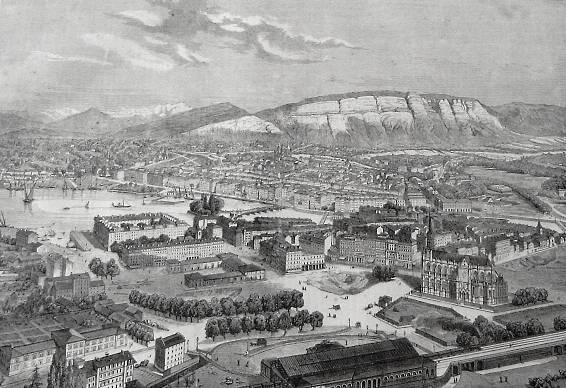
File:Geneve panorama 1860.JPG
Geneva, ca. 1860.

Hotel de l’Eau ~ This is indeed a beautiful city, clean, modern, and enjoyable. The houses are large and handsome – almost every second one bears the sign “horrologerie” (watchmaking). The watchmakers shops are large and handsome besides being thick as blackberries. Mount Blanc has not shown himself today. I passed the morning in shopping and have seen so many watches as perfectly to confuse me. I give the preference to two that I have seen. One for 280 francs ($56), a fine gold watch, lepine, or “echappement a cylindre” with eight holes in rubies. It is the quality sold in Boston for 75 or 80 dollars I think. The other is a compensated lever (“ichappement a l’ancre”) or half chronometer with fifteen holes in rubies, splendid workmanship, and costs 380 francs or 76 dollars. It would be worth in Boston from $125 to $150. On our arrival yesterday I posted off to the post office immediately and found a long and pleasant letter to me from Mother, one from Kitty to Lizzie, and several more indifferent ones. Alice had none and feels very badly. Poor girl, her last was received at London. We dined at four today on broiled chicken, dessert and “vin du pays.” The Swiss silver is much mingled with copper so that their size is large for value. Pieces of from 5 to 50 centimeters - 8 Francs, with gold Napoleon always {} Francs.

Thursday, October 26th 1854 ~ Geneva

File:MountBlanc04.jpg
Mount Blanc.

Hotel de l’Eau ~ We became quite attached to the Hotel Byron. It was so neat orderly and pleasant. In fact I suppose it might be called a “pension” more than a hotel. We dined there yesterday as they had us table d’hote on broiled chicken, vin du pays, and dessert. At ten o’clock we took the little steamer at Villeneuve for Geneva. (Some palpitations about the Treadwells!) The lake struck us as beautiful but not remarkably so, for the end toward Villeneuve alone commands a view of the mountains and the shores elsewhere and low and ordinary looking. On the trip we made the acquaintance of the English ladies, residents of Vivey, going also to Geneva and to Italy afterward by the Mount Cenis. They cautioned us against the snows of the Semplon, the elder of the two having met with some accident there. We arrived here at three in the afternoon and were obliged to give up our passport on landing to a Swiss soldier on the g-way. Geneva is built around the bay so that its finest streets face the water and face Mt. Blanc in the distance looking over the lake. A great snow capt dome seems from here merely the highest of a high chain of mountains, nearly equal in majesty. The range must be superb from here in Summer for they are always white with snow.

Monday, March 29, 2010

Saturday, October 21th 1854 ~ Interlochen


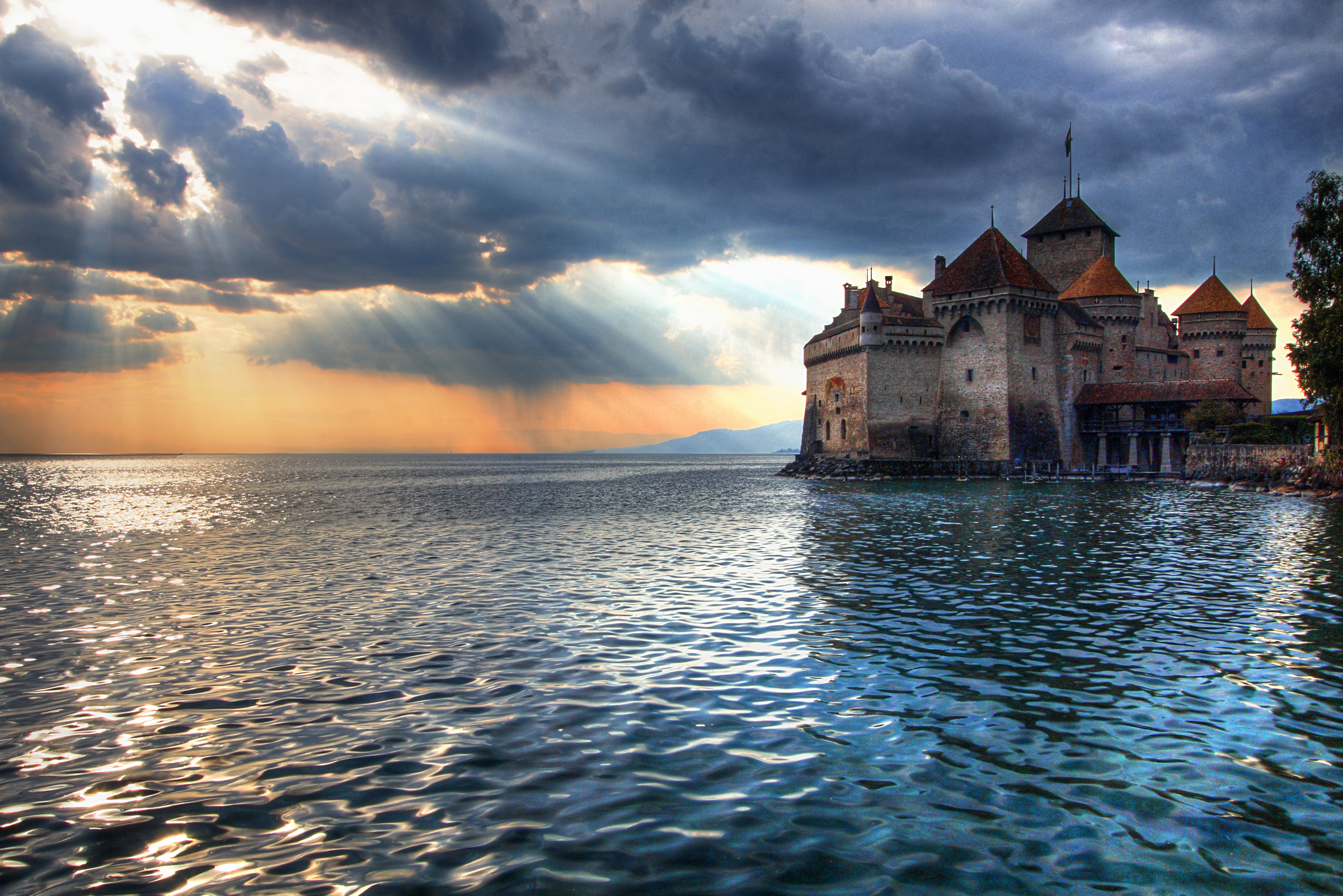
File:The Sun Sets on Château de Chillon.jpg
Castle of Chillon, on the shores of Lake Geneva.

Hotel Belvidere ~ Our windows at Grindelwald looked out upon the {Mittenberg} mountain and Unt glacier which descended close to us. It is a small but pretty collection of wooden houses, surrounded by mountains. The Wetterhorn Eiger, Mittenberg, and Wengern Alp all look very near. In fact, we seemed to be just under them. The Eiger is the most imposing at Grindelwald. It rises so like a needle of rock (as the Swiss call it) into the air. Its summit always clothed in ice and snow, from which the black rock shows itself in jagged points and ridges.

At ten o’clock this morning we took a carriage for Lauterbrunnen and Staubach on the way to Interlachen. The drive was a very pleasant one although it rained quite hard. The road winds between high mountains, but we could not see their summits on account of the clouds. The Staubach fall is about half a mile from Lauterbrunnen and this last place was about three miles out of our way. Still we thought it would be a shame not to see a fall so celebrated by Byron, Longfellow and other poets. At Lauterbrunnen we were forced to leave the carriage and walk under umbrellas though the wind to see this beautiful object. Our path was pointed out by the driver and after having pursued it for some time we asked a peasant to point out the fall and were told we had “just past it!” and there it was, a little meek stream trickling down from very high rocks; scarcely a teacup full of water. We had passed it without remarking it. I can however imagine its being very beautiful during the spring and summer when there is more water and of a bright day where the sun would tinge with rainbow hues the “lace veil” which the water is converted into before it reaches the earth by the action of the air. A little girl and boy seeing us staring at this “wonder work of God and Nature’s hand”! brought out an Alpine horn and sounded it there. The echo was wonderful. The air was instinct with the melody long after the instrument ceased. It is a long wooden pipe, perhaps five feet long and produces a very loud and at a distance a very melodious sound. We did not appreciate Longfellow’s fall or his chime of Bells at Bruges. The magnificent king Frau and {Monk} here rose just above us but we could not see them. We reached Interlachen at four o’clock, and after getting settled at the hotel I posted off to the “poste aux lettres” and received there a letter from Mother, our first since leaving Liverpool. Poor Alice had none and is in {} despair. Also a letter from Sidney Homer saying he would meet {} chain. In descending to Vivey we took out our Childe Harold and read the passages which have added if possible even more renown to Lake Geneva so celebrated in history, poetry, and painting. We remained for two hours at Vivey and then took a boat for Ville{men}, a little place just at the extreme end of the lake. The sail of course was delightful, the waters smooth and clear reflecting every cloud. On the other side of Vivey the shores are rather low and on the other, hills not very high just serve to shut off the view of the great mountain range behind them. The lake has no islands and is not in itself as beautiful as many of our own lakes. It cannot compare in beauty with Lake Lucerne although they can hardly be compared for one has the charms of wilderness, the other is all smiles and soft sunlit beauty. Vivey is far the handsomest Swiss city we have yet seen. The streets are wide, clean and well paved, the houses large and tasty.

Our hotel here is about a quarter or half mile from Villeneuve and quite near the Castle of Chillon. It looks much more like a gentleman’s country place than a hotel. The long avenue leading from the road to the door is shaded with high trees while a large flower garden behind, perfume in the air. English people often pass the summer here, for it is said to be a particularly healthy situation. We ordered dinner and then started the walk over a muddy road to the Castle. It is a fine looking old place, but not as picturesque as many of the Rhemish castles. Its chief interest to us consisted in the story with which Lord Byron has invested it – “the prisoner of Chillon.” The castle is of reddish stone. It is built at the waters edge so that its principal tower stands in the water. Just opposite it and quite near is the “little isle” on which the “prisoner” saw the sun beams play. It is a mere heap of stones not large enough to contain the trees spoken of. We were shown the dungeon where Bonivard was confined. The ring which had bound him to one of its stone pillars and the little path worn by his feet in the stone pavement, about three feed long, in a half circle, around the pillar showing the length of his chain. On a neighboring column Byron, Jean Jaque Rousseau, Eugene Sue, Victor Hugo, Richard Dana and others have inscribed their names. Why Dana’s name should be in such company I cannot conceive. The vaulted roof is supported by about seven of these columns. The dungeon though strong is not as gloomy and terrible as that of Baden. In one of the apartments we were shown a great slanting stone on which two thousand Jews had been strangled. In the torture room is still standing a beam to which offenders were fastened while fire was applied to the soles of their feet. The wood is still scorched. Here also is an “oubliette” A cross beam of an often used gibbet which stands or stood opposite an image of the Virgin. These relics should teach us to appreciate our days of law and order. “Chillon thy prison is a holy place and thy sad floor an altar.”

Monday, March 22, 2010

Friday, October 20th 1854 ~ Grindelwald

File:Grindelwald Wetterhorn.jpg
The Wetterhorn in Grindelwald, Switzerland.

Hotel de l’Aigle ~ We engaged horses, one for each of the ladies with two men as guides, and a man to carry the baggage and with them left Meyringen this morning over the great Scheidek Pass at half past nine. Meyringen is beautifully situated between mountains that literally shut it in on every side but one, and from that the high road conducts to Breintz. All these mountains were covered with snow at about halfway up, presenting a strange contrast with the deep green of the valley. And from the summit of one of them descends the glacier of “Rosenlaui”, a brook of ice glittering in the sunlight. Our host and hostess came out to bid us goodbye and wish us a bon voyage, and we were en route up the mountain in single file, the girls ahead on their led horses and I bringing up the rear with a Swiss mountain pole with a pike on the end. And never was such a staff more needed than during the seven hours of incessant walking, or rather climbing that ensued. The path for the greater part was so steep that it would have been a relief could it have been converted into a regular flight of steps. After reaching Rosenlaui it became a little less steep. There we rested and took a little lunch almost at the foot of the glacier, and then in half an hour pushed on in our winding way. The path is open so that it gives at every step fine views of the vale and neighboring mountain. The distance is about 20 miles and the highest elevation of the path above the sea 6000 feet. From Rosenlaui it conducted us almost immediately from verdure trees and flowers into snow, gradually increasing in depth until we stood on the summit of the Scheidek, standing in snow of more than a foot deep and having left all trees and verdure far behind. I shall never forget the view. It was snowing hard where we stood but the sun shone brightly in the green valleys on either side below. Before us lay the Wengern Alp and the great Eiger apparently close to us. The Eiger is 12220 feet higher than the sea. Immediately above us rose, like a wall of rock, snow and ice, the highest peak of the Wetterhorn (11450 feet) crowned by a great glacier which curled over its summit and crept down its sides. While we were looking up, an avalanche of snow came tumbling down from rock to rock until it rested within a gun shot of where we stood in a cloud of spray broken by the rock and air. On the other side of us rose the great domes of the Fanl-horn, the Schwerz-horn and the lesser mountains without number. We took a lunch, on the summit, of bread, meat, and wine in a little log hut uninhabited except by the “cramping wind,” or rather the guides and myself did, for the ladies lunched on horseback outside. We had brought up the provisions from Meryringen. The rarefied air of the mountain gave an additional effect to the wine in raising our spirits and Alice found the scenery far more magnificent than usual for the ensuing hour. At least she seemed to enjoy it more than before. After our halt of fifteen minutes, two hours of descent brought us to the glacier called the Ober where we dismounted (all but Alice, who was thrown off by a misstep) and leaving our horses passed into one of the transparent caves of the glacier. The green walls above and around us recalled the fabled abodes of the mermaids in old Ocean’s dominions. It descends a gorge in the mountains, looking not unlike a foaming cataract, each great frozen wave seems struggling with its fellow which first shall reach the plain, and here they are alike transfixed in Winter’s cold and in Summer’s heat. Another half hour brought us to Grindelwald and to a comfortable hotel. We ordered fire in our rooms. The girls are on the floor, before theirs at full length, much fatigued. I feel tired, not very much so, but shall not try such a walk again.

Friday, February 19, 2010

Thursday, October 19th 1854 ~ Meiringen

File:Meiringen um 1900.jpg
Postcard of Meiringen, Switzerland, ca. 1900.

Hotel du Sauvage ~ We breakfasted as usual this morning on mutton chops, cream, honey, bread, butter, etc. It was rainy but the clouds were broken and at all heights, as that we could sometimes see the tops of the hills which surrounded the little vale, in which the cottages of Lungern are scattered. Mountain rills come tumbling down the hillsides with a rushing sound. It partially cleared off at noon and we started then for Meyringen over the Brunig pass. The ladies each had a horse and a man to lead him while I brought up the train on foot. Our baggage was carried over the mountain with us on the shoulders of a fine looking Swiss. It weighed seventy pounds! Our party looked picturesque enough winding up the narrow path, in single file (large trees on either side) accompanied by their guides carrying long staves. At short intervals the men sang Tyrolean songs, which the echo returned seven fold. The view from the highest point of the pass must be very pretty but as we saw it (in the rain) it was not remarkably so. We arrived at Meyringen at four o’clock, and found a marriage feast in progress at the hotel. We were the only travelers in the house and were invited to join in the festivities. The young couple had been married at two o’clock and even now dancing with their guests, one hundred and fifty or two hundred in number, to the music of an orchestra of five pieces. The dresses were very peculiar; the man wearing very short tailed frock coats and the women in short skirts, velvet vests, without sleeves, displaying a long shirt sleeve (white). We found that they were the sons and daughters of Swiss farmers living in the neighborhood. They were having a real merry time; we joined the company and after a few moments I asked mine host to introduce me to one of the fair dames and was soon engaged in the mazes of the polka and schottische with a native of the land in which they originated. I was unable to say a word to my partner for she could speak no French, and I could speak no German. At eight o’clock dinner was served; the company were seated around three long tables. At the head of the middle one the bride and groom were placed under a canopy made of green leaves. He was a fine looking fellow speaking French, German and English. The bride fine looking but not pretty. Seats were allotted us at their left hands. Near them were the respective families and the Lutheran clergyman who tied the knot. He was a jolly looking German with a cigar in his mouth. The dinner was a very good but a plain one consisting of soup, several courses of meats, dessert and wine of the country. After it had been discussed the clergy man made a congratulatory address, ending with the song (joined in by all) “Sie Leben Hoch.” This was followed by some toasts and then young men went out of the room and returned with little presents (mostly articles of dress) which they presented to their respective favorites of the other sex. They were given with many jokes, holdings of mock auctions over them etc. After this everyone made some present to the bride or groom in the same gay style. Generally articles of household use, and in several instances money. One of these was an apple with gold pieces stuck in it. There were several baskets of chinaware etc. etc. It was a scene of great festivity without ceremony or restraint and we enjoyed it vastly. After dinner the company assembled again in the ball room where they danced until two in the morning. Very beautiful chessmen of carved wood are made here, but there are so many custom houses still before us that I do not dare to purchase.

Wednesday, October 18th 1854 ~ Lungern

Hotel du Lion d’Or. ~ The fine weather lasted but a single day. This morning it rained quite hard again. We breakfasted early at Lucerne, packed our trunks and forwarded them by poste to Berne and at nine o’clock we took a boat with two rowers for Fahr. It is only a trip of two hours and a half and our boat was covered by an awning which kept off the rain nicely. At Fahr we took a carriage for Lungern, through Sarnen, Sachseln and over the mountain called the Kaiser Stuhl. The road conducts along the borders of the little lakes Sarnen and Lung, which lie cradled among high hills and much above the level of Lake Lucerne. It is a highly picturesque road. The hills above it and among which it winds are as high as to be (many of them) covered with snow. The Swiss valleys along it are beautiful. In them we saw more of the real Swiss cottages than we have seen elsewhere, with their covered balconies, one above the other. We arrived here at four o’clock and find our hotel very comfortable. Lungern is a peasants’ village, surrounded on all sides but one by hills and here the carriage road ceases. Two men followed our carriage for some distance, to be engaged for tomorrow.

Sunday, February 14, 2010

Tuesday, October 17th 1854 ~ Lucerne

The View From Mount Rigi by Paul Robert Lloyd.
View from Mt. Rigi (Photo: P.R. Lloyd)

Hotel du Cygne ~ I awoke at four o’clock this morning and sprang out of bed with delight at the sight of the moonbeams on the floor; the stars were out and not a cloud in the sky. I could not get asleep again and at five the porter knocked at my door and announced the hour, with the cheering words “il fait bien tempis monsieur.” [“it’s about time sir.”] To us who had waited so long for this sound, that we might see one of the finest views of Switzerland, it was welcome indeed. At six o’clock, we were on our way to “Weggis”, in the little “beautean a vapiur,” from thence to ascend the Rigi. The morning was charming; the tops of the mountains were covered with freshly fallen snow, which was silvered by the rising beams of the sun. The mists of the Lake curled up from the water and hung in the fleecy clouds below the mountain summits, dyed by the sun in rainbow hues. The lake is very narrow and makes very picturesque windings between its high and verdant banks. I shall never forget this scene, the rainbow mist, the shadows of the clouds on lake and mountain, the verdure below and the snow above! One hours steaming brought us to Weggis, where we breakfasted and took horses for the ascent of the mountain. Each horse accompanied by a man to lead him. The path up was conducted along the side of the mountain and gave splendid views of the lake and adjoining mountains at every step. The soil was very fine and vegetation abounded, but as we advanced, it gradually became less fourishing until at the summit we rode through snow six inches deep. The Rigi is only 5600 feet high and therefore never takes snow in the summer. Still the change of temperature is very marked between it and the valley. Below we had summer weather (too warm for overcoats), above they were greatly needed. The view from the Rigi-kulen was magnificent beyond description. Looking Southward a mass of snow covered peaks met our gaze, rising into the air like waves of some polar sea charmed by the cold while in full careen. Among them our guides pointed out the Jung Frau, the Silberhorn, the Bright-horn, the Monk etc., some of the highest mountains in Europe. Looking north a great extent of level country is visible extending as far as the Lake of Zurich, whose waters we saw a shining surface set in green. There is a good hotel on the top of the Rigi, when we took a lunch of petit pains and butter with hot milk punch, a beverage our landlord had never heard of before. We rested there an hour, had a polka in the drawing room and then took up our winding way downwards. We often see clouds below us. The lake of Zug lies on the opposite side of the Rigi from Lake Lucerne, and from the summit both are distinctly seen [louing?] either base. There are half a dozen smaller lakes quite near and within sight. From here a steamer is scarcely seen on Lake Lucerne just at our feet. It is but a mooring spot on the waters and looks like a duck on a mill pond. The ascent of the Rigi requires about two hours and the decent about the same time. We got back to Weggis at four o’clock and there took a row boat back to Lucerne propelled by two strong men. We past in skirting the shore several small islands on one of which was a little chapel dedicated to the patron saint of row boats. A man has been perfectly haunting us this afternoon to allow him to travel with us as a servant and will not take no for an answer, but we do not want him. One great nuisance in traveling on the Continent is to have to wade the importunities of guides, servants, couriers etc. that one does not want…and such importunities!

Friday, January 8, 2010

Monday, October 16th 1854 ~ Lucerne

File:Luzern old part of town.JPG
Lucerne, Switzerland.

Hotel du Cygne ~ The morning opened gloomily enough with rain and cloud, but at noon it cleared up a little, the wind changed and dispersed the lower clouds, so that we obtained a fine view of Mount Pilatus and Rigi, their summits covered with a snowy mantle. Mt. Pilatus is the higher of the two, but is not often ascended. It is almost a perpendicular rock, in the crevices of which the snow contrasts beautifully with the dark stone of the more exposed parts. One of the finest points of view from mountain tops in all Switzerland is that on the top of the Rigi. Oh for the sun once more to enable us to enjoy it! This afternoon we all took a row upon the lake. We dined at five and ~ half and drank John’s health and happiness for it is his birthday. During our walks we meet rough wooden crosses very often, set up by the side of the public roads, in passing which the peasants cross themselves with much apparent feeling. It seems to me very proper thus to remind men during their daily avocations of the employments of Eternity.