Showing posts with label wine. Show all posts
Showing posts with label wine. Show all posts
Saturday, April 10, 2010
Monday, October 30th 1854 ~ Chamonix
Hotel de Londres ~ We were called at six and a half this morning and breakfasted at seven. After breakfast bid the girls good bye (I kissed Alice at parting) and started off for Sallenches. The idea was so ridiculous of our going in different directions that it put us into fine spirits. We left our trunks to the girls to take care of and at eight o’clock were comfortably seated in the coupé of the diligence and “en route.” This is the best seat. It is front, just under the driver and shut in with glass. It holds just three people and after the first two hours we had it all to ourselves. The early morning was misty so that we saw but little of the country. As we approached Sallenches the view became superb. The great chain of Mt. Blanc coming into sight, the sun gilding its summits and the mist rolling upward from the valley and creeping up the hill sides. At Sallenches, we obtained our second sight of Mt. Blanc (the first was from Geneva). We dined there and the dinner was miserable in the extreme, bad wine, bad meat, bad everything, cold room. It was market-day however and the costumes of the peasants in the great square were very pretty, standing before their booths, ornamented with ribands etc. We dined with a Polish Count and his sister, the widow of a Russian officer, and with them we took a carriage for Chamonix. They had been fellow travelers in the diligence from Geneva. By the way, on the road to Sallenches we met quantities of market people coming from and going to the fair with droves of cattle, shepherds carrying their little lambs and followed by the flock, droves of black pigs, carts of calves, in one a number of dead ones and one standing alive in their midst. The Polish Count was very deaf and did no talking but his sister did enough for both and in very glib French (which was her native tongue) and we had to keep our heads very clear to understand her rattle. She told us she had one son who was in the Russian army and to my question “how do you like the Russians and their rule” she answered with an expressive shrug “je suis Polonaise.” {I am Polish.} That told the whole story and seemed a history of a great nation’s wrongs. She seemed much interested in hearing about America and showed us by her questions that she had read much about us. The country between Sallenches and Chamonny is very beautiful. The road winds between the mountains, now ascending, now descending, passing through deep defiles, by rushing brooks and waterfalls and among snow capt hills. We had a drunken driver, who whirled us down the hills at a pace that threatened to shake the carriage to pieces; still we did not reach Chamonnix until eight o’clock. Our view as we drove through the vale of Chomonix by moonlight passes description. Mt. Blanc and his aiguilles on the one hand and lesser mountains on the other; in the half light they seemed supernaturally high and their glittering summits seemed as if cut out of solid silver. In many places they were so high that the moon rays did not reach us at all, but were arrested on the sides of the opposite mountains, daguerreotyping there the fantastic shapes of the great Alpine range. The road passes close to three arms of the great “mer de glace,” which descends from the summit of Mt. Blanc into the plain, wave upon wave of ice throwing back the moonlight. Just as the moon rose this evening the sun disappeared so that their rays were blended on the great white dome of Mt. Blanc, the moon rising over it, the sun’s last rays gulding it with rosy hues after they had for some time left us in the valley in the shades of night. Oh man, what are thy works compared with Natures wonders! We cannot help asking here “what is man that thou should’st be mindful of him! We took tea with our Polish friends and retired at midnight. We are the only people at the hotel which is about to be closed for the season.


Wednesday, March 31, 2010
Friday, October 27th 1854 ~ Geneva
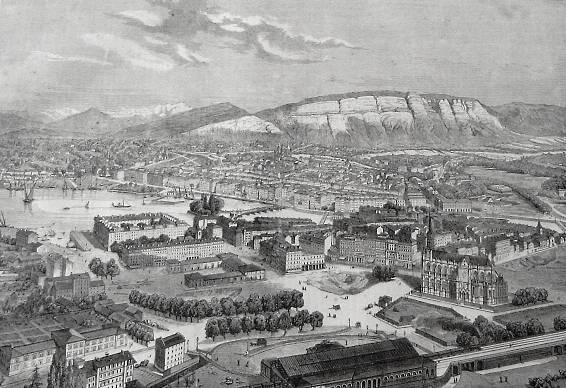
Geneva, ca. 1860.
Hotel de l’Eau ~ This is indeed a beautiful city, clean, modern, and enjoyable. The houses are large and handsome – almost every second one bears the sign “horrologerie” (watchmaking). The watchmakers shops are large and handsome besides being thick as blackberries. Mount Blanc has not shown himself today. I passed the morning in shopping and have seen so many watches as perfectly to confuse me. I give the preference to two that I have seen. One for 280 francs ($56), a fine gold watch, lepine, or “echappement a cylindre” with eight holes in rubies. It is the quality sold in Boston for 75 or 80 dollars I think. The other is a compensated lever (“ichappement a l’ancre”) or half chronometer with fifteen holes in rubies, splendid workmanship, and costs 380 francs or 76 dollars. It would be worth in Boston from $125 to $150. On our arrival yesterday I posted off to the post office immediately and found a long and pleasant letter to me from Mother, one from Kitty to Lizzie, and several more indifferent ones. Alice had none and feels very badly. Poor girl, her last was received at London. We dined at four today on broiled chicken, dessert and “vin du pays.” The Swiss silver is much mingled with copper so that their size is large for value. Pieces of from 5 to 50 centimeters - 8 Francs, with gold Napoleon always {} Francs.
Thursday, October 26th 1854 ~ Geneva

Mount Blanc.
Hotel de l’Eau ~ We became quite attached to the Hotel Byron. It was so neat orderly and pleasant. In fact I suppose it might be called a “pension” more than a hotel. We dined there yesterday as they had us table d’hote on broiled chicken, vin du pays, and dessert. At ten o’clock we took the little steamer at Villeneuve for Geneva. (Some palpitations about the Treadwells!) The lake struck us as beautiful but not remarkably so, for the end toward Villeneuve alone commands a view of the mountains and the shores elsewhere and low and ordinary looking. On the trip we made the acquaintance of the English ladies, residents of Vivey, going also to Geneva and to Italy afterward by the Mount Cenis. They cautioned us against the snows of the Semplon, the elder of the two having met with some accident there. We arrived here at three in the afternoon and were obliged to give up our passport on landing to a Swiss soldier on the g-way. Geneva is built around the bay so that its finest streets face the water and face Mt. Blanc in the distance looking over the lake. A great snow capt dome seems from here merely the highest of a high chain of mountains, nearly equal in majesty. The range must be superb from here in Summer for they are always white with snow.
Monday, March 22, 2010
Friday, October 20th 1854 ~ Grindelwald

The Wetterhorn in Grindelwald, Switzerland.
Hotel de l’Aigle ~ We engaged horses, one for each of the ladies with two men as guides, and a man to carry the baggage and with them left Meyringen this morning over the great Scheidek Pass at half past nine. Meyringen is beautifully situated between mountains that literally shut it in on every side but one, and from that the high road conducts to Breintz. All these mountains were covered with snow at about halfway up, presenting a strange contrast with the deep green of the valley. And from the summit of one of them descends the glacier of “Rosenlaui”, a brook of ice glittering in the sunlight. Our host and hostess came out to bid us goodbye and wish us a bon voyage, and we were en route up the mountain in single file, the girls ahead on their led horses and I bringing up the rear with a Swiss mountain pole with a pike on the end. And never was such a staff more needed than during the seven hours of incessant walking, or rather climbing that ensued. The path for the greater part was so steep that it would have been a relief could it have been converted into a regular flight of steps. After reaching Rosenlaui it became a little less steep. There we rested and took a little lunch almost at the foot of the glacier, and then in half an hour pushed on in our winding way. The path is open so that it gives at every step fine views of the vale and neighboring mountain. The distance is about 20 miles and the highest elevation of the path above the sea 6000 feet. From Rosenlaui it conducted us almost immediately from verdure trees and flowers into snow, gradually increasing in depth until we stood on the summit of the Scheidek, standing in snow of more than a foot deep and having left all trees and verdure far behind. I shall never forget the view. It was snowing hard where we stood but the sun shone brightly in the green valleys on either side below. Before us lay the Wengern Alp and the great Eiger apparently close to us. The Eiger is 12220 feet higher than the sea. Immediately above us rose, like a wall of rock, snow and ice, the highest peak of the Wetterhorn (11450 feet) crowned by a great glacier which curled over its summit and crept down its sides. While we were looking up, an avalanche of snow came tumbling down from rock to rock until it rested within a gun shot of where we stood in a cloud of spray broken by the rock and air. On the other side of us rose the great domes of the Fanl-horn, the Schwerz-horn and the lesser mountains without number. We took a lunch, on the summit, of bread, meat, and wine in a little log hut uninhabited except by the “cramping wind,” or rather the guides and myself did, for the ladies lunched on horseback outside. We had brought up the provisions from Meryringen. The rarefied air of the mountain gave an additional effect to the wine in raising our spirits and Alice found the scenery far more magnificent than usual for the ensuing hour. At least she seemed to enjoy it more than before. After our halt of fifteen minutes, two hours of descent brought us to the glacier called the Ober where we dismounted (all but Alice, who was thrown off by a misstep) and leaving our horses passed into one of the transparent caves of the glacier. The green walls above and around us recalled the fabled abodes of the mermaids in old Ocean’s dominions. It descends a gorge in the mountains, looking not unlike a foaming cataract, each great frozen wave seems struggling with its fellow which first shall reach the plain, and here they are alike transfixed in Winter’s cold and in Summer’s heat. Another half hour brought us to Grindelwald and to a comfortable hotel. We ordered fire in our rooms. The girls are on the floor, before theirs at full length, much fatigued. I feel tired, not very much so, but shall not try such a walk again.
Saturday, January 2, 2010
Thursday, September 28th 1854 ~ Ghent, Belgium
Hotel Royale ~ We breakfasted early and started at nine o’clock to visit the celebrated cathedral ‘St. Bavous.” It was founded in 944 and is a fine type of the architecture of all this country during the middle ages. The inside is of white stone and the choir lined with black marble which of course presents a very strange appearance. Here Charles 5th was baptized - our guide pointed out the exact spot and showed us also the font in which the water stood. There were some (so called) fine paintings here by Rubens and Van Eyck but we did not appreciate them as much as we did the statuary on the sarcophagi. The figures of two bishops in marble reclining on their own graves seemed to us very beautiful. The perfect attitude of repose, natural position was wonderful one could almost see the marble breathe. We dined at the table d’hote at four o’clock and met there but four ladies. Almost all the guests were officers in uniform and it gave the table a very gay appearance. All drink wine. We saw scarcely a person at the table that had not his bottle. The wine are generally Rhemish. After dinner we drove to the “Marchi de Corseaux," saw the house where John of Gaunt was born. A very old looking building, narrow, and a story higher than its fellows.
Wednesday, December 23, 2009
Monday, September 18, 1854 ~ Liverpool, U.K.

Liverpool docks, ca. mid 1800's (painting by R. Dudley)
Queens Hotel ~ Captain Knowles dined with us yesterday at six o’clock. Prof. Treadwell* undertook to do the honors of the table. He ordered the dinner and had the general getting up of the whole affair. Dr. Gallup and Dr. Spooner dined also with us. We had a very fair dinner – an immense piece of roast beef in real English style, so large that it took my appetite away to look at it, but the Prof. did not provide properly in the way of wine, and before dinner was over we had to look at empty bottles, and no more was ordered. I should have taken the matter into my own hands, but did not do it. Thus far I have not been particularly pleased with the English, with whom we have come in contact. They have shown themselves somewhat extortioners and unjust in little ways, however we are still green, verdant in the ways of the old world. Professor Treadwell has been joking Dr. Gallup so much at the table and elsewhere about Alice, that the little gentleman has evidently been persuaded that he is in love. Unfortunately Alice at such times could not always refrain from a blush, which of course greatly encouraged the Dr. I fear we shall have some little trouble in getting rid of the fellow, or keeping him quiet. He is in many respects a fine man but this time “can not come in”. Our rooms are in the third story and look out on a large square, in which is the great St. Lawrence Hall just being finished; an immense stone building to be used (I believe) for municipal purposes. Most Americans go to Mrs. Blodget’s boarding house, we called there yesterday but it was full. The “Queens” is not the crack house, but it was the best we could get into yesterday, all are full. It is however first class and very comfortable. This morning I went dawn to the custom house with Prof Treadwell; there we met Capt Knowles and had our baggage passed with but a slight examination. Capt Knowles brought it in, with the emigrants and their effects on a steam tug. They are particular here in searching Americans for Segars and tobacco in every form, for there is a very high duty on it, $2.25 I think on every pound. By the way it is the custom for American ships to give a pound paper of chewing tobacco to the pilot when he boards them. The custom house are careful to see that no reprints of English books are brought into the country. I called on Brown and Shipley, and took a letter of credit on the London house. Received a delightful letter from Mother. Mr. and Mrs. Treadwell left today for the Chester and London also Dr Spooner. I presented letters of introduction to Chas Humbertson** and others. He wears a threadbare coat and is a plain enough man for one so well known.
--------------------
*Prof. Treadwell may be the inventor and Harvard professor Daniel Treadwell (1791-1892). He was a friend of Longfellow and the inventor of the first mechanized printing press and rope spinner!!
**A newspaper in Liverpool references Charles Humberston as a "commission merchant," which was also C.K. Cobb's trade at the time.
Subscribe to:
Posts (Atom)