Showing posts with label Elizabeth Codman Cobb. Show all posts
Showing posts with label Elizabeth Codman Cobb. Show all posts
Thursday, May 27, 2010
Sunday, November 5th 1854 ~ Milan
Hotel de Ville ~ We find ourselves in a fine situation not far from the cathedral and the Imperial Palace. Today (there being no protestant church in the city) we attended the Catholic church “San Carlo Borromeo” and heard some very fine music there. It happened to be the day of this saint and a fine opera corps had been engaged for the occasion who supplied us with music that sounded anything but devotional. After services there we went over to the celebrated cathedral or “Duomo” and were delighted with its beauties and overcome with wonder at the {minute a dommient}. Its many long graceful gothic spires of stone recall in a measure Westminster Abbey. It is unfair for me to attempt its description. As a mere item however I may mention that the outside is adorned with two thousand statues, all in marble, the size of life or greater, in niches, at different heights. As a whole the cathedral is wonderful in its beauty and imposing in its proportions. I had often read descriptions and seen prints of it but never knew it as it is. Today all the shops are closed here, as much as in one of our own New England villages, but the city lacks that aspect of quiet; for the streets are crowded. Apple, cake, and candy venders abound. People peddling portraits of saints etc. etc. At four, Lizzie and myself took a walk out to the Porte Orientale to see the “belle-monde”. This fashionable thoroughfare was crowded with ladies and gentlemen handsomely drest, Austrian officers in their gay uniforms, handsome carriages , and single turnouts, each gentleman with his footman behind etc. A fine military band way playing in the square. We returned to a five o’clock table d’hote dinner as usual in the French style. In the evening we read the Episcopal service before a wood fire in our own room. When we entered the cars at Como for Milan, an official in uniform took away our passport and gave us a receipt for it on the back of which I found that unless I called at the police office in Milan within 24 hours I should subject myself to a fine and fourteen days imprisonment etc. The arrival at the gates of the city was the signal for the receipt being demanded and shown. We had not been in the hotel half an hour when a printed blanc was sent me to be filled up with my country, age, profession, wherefrom, destination, object in traveling etc. Tomorrow I must call at the police office in propria personae to verify the description and furthermore must wait upon the gentlemen every third day after, while I remain to report myself. A government loved at home and respected abroad!


Tuesday, May 25, 2010
Tuesday, October 31st 1854 ~ Martigny
Hotel de la Tour ~ We breakfasted at Chamonix this morning still with the Polish party and bid them goodbye at nine leaving them on their way to the Fligire, a mountain from which perhaps the best view of Mt. Blanc is to be had, while we started for this place over the “Tite-noire” and the “Val Orsini” on horses each having a guide to lead him. It was a clear bright day and all nature looked fresh and beautiful. Mt. Blanc from the village of Chamonix is in plain sight but looks lower than many of the other mountains because it is somewhat farther removed than they and it is only when the traveler reaches pretty high ground that the Monarch unveils his majesty and rises supreme, a great dom of snow. Our path conducted first through the Val d’Orsini, a narrow valley bounded on either side by sloping rocks, forming high shelving walls and looking like one of the sterile vales of the Arabian nights entertainments. All around us were great masses of jagged stone broken off and thrown here by the winters avalanches, many of them containing twenty and many sixty cubic feet. Between these, the mules picked their way, until the path began to ascend one of the hillsides; as it rose giving us views of the Alpine chain presided over by Mt. Blanc, unapproachable and vast, who here assumed his true rank. The road rising still, soon brought us to the “Tete Noire” which is the summit of the mountain, along whose side we had been creeping – rushing brooks from time to time appear forming beautiful cascades which are lost to view in the dark glens about us, or leaping down the precipice at our feet their voice is hushed in their distant landing. Looking down, the Swiss houses in the vale are reduced to the size of toy buildings in shop windows. Green meadows, little men and miniature cattle, sparkling brooks whose voices are lost in the distance. Now passing through a rock tunnel’d to receive the path we reached a little hotel closed to travelers for the season, but where we obtained some bread and wine and a pleasant parlor to rest in. Walking on, and leaving the mules and guides to follow, we wind through the woods on the top of the mountain picking wild flowers and obtaining beautiful views of nigh looking hillsides clothed in Autumnal verdure. A little further on the road descends and then ascends again and we recoup the frontier of Switzerland. Lizzie’s mule is the quickest walker so that she is in Switzerland while I remain’d in Savoy. A good natured gendarme came out and examined our passport and admired his own signature which allowed us to proceed.
From this point the guide pointed out the Silber-horn. The Jung Frau and before us the great valley of the Rhone almost as far as Brigue two days journey by diligence. The valley is bounded on either side by high hills between which the Rhone looks like a silver thread with the great road by its side running in a straight line through the green meadows. On the other side of the Rhone, rising above all lesser mountains, are the snowcapt mountains of the Bernese chain (which here we bid farewell to) and rich foliage of lesser mountains, makes a scene never to be forgotten. We walked a good part of the way down feeling badly at having bid farewell to our friends the Silber horn and Jung Frow, so beautiful in their majesty. We made friends with some peasants taking their flocks to Matigny which lies on the Rhone just at our feet in plain sight. Had quite a conversation with a peasant woman on her prospects. Lizzie’s guide gave her a history of his life, telling her he was still unmarried because his father wanted him to marry a rich girl that he did not like etc., etc. We found the girls already arrived when we reached the hotel in Matigny and a nice fire in rooms prepared for us. Our hostess’ first words to us were “il y a deux dames ici monsieur gui vous attend” {“there are two ladies waiting for you here, sir”} We were right glad to meet them safe and well.
From this point the guide pointed out the Silber-horn. The Jung Frau and before us the great valley of the Rhone almost as far as Brigue two days journey by diligence. The valley is bounded on either side by high hills between which the Rhone looks like a silver thread with the great road by its side running in a straight line through the green meadows. On the other side of the Rhone, rising above all lesser mountains, are the snowcapt mountains of the Bernese chain (which here we bid farewell to) and rich foliage of lesser mountains, makes a scene never to be forgotten. We walked a good part of the way down feeling badly at having bid farewell to our friends the Silber horn and Jung Frow, so beautiful in their majesty. We made friends with some peasants taking their flocks to Matigny which lies on the Rhone just at our feet in plain sight. Had quite a conversation with a peasant woman on her prospects. Lizzie’s guide gave her a history of his life, telling her he was still unmarried because his father wanted him to marry a rich girl that he did not like etc., etc. We found the girls already arrived when we reached the hotel in Matigny and a nice fire in rooms prepared for us. Our hostess’ first words to us were “il y a deux dames ici monsieur gui vous attend” {“there are two ladies waiting for you here, sir”} We were right glad to meet them safe and well.
Saturday, April 10, 2010
Rev. John Codman

Lizzie's father, Rev. Dr. John Codman (1782-1847)
1782 - Born, August 3rd.
1813 - Married to Mary Wheelwright, January 19th.
1826 - Daughter, Elizabeth Codman, born December 10th.
1847 - Died, December 23rd, Dorchester, Mass.
1800's - worked as a minister/preacher.
Sunday, October 29th 1854 ~ Geneva

Caesar Malan
The day has been perfectly splendid. Lake Leman unruffled and clear as crystal, and in the distance the white chain of Mt. Blanc presided over by the monarch himself. A little before ten this morning Lizzie and myself sallied out on a voyage of discovery for the chapel of the celebrated Caesar Malin {actually spelled Malán}. He does not seem at all popular in his native place and we found it difficult to hear where he could be found. After many inquiries we discovered his house just out of the city proper and his church in the grounds. We rang at his garden gate and were told by the woman that came that he would not preach until two o’clock so we went back to the English Chapel and heard the service badly read and a sermon so delivered that we could comprehend very little of it. After church we returned to the hotel and in a quarter of an hour set out again for Mr. Malan’s. It is a very plain little building of wood not painted on the inside with a high old fashioned pulpit, narrow and covered by a canopy of green velvet. Mr. Malin is a fine looking old man about middle height with long hair white as snow. His text was from St. John’s gospel “He it was that should betray him being one of the twelve.” His doctrine we found were very severe (Calvinistic), and somewhat peculiar, but his sermon forcible and manner most impressive, voice musical and instinct with deep feeling. In speaking of the love of Christ it faintly trembled. It is needless to say the sermon impressed us all much. It was in French but remarkably distinct and clear. As he descended from the pulpit in his long black robe he extended his hand to one, a stranger, and I took the opportunity to introduce myself and Lizzie whose father he remembered well. The sunset was superb; we saw it returning along the banks of the lake. The giant shadows of the mountains were reflected in the many colored waters. Byron’s description does not now seem over drawn. In the evening before our woodfire we talked over our plans and concluded to separate our party, Mary and Alice passing over the lake to Hotel Byron and meeting us at Martigny and we going by way of Chamonix, Alice not being able to bear the fatigue of this route.
Wednesday, March 31, 2010
Friday, October 27th 1854 ~ Geneva
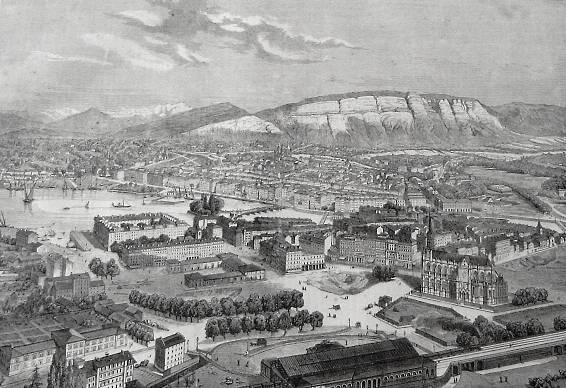
Geneva, ca. 1860.
Hotel de l’Eau ~ This is indeed a beautiful city, clean, modern, and enjoyable. The houses are large and handsome – almost every second one bears the sign “horrologerie” (watchmaking). The watchmakers shops are large and handsome besides being thick as blackberries. Mount Blanc has not shown himself today. I passed the morning in shopping and have seen so many watches as perfectly to confuse me. I give the preference to two that I have seen. One for 280 francs ($56), a fine gold watch, lepine, or “echappement a cylindre” with eight holes in rubies. It is the quality sold in Boston for 75 or 80 dollars I think. The other is a compensated lever (“ichappement a l’ancre”) or half chronometer with fifteen holes in rubies, splendid workmanship, and costs 380 francs or 76 dollars. It would be worth in Boston from $125 to $150. On our arrival yesterday I posted off to the post office immediately and found a long and pleasant letter to me from Mother, one from Kitty to Lizzie, and several more indifferent ones. Alice had none and feels very badly. Poor girl, her last was received at London. We dined at four today on broiled chicken, dessert and “vin du pays.” The Swiss silver is much mingled with copper so that their size is large for value. Pieces of from 5 to 50 centimeters - 8 Francs, with gold Napoleon always {} Francs.
Monday, March 22, 2010
Friday, October 20th 1854 ~ Grindelwald

The Wetterhorn in Grindelwald, Switzerland.
Hotel de l’Aigle ~ We engaged horses, one for each of the ladies with two men as guides, and a man to carry the baggage and with them left Meyringen this morning over the great Scheidek Pass at half past nine. Meyringen is beautifully situated between mountains that literally shut it in on every side but one, and from that the high road conducts to Breintz. All these mountains were covered with snow at about halfway up, presenting a strange contrast with the deep green of the valley. And from the summit of one of them descends the glacier of “Rosenlaui”, a brook of ice glittering in the sunlight. Our host and hostess came out to bid us goodbye and wish us a bon voyage, and we were en route up the mountain in single file, the girls ahead on their led horses and I bringing up the rear with a Swiss mountain pole with a pike on the end. And never was such a staff more needed than during the seven hours of incessant walking, or rather climbing that ensued. The path for the greater part was so steep that it would have been a relief could it have been converted into a regular flight of steps. After reaching Rosenlaui it became a little less steep. There we rested and took a little lunch almost at the foot of the glacier, and then in half an hour pushed on in our winding way. The path is open so that it gives at every step fine views of the vale and neighboring mountain. The distance is about 20 miles and the highest elevation of the path above the sea 6000 feet. From Rosenlaui it conducted us almost immediately from verdure trees and flowers into snow, gradually increasing in depth until we stood on the summit of the Scheidek, standing in snow of more than a foot deep and having left all trees and verdure far behind. I shall never forget the view. It was snowing hard where we stood but the sun shone brightly in the green valleys on either side below. Before us lay the Wengern Alp and the great Eiger apparently close to us. The Eiger is 12220 feet higher than the sea. Immediately above us rose, like a wall of rock, snow and ice, the highest peak of the Wetterhorn (11450 feet) crowned by a great glacier which curled over its summit and crept down its sides. While we were looking up, an avalanche of snow came tumbling down from rock to rock until it rested within a gun shot of where we stood in a cloud of spray broken by the rock and air. On the other side of us rose the great domes of the Fanl-horn, the Schwerz-horn and the lesser mountains without number. We took a lunch, on the summit, of bread, meat, and wine in a little log hut uninhabited except by the “cramping wind,” or rather the guides and myself did, for the ladies lunched on horseback outside. We had brought up the provisions from Meryringen. The rarefied air of the mountain gave an additional effect to the wine in raising our spirits and Alice found the scenery far more magnificent than usual for the ensuing hour. At least she seemed to enjoy it more than before. After our halt of fifteen minutes, two hours of descent brought us to the glacier called the Ober where we dismounted (all but Alice, who was thrown off by a misstep) and leaving our horses passed into one of the transparent caves of the glacier. The green walls above and around us recalled the fabled abodes of the mermaids in old Ocean’s dominions. It descends a gorge in the mountains, looking not unlike a foaming cataract, each great frozen wave seems struggling with its fellow which first shall reach the plain, and here they are alike transfixed in Winter’s cold and in Summer’s heat. Another half hour brought us to Grindelwald and to a comfortable hotel. We ordered fire in our rooms. The girls are on the floor, before theirs at full length, much fatigued. I feel tired, not very much so, but shall not try such a walk again.
Friday, January 8, 2010
Sunday, October 15th 1854, Lucerne, Switzerland
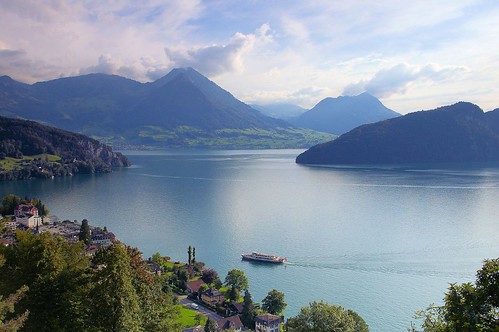
Lake Lucerne from Mt. Rigi (photo: J. Selby, cc).
Hotel du Cygne ~ Last evening Lizzie and myself took a row boat and made a little excursion on the Lake, I rowing, but the boat was heavy and the clouds too low to enable us to see anything of the mountains. Coming back we met a party of washerwomen, rowing themselves and their linen [Lumenards] and singing so merrily that it was quite delightful. A little steamer that makes the trip over the Lake and back lies just under our windows. The day has been cloudy and rainy part of the time. We however got a little sight of the top of the Rigi for the first time. There is no English chapel here, or rather none open at present, so after watching the peasants pass the hotel on their way to church, we followed them there (the cathedral is quite near us). The dress of the female peasants was a striped skirt reaching a little below the knee, a short white apron, basque looking like a boys jacket open in front, disclosing what old fashioned people call a stomacher of black velvet and tinsel, worn with a white under handkerchief pleated. The hair generally long, braided, and hanging down the back with ribbons on the ends. We had in the cathedral some quite fine orchestral music, or rather fine music with orchestral accompaniment. European cathedrals are never provided with fixed seats, but each person, on entering, calls for a chair which is provided upon the payment of a small fee. They are used more for kneeling on than for sitting, the back of the chair being as arranged as to make a very good desk or shelf for a prayer book. All these peasants looked very picturesquely kneeling with their faces to the Alter. After church we took a walk into the country choosing a road, running along the border of the Lake, but on the hill side. We walked several miles enjoying the beautiful scenery. On the road we past an old watch tower in ruins, and were drown by a sudden shower under the forties of a large and very dirty cottage. We could not persuade ourselves to enter its hallowed precincts, and after a time were forced to walk home with umbrellas up. Ours is not the first house and we regret having come to it. It is comfortable but small, has no table d’hote, so that we are obliged to dine in private. Today we had nothing but chicken and for dessert ‘compot’ of peaches. This afternoon read the church service at home. The Switzerhof is the name of the best house; this is the first class of course but not as good.
Thursday, January 7, 2010
Friday, October 13th 1854 ~ Lucerne, Switzerland

"The Lake of Lucerne: Mont Pilatus in the Distance" (1857) by J. Inchbold.
The morning was chilly, cold, and disagreeable, but promised to be more pleasant than yesterday. The sun peeped out at intervals and seemed to be making efforts to redeem the character of a Swiss autumn. We left Kreutzstrasse at half past eight this morning and arrived at Lucerne at four o’clock this afternoon. The country is generally level and does not possess much that would be interesting to old European travelers, but we were delighted with the picturesque dresses of the peasantry, the brown cows, eight harnessed to a plow. The peculiar houses, generally of wood, pretty at a distance but dirty and uncomfortable when closely inspected. The occasional ruins of castles each on its high rock, the pleasant manners of the peasants, who all touched their hats to us as we passed etc. Our road lay through Sursee and along the borders of the pretty little Lake Sempach. When our witurier stopt to find his horses at noon Lizzie and myself walked on, leavin the carriage to come up in an hours time. During our walk we met an old priest, drest in the rusty brown cloth frock of a monk, with a rope girdle. Around him were grouped a dozen children with whom he was talking. We joined him and in conversation he informed us that he no longer exercised the holy office. The reason why was apparent from the state of his breath. He was without a hat and had a rosary hung from his rope belt. On this road I first saw an English walnut tree. We stopt and partook of its fruit which some little boys were shaking down. One seems to see infinitely more of the country when walking and of the people. Indeed I think it is the only way to become well acquainted and enjoy a European country. If I could I should much prefer traversing Switzerland on foot. The peasants of the Northern and Eastern cantons speak bad German. In the neighborhood of Geneva the language is French, but not Parisian French. Our breakfasts since we have been in Switzerland have been peculiar. We have always honey, good butter, rich cream, French rolls or “petit pains” as they are called here. These “petit pains” are only found in the hotels, the Swiss bread tastes like our home made except that it is always a little acid and darker in color. Fresh eggs are plenty. Mutton chops are very nice here. As we approached Lucerne the country became more hilly as if to give us a foretaste of the glories to be revealed.
Monday, October 9th 1854 ~ Strasbourg, France

View from "Das alte Schloss," the Old Castle.
Hotel de la Ville de Paris ~ We left Baden at one o’clock this afternoon and arrived here at four by rail. The country is somewhat uninteresting but the cars are good and very comfortable. In the cars we met an English family who came also from Baden, the man a great fop and fool, the lady more sensible. They had lived so long in Germany that they spoke English with a decided accent. Their child (a little girl) was quite a prodigy. She was but five years old and spoke about equally well English, French, German, and Italian and all very well. Before leaving Baden this morning Lizzie and myself walked to “das neue Schloss” the present summer residence of the Dukes of Baden. This castle is rather a modern looking gothic building, founded in 1471 but which has built and demolished several times since, so that now only the foundation of the edifice remains. We were taken into the cellars by the castellan and found ourselves at a great depth in chambers hewn out of the solid rock on which the castle is placed. The first room we entered was a Roman bath, then followed a succession of cells, closed by doors of stone two feet thick, which led us into the judgment hall, where still are the stone seats of the judges of the secret tribunal. Out of this chamber opens a small room called the chamber of torture. Here stood the rack, rows of iron rings still remain in the walls, part of the paraphernalia of the dreadful apparatus. On one side of this room is a narrow passage terminated by an image of the Virgin. Just before reaching this image is a deep well called the “oubliette,” ninety feet deep, armed at the bottom by knives etc. and covered with a trap door. Along this passage the trembling victim is told to pass to kiss the image of the Virgin. Before he reaches it, the “oubliette” receives its victim. All these apartments are about 8 feet in height and perfectly dark, that is the light of day does not penetrate at all.
From these subterranean passages we again ascended to the realms of day, and visited the gorgeously furnished apartments of the Duke. These were the handsomest rooms we have thus far seen. The walls and ceiling are principally of oak, heavily carved and richly gilded. The floors of colored woods inlaid and highly polished, of course without carpets. In the state rooms were portraits of all the Dukes of Baden full length and in complete armor. The Protestant dukes on one side and the catholic on the other. From this chateau we ascended to “das alte Schloss,” a ruin on a high neighboring hill. Lizzie took an ass for the trip with a pretty little boy to lead him, while I went up on foot. The path wound through thick woods and was extremely pretty, to the old castle. This is a highly picturesque ruin which was the residence of the Dukes of Baden until somewhat more peaceful times, when they ventured down from their inaccessible cliff, to a strong castle below. The view from here is superb. At our feet is the beautiful little village of Baden, its tiled roofs glittering in the sunlight. To the west may be traced the course of the Rhine, in the distance looking like a thread of light in the green meadows. Behind us is seen the commencement of the great “black forest.” Beautiful walks wind through the woods.
Saturday, October 7th 1854 ~ Baden Baden, Germany
Hotel de la Courde Baden ~ This certainly is a charming place. Very beautifully situated, but looking in itself like all watering places. The streets wide and unpaved, rows of trees, wooden houses etc. Baden is surrounded on three sides by high hills covered with deep woods, and having beautiful walks along their sides extending for miles in every direction. Just behind our hotel is a large flower garden filled with bright autumnal flowers, bounded by a high brick wall and behind it rises one of the three hills to a height, which would make its ascent very toilsome. At a distance of about half a mile in front is the hill which forms the opposite boundary of our little valley. It is somewhat higher than the one behind us and is crowned by an old ruin which was the earliest residence of the Dukes of Baden. This ruin is so embowered by the trees, that it is only seen through the foliage and above it, in its iron strength of other days. We attended service this morning at the English Chapel, but Alice was obliged to remain in the house on account of a bad toothache. At four o’clock Lizzie and myself took a walk to the neighborhood of the great club house, which seems to be the favorite promenade; there a band (a large and fine one) was playing polkas in the open air, while ladies and gentlemen handsomely drest were sitting or walking under thee trees. Nurses teaching children to dance to the music etc. Rather a gay scene for the Sabbath! From here we struck off on one of the paths through the hill side woods, taking religious books with us and using them when quite above society and its [voices]. After returning home we started out again to obtain some medicine for Alice and were informed that the apothecary could only sell a small quantity of landanum (too small to take life) to any one person. Baden is a place where gambling is authorized by law, and this perhaps accounts for such a regulation. In our walk before breakfast this morning, we saw a handsome house of peculiar architecture, with long piazzas, etc. which we found covered the chief springs. We went in and were served from the spring which comes up into the midst of a handsome room with frescoed ceiling. The waters are hot, have no decided taste and resemble in color water slightly tinged with milk. They spring from the ground in thirteen places at a boiling heat. I bathed in them this evening and found the bath so warm that cold water was needed to dilute.
Wednesday, January 6, 2010
Charles Kane Cobb, timeline

A photo of Charles K. Cobb ca. 1861.
1831 - Born in Boston, MA.
1833 - Sister Mary Wray Cobb is born in Boston.
1830s - Family moves to Schenectady, NY.
1848 - Father, Frederick Augustus Cobb, dies in Schenectady.
1850 - Possibly boards at 7 Morton Pl., Boston (Charles Cobb, clerk).
1852 - Boards at "Winthrop House" in Boston.
1853 - Marries Elizabeth Codman.
1854 - Clerkship in a dry goods commission house.
1854 - Trip to Europe with wife Lizzie and sister Mary.
1855 - Son born in Schenectady, NY: Charles Kane Cobb, Jr.

1856 - Grandmother mentioned in journal (Maria Wray) dies.
1857 - Resides at 18 E. Brookline St., Boston.
1857 - Daughter born in Boston: Helen Kent Cobb.
1857-8 Works as a merchant at 53 Central Wharf.

1858 - Possibly boards at 4 Bulfinch Place (C.K. Cobb).
1858 - Mother, Helen Augusta Kane, dies in Boston.
1859 - Son born in Boston: Frederick Codman Cobb.
1860 - Appears in US Census as Boston resident, merchant.

1861 - Works at 22 Central Wharf, J.P. Hawes & Co., merchants.
1861-? - Lieutenant/adjutant in Civil War, stationed in Boston Harbor.

1862 - Absent from the Boston Directory. At war?
1864 - Daughter born in Boston: Elizabeth Codman Cobb.
1864 - Starts a bank and brokerage company.
1865-6 - Partners with Francis V. Parker becoming "Parker & Cobb."
1865 - Resides at 11 Brookline St.
1865 - Parker & Cobb located at "1 Phoenix Building" in Boston.
1868 - Parker & Cobb located at 8 Devonshire St.
1868-death - Resides at 11 Marlboro St.
1870-3 - Parker & Cobb located at 36 Devonshire St.


1872 - Parker & Cobb narrowly escapes the "great fire" of Nov 9.

1873 - Charles is a member of the Boston Stock and Exchange Board.
1873-6 - Parker & Cobb is located at 78 Devonshire St.

1876 - Dies in Boston, age 45. Bank becomes F.V. Parker & Co.


Advertisement from The Banker's Almanac, 1874.
sources:
Banker's Almanacs, 1872-1874.
Barron, C. W. and J. G. Martin. 1893. The Boston Stock Exchange.
Boston Directories 1849 to 1875.
Chandler, A. 1876. Secretary's Report, class of 1868, Harvard.
Greenough, Jones & Co. 1872. Boston Business Directory.
Parker, F. J. 1880. The story of the 32nd regiment Massachusetts...
Reno, C. 1900. Memoirs of the judiciary and the bar of New England...
Note: some dates and/or places may be wrong! (i.e., mistaken identities)
Tuesday, January 5, 2010
Elizabeth Codman

This is a photo/painting of Elizabeth Codman Cobb ("Lizzie"), wife of Charles, around 1900. She was born in 1826, which would make her about 75 in the painting and about 28 during the trip. Thanks to great-grandson-in-law Rich Allen for photographing it and to great-great-granddaughter Becky James for improving the image.
Monday, January 4, 2010
A photo of Charles?

"Whipple studio portrait of Lieutenant Charles K. Cobb, Adjutant of the 32nd Massachusetts Volunteer Regiment during the Civil War." (CORBIS)
This is a possible photo of the author (my great-great-grandfather) taken in Boston ca. 1861. He would have been about 30 years old - about 6 years after the trip with Lizzy, during which the mustache would have first sprouted (see entry of 30 August 1854).
A Charles K. Cobb was stationed at Fort Warren in Boston Harbor in 1861 (*)
Wednesday, October 4th 1854 ~ Koblenz, Germany


Drachenfels Castle as it looked in the 21st and 17th centuries (photo: S. Mense, engraving: M. Merian).
Hotel Du Géant ~ Last evening at six o’clock we left Cologne for Bonn by rail and past the night there. It is only one hours ride. Bonn is a lovely place, just upon the river, where it begins to be picturesque and commands a fine view of the seven hills, with the Drachenfells castle in the distance. We saw the river by moonlight last evening. Bonn is a fine looking city, looking somewhat like an American watering place, handsome houses, unpaved streets, large trees on either side etc. It contains a celebrated university in which Prince Albert was educated. The house is still shown there in which Bethoven was born. At ten o’clock we took an open carriage provided by our hotel and left Bonn en route up the river. The drive is delightful to Godesberg, a hill overlooking the river, crowned by a ruined castle built by one of the Archbishops of Cologne in the 13th century, on the site of a Roman fort. We made the ascent on Donkeys in about 15 minutes. Our donkeys were each led by little boys. The view from the top is magnificent, finer much than that from the Drachenfells. It is a hard scrambling ride but the view repays the trouble. Our little guides, when we arrived at the top, picked little bouquets for us, in hopes to increase their “drink geld.” The little asses seemed quite disproportionate to the load they bear. My feet almost touched the ground, on either side, when seated on one of them. They walk with great elasticity and force but do not like to trot. They seem to posses more sagacity than a horse and make a loud crying when displeased, which is very painful to unaccustomed ears. Continuing our drive up the river, we found we were traversing a road founded by Marcus Aurelius of Lucius Verus, 160 years after Christ. A few miles brought us to the foot of the Drachenfells, which we ascended on mules. The hill is very steep indeed and the road winds up through vineyards almost all the way. The ruined towers at the top and the view is not as fine as in many other places on the Rhine. Still it is beautiful. We took out Childe Harold and read the passages relating to this part of the river. At half past one we took a steamer and were soon sailing rapidly up the river, between very high and irregular banks. Just above Konigswinter on the opposite side rises a steep hill on which is the ruin of the castle of Rolandseck. The nephew of Charlemagne (Roland) built it to command a view of the convent where his betrothed had taken the veil. From a point a short distance above this the prospect is charming. One may see the ruins of the Drachenfells, Rolandseck Castle, on their separate heights and the convent below, besides several less important castellated summits. Farther up the river are the ruins of Hammerstein Castle, on a high rock just over the water. It was built in the 10th century and was besieged by the Swedes in the 30 years war. Still farther up we passed the white tower which marks the spot where Caesar crossed the Rhine when leading an army against the Sicambri and also where General Hoche crossed in 1797 in spite of the opposition of the Austrians. All these Rhemish hillsides are covered with grape vines which grow on terraces and which seem to be inaccessible to mortal foot. Many of these terraces are cut out of the solid rock and the soil has been carried up to them in baskits, on the heads of the peasants. The vines did not seem to us to add to the landscape as they are trained on straight poles only about four or five feet high, which appear merely like scrub bushes from the river below. We have been perfectly enchanted with our days voyaging. The Rhine is beautiful beyond description, more beautiful by far than the Hudson (setting aside the ruins) although there are some small portions of the Hudson that more than equal it in natural beauty. This part of the Rhine is narrower than the Hudson and the banks are far more precipitous, rocky, and the general scenery wilder. The white and red wines are very agreeable to one who is a little used to them. They are entirely without adulteration and admixture of alcohol here, that these wines always have in America and possess a purer taste. Lizzie and the girls do not like them because they are not accustomed to any acid wine. The price on board the Rhine boats is one franc to one and a half per bottle (20 to 30 cts). Last evening at Bonn we all went to a concert because Alice said she “wanted to hear some German music in a German land.” But the concert turned out to be only a four Tyrolian songs given by three or four natives in costume. It would have been decidedly common in America. The audience looked just as any well dressed one would in America. Thus far life seems much the same all over. At the hotels they always give us here a square pillow (about two feet square) stuffed with down as an extra covering. It is a very peculiar arrangement because it only covers half the body, and that only for half the night, for at the first turn it rolls off. We have not seen a double bed for a long while. We arrived this evening at Coblentz. Our rooms look out upon the river.
Saturday, January 2, 2010
Saturday, September 30th 1854 ~ Brussels, Belgium
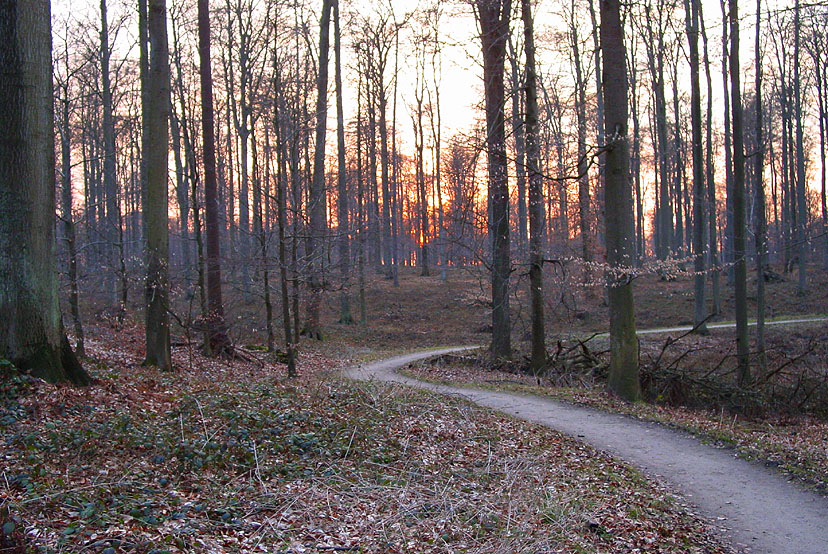
The Sonian Forest or Forêt de Soignes (photo: D. Edgar).
Hotel de L’Unions ~ We find we made a mistake in selecting our hotel. It is a good house celebrated for its table d’hote but in a bad location, not near the park and decidedly “down town”. Here, and indeed all through Germany, there are no double beds, two good sized single beds being invariably used instead. They have always full white curtains descending from a round head piece. The beds are low and in what we call the French style. I took the stage at ten o’clock this morning for Waterloo, leaving Lizzie and the girls to do some shopping for lace etc. in the city. The road to Waterloo is a very fine one, graded almost as well as one of our railways. The county, for the most part, would be considered uninteresting; but some parts of it are beautiful. The distance is thirteen miles and the road is paved with round stone all the way. It passes for several miles through the forest of Soigne and over it the British troops past on their way to the great battle field. This wood Lord Byron alludes to in the beautiful lines commencing “And Ardennes waves above them her green leaves, dewy with Natures tear drops as they pass.” Here the road is truly beautiful, the trees are immense and entirely shade it, and the wood is very thick. In all this level expanse of country there is not a fence or hedge or any other perceptible line to divide a man’s land from his neighbors’. The effect of this view of highly cultivated, unbroken prairie land is very fine, extending as it does, as far as the eye can reach. The field of Waterloo is only marked by a great mound of earth, on the top of which the Belgic lion, in bronze, puts his paw on a small marble world, and looks defiant. The ground the two armies occupied would not seem to give either a great advantage. It is merely a swelling meadow land. The little vale between the foes seems much too small to give either a great advantage. Wellington’s strength of position seems to have consisted entirely in having his extreme wings supported by the brick walls, which surrounded two old farm houses, so protected by clumps of trees that the French could not us their artillery against them and could not therefore get at the English from the rear on account of these temporary forts. They are called “Hougoumont” and “La Haye Sainte.” The walls of the Houngoumont are still standing and are all battered up on the outsides by musket balls fired at the loop holes. I stood upon the spot where Wellington gave his orders and to which the imperial gard almost penetrated during their final charge. The village is in plain sight, and about two miles distant, from which late in the afternoon the Prussians emerged. Our guide was an English officer of low grade who served under Wellington in the battle. He is a very smart fellow in that he does not boast of his courage but says he felt much relieved when his company were withdrawn from the fire. One cannot help feelings of sadness at the remembrance of the misery caused here and I believe we all left the place with subdued feelings and quiet faces. I got back to Brussels at four o’clock just in time for the table d’hote. Dinner in the French style. Nothing on the table, but dishes handed around, already carved and no two things placed on the same plate. Soup, corn beef, roast beef liver, fricandeau of veal larded, roast veal and baked pears, bread and cheese, jelly, pudding, pears, peaches etc. Each kind of meat constituted a separate course. The waiters are drest in black frock coats and white gloves and are generally gentlemanly looking young men speaking two or more languages.
Friday, January 1, 2010
Monday, September 25th 1854 ~ London

A horsedrawn "Handsome" carriage (Bettman archive).
London ~ This morning when the Doctor came he gave me permission to go out for a little drive, so Lizzie and myself got into a “Handsome” which is a one horse conveyance like a chaise except that there is a seat for a driver behind and above so that the reins pass over the chaise top, and the house (to those inside) seems to be without guidance. We saw the outside of St. James Palace of Buckingham Palace, drove around Hyde Park, St. James Park, saw “Temple bar” where the right of the Sovereign bows to the authority of the municipal authorities. Temple Bar was one of the gates of London and it still marks the terminus of the ancient city. It looks not unlike a small and somewhat defaced triumphal arch. The Dr. had forbidden me to breathe the atmosphere of the old city, so Temple Bar was an effectual bar to me. It seems a great pity. I should be thus laid up where there is so much to see, where every foot of ground, the name of every street recalls some story or history.
Thursday, December 24, 2009
Friday, September 22nd 1854 ~ London

Last evening I was taken with an attack of cholera, which began by cold, shivering and colic pains. A physician was called in who by heating drinks and heat applied to the feet, threw me into a high fever, which lasted all night. Today I am better, but not of course out of bed. The Dr. called again this morning. Lizzie makes a fine nurse. This is the first time her abilities have been tested on my behalf.
Monday, December 21, 2009
Saturday, September 9th 1854 ~ At sea
At sea ~ Lizzie is quite unwell today, she has a bad headache and bilious attack. Alice is much better, after dinner she was able to leave her birth and go up on deck. Last night was very rough, but the wind just astern, and very high, so that we made at one time fourteen knots per hour. Capt. Knowles says he never made better time. The wind has been very strong all day and the sea much higher than we had before seen it, many of the waves swelling up as far as the top of the hurricane deck. I spent several hours looking over the stern at the hills and plains of water, they have today realized my idea of ocean waves. Everything not lashed is flying about the cabin floor. We made 260 miles from noon yesterday to noon today, and are now just halfway between Boston and Liverpool, having been out 14 days, could we proceed at this rate one week more would see us ashore. This afternoon we signalized a New York ship bound West and gave name.
Thursday, September 7th 1854 ~ At sea
At sea ~ Just a year ago today Lizzie was taken with her brain fever at Saven Hill. To what a train of recollections does this lead! The Captain started us from our slumbers this morning, by knocking at our state room door, and asking if we wanted to see a ship of war! Of course Lizzie and I were drest (after a fashion) in a moment, and on deck, and there in plain sight were two French frigates just astern, and near enough to read our name. They were under full sail and bound West, with colors flying. They looked splendidly, very unlike in rig and general appearance to merchantmen, the masts were straighter, “taughter”, firmer, more raking, and the hull less crank. We ran up our flag and passed without hindrance, but our neighbor the ship New York was less lucky. She was about a mile on the other side of us, but as she was a new ship and a little tardy about showing her colors, the Frenchman determined to over haul her. By this time we were both well ahead, so one of the French frigates rounded to and gave chase. Her yards were alive with men to effect this maneuver, crowd all sail etc. It was indeed a most beautiful sight. A stern chase is always a long one and so it proved in this instance for it was only after three hours of close sailing that the Yankee was overtaken and boarded. We had preserved the same relative distance between the pursuer and the pursued, but now of course we left our competitor behind, the result of the examination was favorable and she was soon allowed to proceed. This was a highly exciting scene and one I suppose that rarely falls to the lot of mere land-lubbers - the breeze was strong and the American ship laid down to it until her hull seemed nearly out of water, while the frigate maintained a perpendicular position. Every short time after the chase began the second frigate was lost in the distance. Alice is ill today was taken with cramp last night and has not been able to bear her birth. This afternoon the weather became thick and we are once more alone on the ocean.
Sunday, December 20, 2009
Wednesday, September 6th 1854 ~ At sea

A Whist Marker, used in the English card game "whist."
At Sea ~ Wind still from the East. We passed another Bark bound West this morning, and signalized her. There is very little sea today and we all are not only feeling well, but bright and in high spirits. My health seems to have improved already under the influence of the invigorating sea air. Dr. Gallup has made 36 pills for Lizzie, of monstrous size, all to be taken in four days! For general debility. She is about as well as usual and rather rebels at such a fare. Lizzie and Mary have begun writing home but as we have not yet reached the “banks”, there is but little chance of the letters being sent under two weeks.
About noon today we discovered a new ship on our lee quarter and have been racing with her all day. At present she is about two miles behind. She is about 2000 tons clipper built and Captain Knowles thinks she is the “New York”, on her first trip from N.Y. for Liverpool. If so she left N.Y. on the 25th one day before we left Boston. Which will reach England first? The Capt. Signalized her but she refuses to tell her name. We are both close hauled. We read today 11 weeks in Europe by Clark and had a game of whist in the evening.
Subscribe to:
Posts (Atom)