Showing posts with label art. Show all posts

Thursday, May 27, 2010

Monday, November 6th 1854 ~ Milan


Hotel de Ville ~ I began today’s labors by visiting the post office and found there a letter for Alice. The first she has had since leaving home. Of course, she is perfectly enchanted and has been clapping her hands and jumping about like a child with a new toy. I bought a hat this morning and the girls looked for bonnets. After this important business ended, we walked to the other end of the city following the lead of our friend Mr. Murray to see the celebrated painting in frescoe of Leonardo da Vinci “the last supper.” It is on the wall of the refectory of the Jesuit college Santa Maria delle Grazie, a tumble down old building of brick now used as a military barrack. The refectory itself is quite a large room, somewhat longer than it is broad and paved with brick. The painting occupies all one end of it, and is dropping off every year. Traces of the great master are still to be seen in its fading design and general conception, more than in any particular part. It has been repainted and thus greatly damaged several times and it is said that the faces of the Saviour and of Judas are the only ones which are at all perfect (whose expression has not been entirely changed by the repainting). The apostles are placed around a long table, and the scene is drawn at the moment when the servant Peter demands of his Lord “is it I?” Our Lord’s expression is most saintlike and is clothed with an almost unearthly spirituality and dignity. The faces of the group show their interest in the answer expected, and their innocence. The features of Judas are thrown a little in the shade, the better to produce a fiendish expression in which evil passions and cowardice are blended. His face alone does not ask “is it I” but retired from the light. The monks have cut a door through the lower part of the painting, thus taking off all the lower part of our Lord’s person. It’s study gave me a new idea of the effects attainable in painting. As we passed out, soldiers were practicing gymnastic exercises in front of their quarters. They had a rope suspended from the roof to the sidewalk, and were coming down on it head downwards, sitting on each other’s shoulders etc. These operations were superintended by an officer in uniform and apparently on duty. We then walked over to the castle where fifteen hundred or two thousand men were on parade, marching over the great square in front.

Just at the end of this ground is the “Arco della Pace,” a very beautiful triumphal arch, modern, surmounted by bronze statues, chariot and horses and a group of figures about it. We dined at six, just after the table d’hote, and Lizzie was much incommoded by being stared at by an Englishman, who was lingering over his coffee.

Thursday, January 7, 2010

Saturday, October 14th 1854 ~ Lucerne, Switzerland

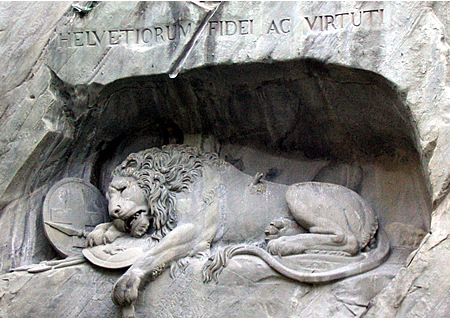
File:Lionmonumentlucerne.jpg
Lion Monument carved in 1819 by B. Thorvaldsen.

Hotel du Cygne ~ It is rainy and cloudy again today, but at intervals among the shifting clouds we can see the mountains around us. Lucerne is directly upon the lake; on one side of the city rises the steep Mount Pilatus, on the other, but further off towers the Rigi (spelt in several ways). Up to this evening we have not seen the summit of either mountain, both are above the clouds. Lucerne is surrounded on all sides but one by high land and seems to be a fitting portal to the majestic scenery of the Oberlands. Our rooms are large, connect and have each two windows that look out over the Lake with a little balcony in front. I could almost toss a cigar into the water from them. This afternoon during a pause in the rain, we went to see the lion designed by Thorvaldsen and cut in solid rock, in memory of the Swiss guard who fell while defending the palace of Luis 16th. It is colossal in size and cut in the face of a perpendicular rock, so that it rests in a niche formed by cutting the figure. The lion is 26 feet long but as it is above one and proportions well preserved it does not look very large. He is in a crouching attitude, transfixed by a dart, with his paw resting on a shield on which are engraved the “fleur de lis” of France. The whole design is full of grace, life, and feeling. Our rooms cold and damp. We bought some Swiss wood carving on our way home.

Wednesday, January 6, 2010

Friday, October 6th 1854 ~ Frankfurt, Germany

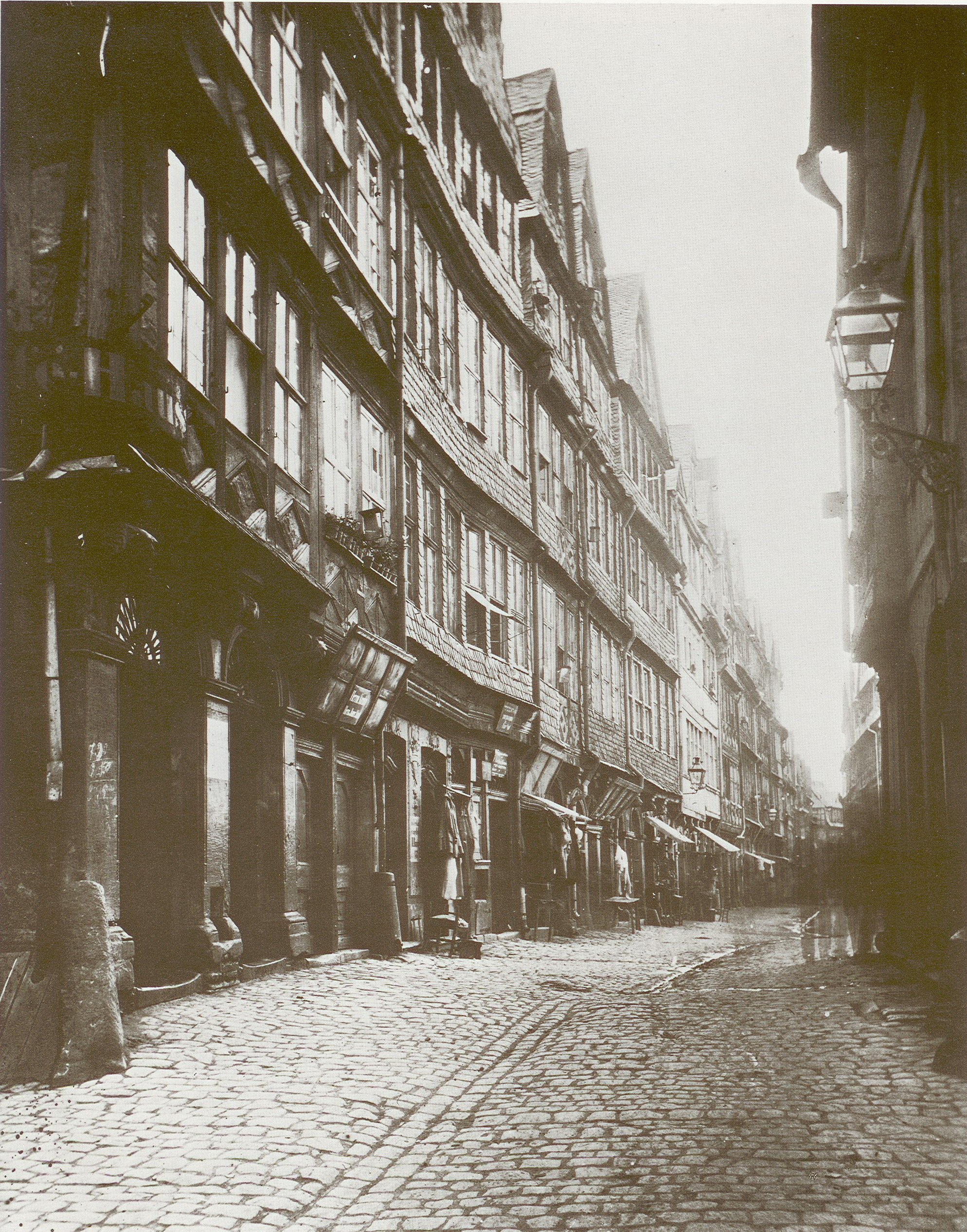
File:Frankfurt Judengasse 1868.jpg
Frankfurt's "Jewish Quarter," or Judengasse in 1868.

Hotel de Russie ~ I forgot to mention that the grape harvest was being gathered in as we ascended the river yesterday. Peasants, men and women, were to be seen toiling up and down the hills, with baskets of the ripe fruit upon their heads. We left Mayence this morning. It is only about an hours ride from here. Before leaving we took a walk about the city and concluded that there was not much to be seen there. It has no surrounding high land and therefore no fine scenery. We took a walk some distance beyond its gates to a garden, on the banks of the river farther up, and obtained from there a fair view of the city besides seeing some forest trees changing color, to remind us of the scenery in our own native land. Mayence is strongly fortified by a succession of small forts, so small as and so placed among the trees that one scarcely notices them. Murray calls it one of the most important fortresses of Germany on the side of France. It suffered greatly during the 30 years war. This afternoon we took a guide from our hotel, here in Frankfort, and walked to see the celebrated Ariadni (a woman seated on a lion) and were delighted with it beyond measure. The models one sees of this in all our shop windows at home give a very good idea of it but fail to convey the exquisite “feeling” of the original, fail to impress as this. It is the prosperity of a private gentleman here, who has a building appropriated entirely to its use in his grounds. One of its beauties consists in the marble being still fresh pure and white. The statuary we have generally seen has been yellow or brown with age. Leaving the Ariadni we dismissed our guide, took a carriage and drove to see the house in which Martin Luther was born and from which the Protestant religion and the bible went out to all the worlds. We saw the house in which Goethe was born and his monument (a colossal sitting figure in marble) finely done. It was still crowned with garlands of oak leaves placed there on his last birth day. We drove through the “jews quarter” the worst in Europe. It is the vilest, darkest, dirtiest street I ever saw, without sidewalks, without the light of heaven almost, and crowded with tumble down houses. Here they were formerly shut up every night, but now they may live where they please. Frankfort has very extensive parks but is not a handsome city, cannot compare with Brussels. In the public library we saw the wooden shoes etc. Luther wore, a copy of the first edition of the bible printed in Latin and some other rare books.

Monday, January 4, 2010

Tuesday, October 3rd 1854 ~ Bonn, Germany

Old photo of the cathedral before completion shows the east end finished and roofed, while other parts of the building are in various stages of construction.
Left: Cologne Cathedral under construction in 1856. Right: in 1912, after its completion in 1880.

Hotel Bellevue ~ I date at Bonn because I write from there this evening but the whole day has been spent at Cologne. Mary was quite unwell this morning. She had headache and was obliged to remain at the hotel while we were sightseeing. We started early and first directed our steps to the great Cathedral “Domkirche.” It is still unfinished and was begun in the 11th century. At present the work is being prosecuted with vigor and will probably be concluded in a half century more. This is a great gothic structure and when completed will be the largest of its style in the world. It has two towers, one on either side of the nave, that will be 500 feet high. It contains of course many wonderful relics (what Rhemish or Belgian cathedral does not!). Among them are a “lock of the hair of the Virgin” and the “skulls of the three Kings of Cologne,” the wise men or Magi, who first came to adore the infant Christ. The vast proportions of the outside of this cathedral impressed us much. We gazed at its proportions a long while. From one of its towers springs quite a good sized tree, taken root on a deposit of ages. We now went to the Ursuline Chapel, whose walls are filled with the bones of the eleven thousand sainted virgins who were massacred here by the Huns in the 3rd century. I have given their history under date of Sept. 29th. In the sacristy their bones are arranged in glass cases which extend from the floor to the ceiling and perfectly line the room. We were shown the skull of St. Ursula with her name embroidered upon a band of crimson velvet which encircles it, covering up the lower jaw and thus taking from the face that repulsive expression common to this object. Very many of the other skulls were similarly adorned. The question presented itself to us, how they came to know these skulls one from another, after they had been in a confused heap for ages. In this same place they pointed out to us one of the “alabaster wine pots used by our Lord at [Cans] of Galilee. It was broken and looked old. From here we visited another church where there is a splendid painting of Rubens. It was presented by him to the church, the one in which he was baptized. The subject is the crucifixion of St. Peter. His executioners are affixing his ponderous body to the cross head downwards and driving the nails. His face is calm, but each mussel of the body betrays his suffering. He is represented as in high health, but an old man with gray hair. This picture impresses us more than any we have ever seen and now we feel as if we never should see its like again. We saw the house in which Ruben was born and Mary de Médicis died. The church which has Rubens painting still preserves the font in which he was baptized. It has the tomb of a child of an English king in the 3rd century, a monument much defaced.

Sunday, January 3, 2010

Sunday, October 1st 1854 ~ Brussels, Belgium

A Canal near Brussels in 1871 Claude Monet
"A canal near Brussels in 1871" (C. Monet).

Hotel de l’Univers ~ We all went to an English chapel this morning and heard the service badly performed. After church I wandered about the city and saw the Place Royale in the centre of which is a beautiful equestrian statue in bronze of Godfrey of Bouillon of enormous size. This square is in the very best part of the city at the upper end of the Park. I walked around the Park, seeing in passing the Palais Royal, the Palais de la Nation and the Museum or Palais des Beaux Arts. This last I went into, but was unable to see anything but ordinary paintings. Those by Rubens and Van Dyck being closed for the season. The public buildings are large and handsome and the whole city wears an air of fite. It is clean, has nice, broad sidewalks, wide streets and a gay mirth seeking population. Brussels is said to imitate Paris closely, at least as closely as a place of this size can. All the shops are open today and many places of amusement which are open once each week. Even during the morning the shops were all open. Many English people come here to enconomize, so many that Brussels has ceased to be a cheap place to live in. The Park is truly beautiful. It is made into hill and dale, and ornamented with statuary. It is well shaded with large trees and contains several little ponds of water. There was one that took my fancy very much, with a grotto at one end and in it a reclining nymph. The whole shaded with high trees and the grounds about covered with the greenest grass. Brussels like Paris boasts here Boulevarts, which are long wide avenues shaded with trees, not paved, but macadamized. These were originally the top of the walls of the city, but as the city grew, they have in some places become almost its centre. The boulevards today are crowded with ladies and gentlemen showily drest, walking and driving. Young men in handsome military uniforms form a large part of the assemblage. The stately trees, the gay looking people, the bright uniforms, the foreign intonation, the military bands, makes this to me a scene of enchantment. This city is more lively and strikes me as more beautiful than London. In this fashionable part of the town each house is a palace. I past the house in which the Dutchess of Richmond gave a ball the night before the battle of Waterloo. “There was a sound of revelry by night.” This house is close to the great conservatory. One of the largest in Europe. The weather is fine, too warm for an overcoat, and the trees have not yet lost their verdure.

Saturday, January 2, 2010

Thursday, September 28th 1854 ~ Ghent, Belgium

Hotel Royale ~ We breakfasted early and started at nine o’clock to visit the celebrated cathedral ‘St. Bavous.” It was founded in 944 and is a fine type of the architecture of all this country during the middle ages. The inside is of white stone and the choir lined with black marble which of course presents a very strange appearance. Here Charles 5th was baptized - our guide pointed out the exact spot and showed us also the font in which the water stood. There were some (so called) fine paintings here by Rubens and Van Eyck but we did not appreciate them as much as we did the statuary on the sarcophagi. The figures of two bishops in marble reclining on their own graves seemed to us very beautiful. The perfect attitude of repose, natural position was wonderful one could almost see the marble breathe. We dined at the table d’hote at four o’clock and met there but four ladies. Almost all the guests were officers in uniform and it gave the table a very gay appearance. All drink wine. We saw scarcely a person at the table that had not his bottle. The wine are generally Rhemish. After dinner we drove to the “Marchi de Corseaux," saw the house where John of Gaunt was born. A very old looking building, narrow, and a story higher than its fellows.